
Last Updated: October 31, 2026
Quick Summary
Motorcycle security works best as layers: physical locks, alarms, and trackers, because no single device stops a determined thief. A disc lock buys seconds, an alarm turns those seconds into attention, and a tracker helps after the fact. Stack them and the math changes.
- A lock does not make a bike unstealable; it makes it a worse target than the bike parked next to it.
- Two-way alarms send a signal to your key fob and are worth the extra cost if you park out of sight.
- A GPS tracker is a recovery tool, not a deterrent, and needs a monthly cellular subscription.
- Touring bikes lose saddlebags, seats, and GPS units without the bike ever being moved.
- Test your alarm, fob range, tracker, and locks monthly and before any long trip.
Table of Contents
- Why Motorcycle Security Is a Layered Problem, Not a Single Device
- Motorcycle Anti-Theft Devices: What Actually Stops a Thief
- How Motorcycle Alarm Systems Work, and Where They Fall Short
- GPS Trackers: Recovery Tools, Not Theft Deterrents
- Motorcycle Saddlebag Locks and Seat Security for Touring Bikes
- Motorcycle Theft Prevention Tips: Building a Setup That Fits Your Risk
- Choosing and Testing Your Accessory Locks
- Protect Your Touring Bike with Robert Becker Design Hardware
- Frequently Asked Questions
Why Motorcycle Security Is a Layered Problem, Not a Single Device
Motorcycle security is the practice of combining physical locks, alarms, and tracking devices so that defeating one layer does not mean losing the bike. The pattern is simple: no single device stops a determined thief.
A disc lock buys seconds. The National Insurance Crime Bureau tracks vehicle theft trends and consistently ranks motorcycles among the most targeted vehicles, which is why riders who park in cities need more than one line of defense.
Below, we break down every major motorcycle security system and how to build a setup that matches your parking reality.
Motorcycle Anti-Theft Devices: What Actually Stops a Thief
Motorcycle anti-theft devices fall into two families: physical deterrents that prevent movement, and electronic systems that detect and report it. Physical locks defeat the simplest attacks, the two-person lift into a truck or a roll-away. Electronics cover what locks cannot.
The honest framing: a lock does not make a bike unstealable. It makes it a worse target than the bike parked next to it.
Disc Locks, Grip Locks, and Chains
Disc locks are a cost-effective motorcycle anti-theft device. A hardened pin slides through the brake rotor holes, and the wheel cannot rotate. Grip locks lock the brake lever to the grip so the front brake stays engaged.
What most guides miss is the attack surface. Look for hardened steel, a covered shackle that resists cutting, and a lock cylinder that resists drilling.
Immobilizers and Keyless Ignition
An immobilizer is an electronic circuit that prevents unauthorized start by cutting ignition or fuel unless the correct key transponder is present. Keyless ignition takes this further, replacing the physical key with a fob that must be in range.
These systems are designed to prevent unauthorized starting. But they do nothing against the two-person lift. Aftermarket immobilizers spliced into a factory harness can trigger fault codes, drain the battery, and void electrical coverage if installed poorly.
How Motorcycle Alarm Systems Work, and Where They Fall Short
Motorcycle alarm systems use motion sensors, tilt sensors, and perimeter detection to trigger a siren and, on better units, a remote notification.
A tilt sensor watches for changes in the bike's angle, so lifting the front wheel or standing the bike upright trips it.
A siren is a deterrence tool, not a prevention tool; it works by drawing attention and signaling to a thief that the bike is monitored.
Installation, Wiring, and Battery Draw
Hardwired units tap the bike's battery through a fused circuit, so they run continuously but a poorly installed unit can drain the battery flat over a week of sitting.
Splicing into a factory harness can trigger fault codes on modern CAN-bus bikes, and a bad ground or a tapped circuit can cause intermittent electrical faults that are hard to trace.
False Alarms, Alert Reliability, and Testing
False alarms are the trade-off. A bike parked on a windy street or next to a construction site can trip a poorly tuned motion sensor all night.
Test your alarm by rocking the bike gently and noting what triggers it, then adjust sensitivity until normal wind and passing traffic do not set it off.
| Alarm Type | What It Does | Best For | Limitation |
|---|---|---|---|
| One-way | Siren only | Deterrence in busy areas | You may not hear it |
| Two-way | Siren plus fob alert | Parking out of sight | Higher cost, fob battery, range limits |
| Tilt/motion sensor | Detects movement and angle change | Covered parking | False alarms if untuned |
| Perimeter sensor | Detects approach | Overnight storage | Weather sensitivity |
| Two-stage response | Chirp then siren | Reducing nuisance triggers | Requires tuning |
A realistic expectation is that an alarm buys attention and time, not recovery.
GPS Trackers: Recovery Tools, Not Theft Deterrents
A GPS tracker does not prevent theft. It reports location after the bike is gone, which makes it a recovery tool.
Trackers combine GPS location with cellular data to transmit coordinates. The GPS receiver calculates position from satellite signals; the cellular modem sends that position to a server you can see in an app.
Hardwired units pull from the bike's battery, which raises the battery drain question, while battery-powered units need charging.
Coverage, Privacy, and Recovery Expectations
Coverage is the first question. Ask whether the tracker uses a cellular network with broad coverage in the areas you ride, and whether it falls back to stored positions when signal drops.
Privacy is the second. The Federal Trade Commission's guidance on connected device data is worth reading before you hand a vendor continuous location data, because where that data lives and who can access it is a real privacy question.
A tracker helps most when the theft is reported quickly and the unit stays powered and hidden. A thief who finds and removes the tracker ends the recovery.
Matching a Tracker to Your Risk
- Urban commuter with street parking: a hardwired tracker with geofence alerts plus a disc lock, so you know quickly if the bike moves.
- Touring rider: a battery-powered unit with long standby and stored-position logging, because you may park in areas with weak signal.
- Collector or high-value bike: a tracker plus a two-way alarm and a chain, because recovery odds improve when the theft is noticed in minutes rather than hours.
Test the tracker monthly: confirm the app reports a recent location, check the battery or charging status, and verify that alerts reach your phone. A tracker you have not tested is a subscription you are paying for without knowing whether it works.
Motorcycle Saddlebag Locks and Seat Security for Touring Bikes
Touring riders face a different threat profile than sport bike owners.
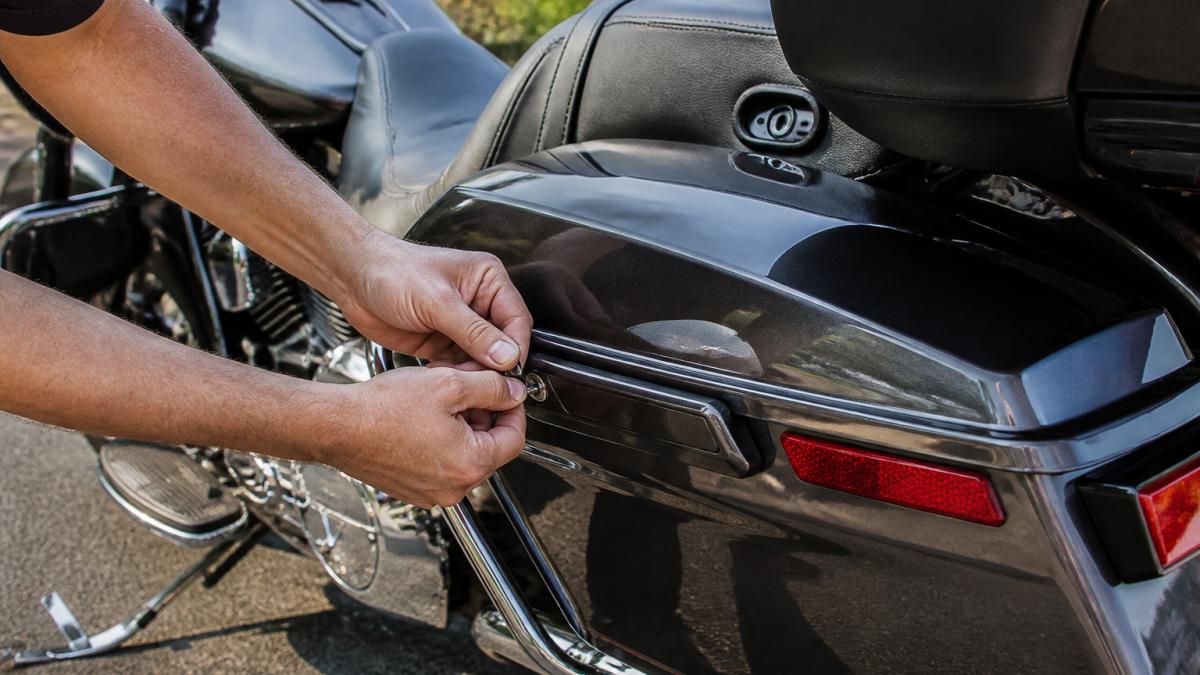
Motorcycle saddlebag locks secure the lid and the bag-to-frame mounting points, the gap factory hardware leaves open. Stock latches are designed for convenience, not resistance.
This is where Robert Becker Design focuses. Our locks are designed for Harley-Davidson and Indian touring models, and we offer hardware for Garmin zumo, Montana, and Monterra GPS units.
Motorcycle Theft Prevention Tips: Building a Setup That Fits Your Risk
Motorcycle theft prevention tips only work when they match your actual parking situation. A rider with a locked garage needs different hardware than someone leaving a bike on a city street eight hours a day.
Start with the threat. Opportunistic theft is the most common, and it is defeated by anything that stops a quick roll-away. Determined theft involves tools, time, and usually two people, and it is slowed by chains, alarms, and tracking.
Matching Devices to Your Parking Situation
- Locked garage at home: a disc lock and a cover are enough for most riders.
- Apartment lot or street parking: disc lock, chain to a fixed anchor, and a two-way alarm.
- Daily urban commuting: grip lock plus a motion alarm, and never the same spot twice.
The Insurance Information Institute's auto theft data shows theft risk varies sharply by location, so check your own area's pattern before deciding how much hardware you need.
Choosing and Testing Your Accessory Locks
Choosing accessory locks comes down to three checks: fit, materials, and the lock cylinder. Fit first, because a lock that does not match your mounting points is useless no matter how strong it is. Materials second, because hardened steel and covered shackles resist grinders longer. The cylinder third, because drilling is the quiet attack.
Then test. Run this checklist once a month and before any long trip:
- Confirm the disc lock engages fully through the rotor and releases cleanly
- Check the chain for link damage and confirm the anchor point is solid
- Rock the bike gently and confirm the alarm triggers at the sensitivity you set
Seasonal maintenance matters too. Road salt and rain attack lock cylinders, so a graphite lubricant before winter keeps them working in spring. A lock that seizes is a lock that gets left at home.
Protect Your Touring Bike with Robert Becker Design Hardware
The gap in most riders' setups is not the wheel. It is the accessories, the saddlebags, the seat, and the GPS mount that factory security ignores entirely.
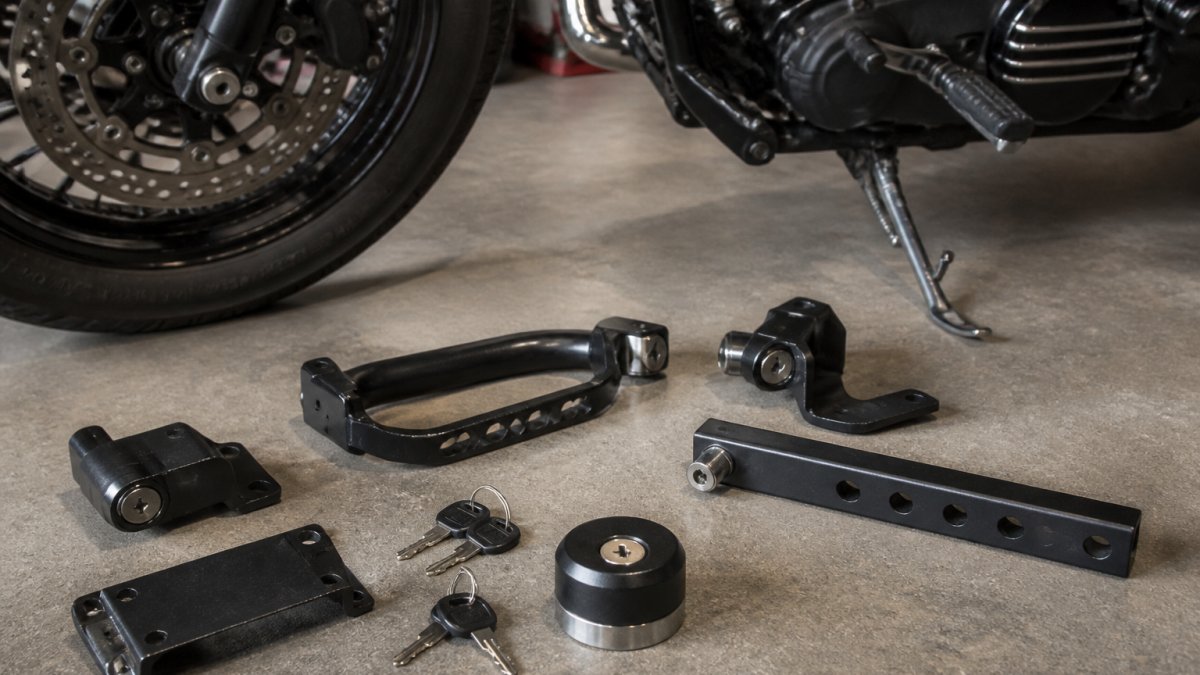
Robert Becker Design builds theft prevention hardware for motorcycles. Our saddlebag locks, seat locks, and mounting arm locks are designed for touring motorcycles, including Garmin zumo, Montana, and Monterra GPS mounting arms.
If you are not sure your aftermarket mounting points will work with our hardware, ask before you order.
Frequently Asked Questions
What security devices can help prevent motorcycle accessory theft?
Accessory theft usually targets saddlebags, seats, GPS units, and mounted hardware. Specialized locks for saddlebags and seats, locking mounts for GPS units, and tamper-resistant fasteners make those parts slow to remove. Pair them with a disc lock or chain to stop the bike from moving and an alarm for audible deterrence. The goal is to make your accessories take longer to steal than the next bike in the lot, since most thieves work on speed.
How do motorcycle alarm systems work?
An alarm uses a motion sensor, shock sensor, or tilt switch to detect movement and triggers a siren, flashing lights, or a remote notification. Two-way systems send an alert to a key fob and confirm it reached you; one-way systems only sound locally. Sensitivity settings control how easily the alarm trips, so a setting that is too high produces false alarms from wind or passing traffic. Test the sensitivity monthly and adjust it to your typical parking environment.
Are motorcycle alarms or physical locks more effective?
They do different jobs. A physical lock such as a disc lock or chain stops the bike from being rolled or ridden away, and it works without power or a subscription. An alarm draws attention and can notify you, but it does not physically stop a thief. In practice, a lock is the stronger deterrent and the alarm is the early warning. Layering both, plus a GPS tracker for recovery, covers more scenarios than relying on any single device.
How can I secure motorcycle saddlebags and seats?
Factory saddlebag latches are often easy to release, and quick-detach seats lift off with one lever. Purpose-built saddlebag locks and seat locks replace or supplement those latches with keyed hardware, so the bag or seat cannot be removed without the key. Check compatibility with your model and any aftermarket mounting points before buying. On touring bikes with custom hardware, confirm the lock works with your existing setup rather than requiring new holes.
Do motorcycle GPS trackers prevent theft or only help recover a bike?
GPS trackers mainly help recovery. They report location data after the bike is taken, which helps police locate it, but they do not stop a thief from moving it. Trackers also carry ongoing costs, usually a monthly or annual service plan, and depend on battery power and signal coverage. Treat a tracker as a backup layer behind physical locks and an alarm, not as a replacement for either.
How often should I test my motorcycle security setup?
Run a monthly check on alarms, trackers, and lock function, and do a fuller seasonal maintenance pass before and after riding season. Test alarm sensitivity, confirm remote notifications arrive, check tracker battery or service status, and make sure locks turn freely and keys are not worn. A device that failed silently is worse than no device, because you are relying on protection that is not there.
What should I look for when choosing a motorcycle accessory lock?
Check three things: fit, material, and installation. Fit means the lock works with your exact model and any aftermarket parts already mounted. Material means hardened steel or comparable construction that resists cutting and prying, plus weather resistance for outdoor parking. Installation should be clear enough to handle with basic tools, without drilling new holes. Ask how the lock is keyed and whether replacement keys are available before you buy.
Your bike is only as secure as its weakest accessory. If your saddlebags, seat, or GPS mount are still held on by factory hardware, that is the weakest link. Get started with Robert Becker Design and lock down the parts a thief can actually carry away.
