
Last Updated: October 30, 2026
Quick Summary
The seven best disc locks for touring motorcycles are the ABUS Granit Detecto 8077, Kryptonite New York 14 mm, Xena XX-6, Kryptonite Keeper, ABUS Granit 68 III Victory, Oxford Alpha XA14, and Robert Becker Design. Match the pin to your rotor hole size first, since a 14 mm pin will not pass through many stock rotors with 10-12 mm holes.
- The ABUS Granit Detecto 8077 weighs 1.85 lb, costs $130, and has a 13.5 mm pin with a Gold rating.
- The Kryptonite New York 14 mm offers a Gold rating and heavy-duty pin for $80 but has no alarm.
- Measure rotor hole diameter, rotor thickness, pin clearance, and caliper clearance before buying any lock.
- Fit the lock on the rear rotor at hotels and use a reminder cable to prevent riding off with it fitted.
- A disc lock defeats ride-away theft but does not stop two people lifting the bike into a van.
Table of Contents
- Why a Disc Lock Belongs in Every Touring Kit
- Quick Comparison: 7 Best Disc Locks for Touring Motorcycles
- 1. ABUS Granit Detecto 8077: Best for Maximum Deterrence
- 2. Kryptonite New York Disc Lock, 14 mm: Best Heavy-Duty Value
- 3. Xena XX-6 Disc Lock with Alarm: Best Alarmed Lock for Everyday Stops
- 4. Kryptonite Keeper Disc Lock: Best Budget Pick
- 5. ABUS Granit 68 III Victory: Best for Established-Brand Shoppers
- 6. Oxford Alpha XA14: Best Compact Alarmed Option
- Motorcycle Disc Lock Fit Guide: Match the Pin to Your Rotor
- Disc Lock vs. Chain: How to Build Layered Security
- How to Secure a Touring Motorcycle Overnight
- Frequently Asked Questions
Why a Disc Lock Belongs in Every Touring Kit
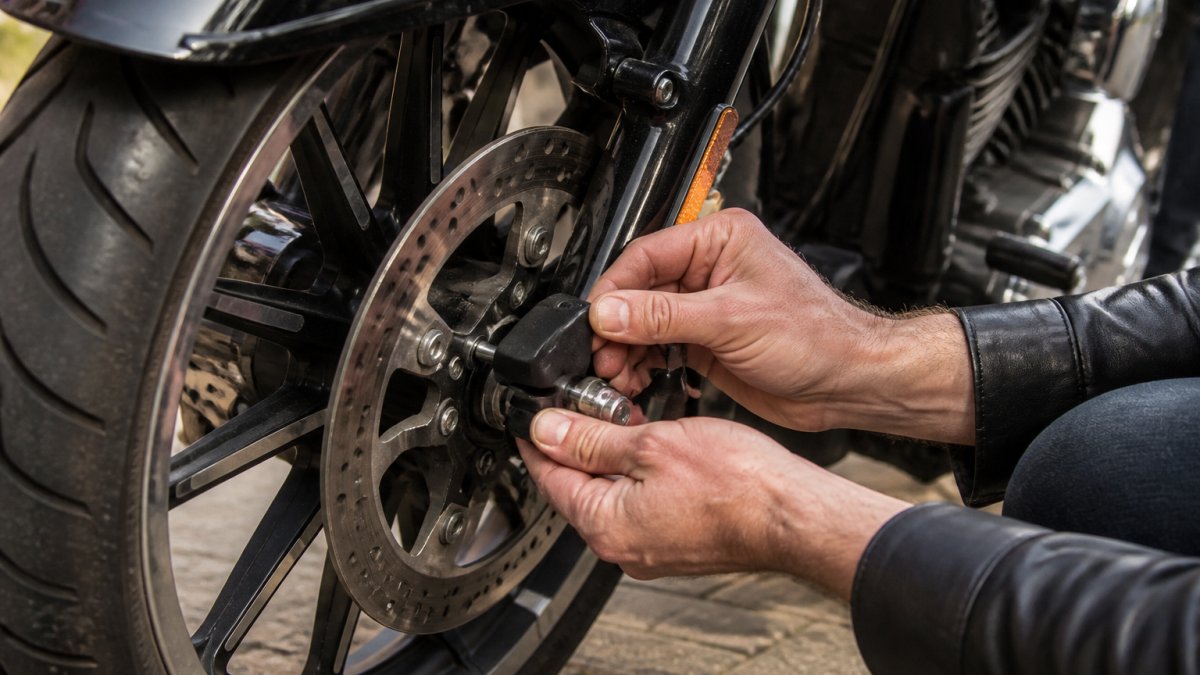
A disc lock is a compact, portable motorcycle lock that passes a hardened steel pin through the drilled holes of a brake rotor, preventing the wheel from rotating.
Touring riders park in unfamiliar places, often overnight, often in cities with active bike theft.
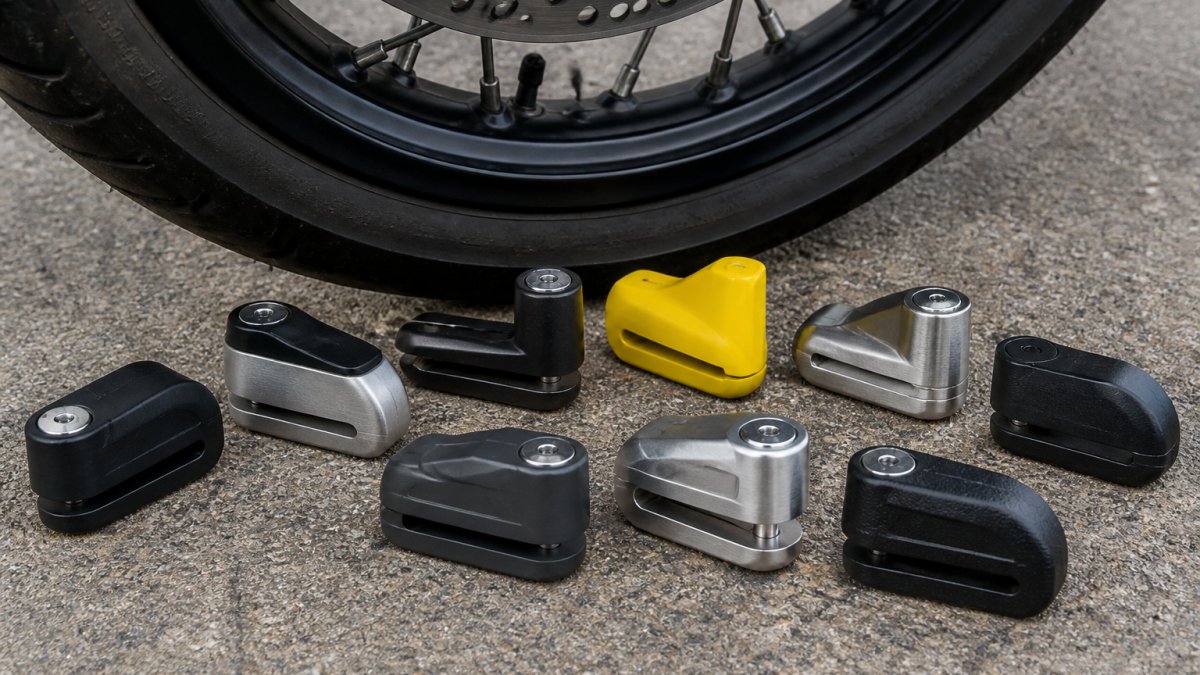
Below, we break down seven disc locks worth considering for touring use, covering deterrence, weight, price, fitment, and alarm behavior.
Quick Comparison: 7 Best Disc Locks for Touring Motorcycles
Here is how the seven picks stack up on the factors that matter most when packing for a long ride.
| Lock | Pin / Spec | Alarm | Weight | Listed Price | Best For |
|---|---|---|---|---|---|
| ABUS Granit Detecto 8077 | 13.5 mm, Gold rating | Yes | 1.85 lb | $130 | Maximum deterrence |
| Kryptonite New York 14 mm | 14 mm, Gold rating | No | 1.8 lb | $80 | Heavy-duty value |
| Xena XX-6 | 6 mm pin | Yes | Not listed | $85.99 | Everyday stops |
| Kryptonite Keeper | Not listed | No | Not listed | $44 | Budget pick |
| ABUS Granit 68 III Victory | Not listed | No | Not listed | Contact for pricing | Brand loyalists |
| Oxford Alpha XA14 | Not listed | Yes | Not listed | Contact for pricing | Compact alarmed option |
| Robert Becker Design | Component-specific | No | Varies by product | See site | Layered touring security |
One note before the reviews: a disc lock is one layer. Pair it with a chain, a cover, and secure storage for your accessories.
1. ABUS Granit Detecto 8077: Best for Maximum Deterrence
The ABUS Granit Detecto 8077 is one of the heavier options on this list, suited to riders who park overnight in higher-risk areas.
The tradeoff is weight and price. At 1.85 lb and $130, this is not a lock you toss in a jacket pocket without noticing.
Best for: riders who want the strongest single lock they can carry. Skip if: you need something light enough to pocket on short errands.
2. Kryptonite New York Disc Lock, 14 mm: Best Heavy-Duty Value
Best for: riders who want a substantial pin and a Gold rating at a lower price. Skip if: you want an alarm built in.
3. Xena XX-6 Disc Lock with Alarm: Best Alarmed Lock for Everyday Stops
Best for: short stops where noise deterrence matters. Skip if: you need maximum cut resistance for overnight parking.
4. Kryptonite Keeper Disc Lock: Best Budget Pick
The supplied results do not give pin dimensions or detailed specs, so treat it as basic immobilization rather than heavy deterrence, a reasonable role for a touring rider who wants a lock in every saddlebag.
Best for: riders who want a lower-priced lock for basic immobilization. Skip if: you park in high-theft areas and need a tested, heavy-duty pin.
5. ABUS Granit 68 III Victory: Best for Established-Brand Shoppers
The supplied results do not provide a price or specifications, so we cannot rank it on pin size or rating. If you already run ABUS hardware and want a consistent keyway and brand ecosystem, this is the natural pick.
Best for: riders comparing established-brand disc locks. Skip if: you need published specs and pricing before you buy.
6. Oxford Alpha XA14: Best Compact Alarmed Option
The supplied results do not give a price or detailed specs, so confirm pin size and alarm behavior before you buy. As a compact alarmed option, it fills a gap between the heavy overnight locks and the plain budget picks.
Best for: riders who want a compact alarmed lock for short stops. Skip if: you need published dimensions and pricing up front.
Motorcycle Disc Lock Fit Guide: Match the Pin to Your Rotor
Fitment is where most buyers get it wrong, and it is the question generic roundups skip.
Measure before you buy
You need four measurements, and a caliper or a good ruler gets you all of them in a few minutes:
- Rotor hole diameter: measure the inside of a drilled hole at the rotor edge, not near the hub. Holes are often chamfered, so measure the straight section. The lock pin should pass with roughly 1 mm of clearance; a force fit means the pin will bind when the rotor is hot or dirty.
- Rotor thickness: measure across the braking surface with a caliper. Most motorcycle rotors run 4-6 mm, but touring bikes with floating rotors and carriers can sit at the thicker end. The lock's jaw opening must exceed rotor thickness plus a margin for the lock body to seat flush.
- Pin diameter vs. hole size: a 14 mm pin needs a rotor hole large enough to accept it with clearance. Many stock rotors have holes in the 10-12 mm range, so a 14 mm pin simply will not pass, check before you assume the biggest pin is best for your bike. A 6 mm pin fits far more holes but offers less cut resistance.
Front vs. rear rotor
On touring bikes with large front rotors, the rear rotor often has smaller holes and a thinner disc. Test-fit on both wheels before you commit to a lock for a long trip. Many riders carry one lock and fit it on the rear at hotels, where the bike is backed into a space and the rear rotor is easier to reach.
What to do if nothing fits
Some touring rotors, particularly wave or petal rotors with irregular hole patterns, will not accept a conventional pin lock cleanly. In that case, a smaller-pin alarmed lock, a rotor-specific lock with an adjustable jaw, or a chain through the rear wheel and frame is the practical fallback. Do not force a pin through a hole that is too small; you will damage the rotor and the lock.
Quick compatibility checklist
- Pin diameter is at least 1 mm smaller than the smallest rotor hole you plan to use.
- Lock jaw opening exceeds rotor thickness with margin.
- Lock body clears caliper, fork, brake line, and spokes through full steering travel.
A lock that fits poorly is a lock you will stop using. Fitment first, then security rating, then price.
Disc Lock vs. Chain: How to Build Layered Security
A disc lock and a chain solve different problems. A disc lock stops the wheel from turning, which defeats ride-away theft. A chain anchors the bike to a fixed object, which defeats lifting and carrying.
For touring, a combination of a disc lock, a chain, and secure storage for your accessories can help. Robert Becker Design builds locks for saddlebags, seats, and GPS mounting arms, so the parts a thief can unbolt are protected too.
How to Secure a Touring Motorcycle Overnight
Overnight parking is the highest-risk scenario for a touring bike, but "overnight" covers very different situations. A hotel lot with a security camera is not the same as a trailhead parking area or a city street. The right lock setup depends on how long the bike sits, who can see it, and whether you can anchor it. Here is how to think about each scenario and what to carry.
Match the setup to the scenario
Brief fuel stops and coffee breaks (under 30 minutes). The threat is ride-away and casual tampering, not a prepared theft crew.
Unattended multi-day parking (airport, trailhead, rally overflow). This is where a disc lock alone is weakest. Use a disc lock plus a hardened chain through the frame and a fixed anchor, plus component locks on saddlebags, seats, and GPS mounts.
Prevent the ride-away mistake
The most common self-inflicted failure on a touring trip is riding off with the disc lock still fitted. The lock jams against the caliper, the bike lurches, and the rotor, caliper, or fork can be damaged, sometimes badly enough to end the trip. Three habits reduce the risk:
- Use a reminder cable. A bright coiled cable from the lock to the handlebar is the simplest and most reliable alert, it costs little and works even if you are tired or distracted.
- Fit the lock on the rear rotor when practical. You are less likely to forget a lock you cannot see from the saddle, and the rear is easier to reach when the bike is backed into a space.
- Build a pre-ride check into your routine. Before you start the engine, walk the bike once and look at both wheels, the same sequence every time so it becomes automatic.
Alarmed locks add a second layer: most sound a warning chirp when the bike is bumped and a full alarm when it is moved. That chirp is useful at a hotel, where it may prompt a passerby to look, but less useful at a trailhead where no one is around. Set sensitivity according to where you park, high in a quiet lot, lower near a road where wind and passing trucks can trigger false alarms.
Layer the protection
A disc lock is one layer. For touring, the practical stack is:
- Disc lock on one or both rotors to defeat ride-away theft.
- Chain and anchor to defeat lifting and carrying when a fixed object is available.
- Component locks on saddlebags, seats, and GPS mounting arms, because those are the parts a thief can unbolt and walk away with.
Overnight routine
- Park in a well-lit spot with foot traffic or camera coverage.
- Fit the disc lock on the rear rotor and attach the reminder cable to the handlebar.
- Chain the frame to a fixed anchor if one is available.
- Lock saddlebags, seats, and GPS mounts with component-specific hardware.
- Cover the bike to hide accessories from casual view.
- Before you ride, walk the bike and check both wheels for the lock.
Frequently Asked Questions
Are alarmed motorcycle disc locks worth it?
An alarmed disc lock adds a warning alert that a plain lock cannot. The trade-offs are battery life and sensitivity settings that need adjusting so wind or passing traffic does not set it off. For touring riders parking in busy lots, the noise draws attention at the moment a thief tests the bike. Pair the alarm with a heavy pin lock rather than relying on sound alone.
How do I choose a disc lock that fits my motorcycle?
Start with pin diameter and rotor hole size. A pin of this size needs a rotor hole wide enough to pass through. Check clearance between the lock body and the caliper or fork leg at full steering lock. Measure before you buy.
Is a disc lock enough to secure a touring motorcycle?
A disc lock stops the wheel from rolling, which defeats ride-away theft and casual tampering. It does not stop two people lifting the bike into a van or a determined thief with cutting tools. Treat it as one layer. Add a chain or U-lock to a fixed anchor for overnight parking, and use a reminder cable so you never ride off with the lock installed. The disc lock is the fastest layer to deploy at short stops, not the only one you own.
How do I avoid riding away with a disc lock installed?
Use a reminder cable clipped from the lock to your handlebar or brake lever. The bright cord sits in your line of sight as you mount, so you see it before you pull away. Some alarmed locks also chirp when the bike is moved, which acts as a second warning. Build the habit of checking the front rotor during your pre-ride walkaround, and store the lock in the same saddlebag pocket every time so its absence is obvious.
Can a disc lock damage a motorcycle brake rotor?
A correctly fitted disc lock does not damage the rotor in normal use. Damage happens when a rider forgets the lock and rides off, or when the bike is pushed while locked. The lock body jams against the caliper or rotor edge and can bend the rotor or crack a caliper mount. A reminder cable and a habit of rolling the bike backward first before riding prevent most of these incidents. Inspect the rotor after any accidental contact.
Every touring kit has a weak point, and for most riders it is the accessories bolted to the bike. A disc lock guards the wheels; it does nothing for your saddlebags, seat, or GPS mount. Robert Becker Design builds locks for exactly those parts, with saddlebag, seat, and Garmin-compatible mounting security designed by riders for touring models. Get started with Robert Becker Design and protect the whole bike, not just the rotors.
