
Last Updated: November 3, 2026
Quick Summary
A modular motorcycle mount is a phone holder built from separate parts, a base, an arm and a head, so you can swap pieces. Choose the system by first checking your bike's mounting point and clearance, then picking locking security or universal fit.
- Measure your handlebar diameter first, since clamps are sized for specific tube diameters.
- Check clearance at full handlebar lock so the mount does not hit the tank, windscreen or controls.
- Locking systems usually feel more secure at highway speed; universal grips allow easier device changes.
- Test a vibration dampener on your usual roads, since it protects the phone camera.
- Price each layer separately, because base, arm and head are rarely sold as one bundle.
Table of Contents
- How Modular Motorcycle Mount Systems Work
- Matching a Mount to Your Cockpit: Handlebars, Mirrors and Stems
- Quad Lock Motorcycle Mount: Locking Security and Ecosystem Lock-In
- RAM Mount Motorcycle Systems: Universal Fit and Modular Flexibility
- Best Motorcycle Phone Mount With Vibration Dampener: Protecting the Camera
- Motorcycle GPS Mount Security: Retention and Theft Resistance
- Total Cost of Ownership and Your Next Mount Decision
- Frequently Asked Questions
Choosing the right modular motorcycle mount comes down to how well it locks onto your phone, how well it fits your cockpit, and how much you'll spend over time. The same practical questions come up again and again: will this fit my bike, will my phone stay put, and what happens when I want to change systems later? This guide compares the major approaches, with Quad Lock and RAM Mounts as the two systems most riders weigh first.
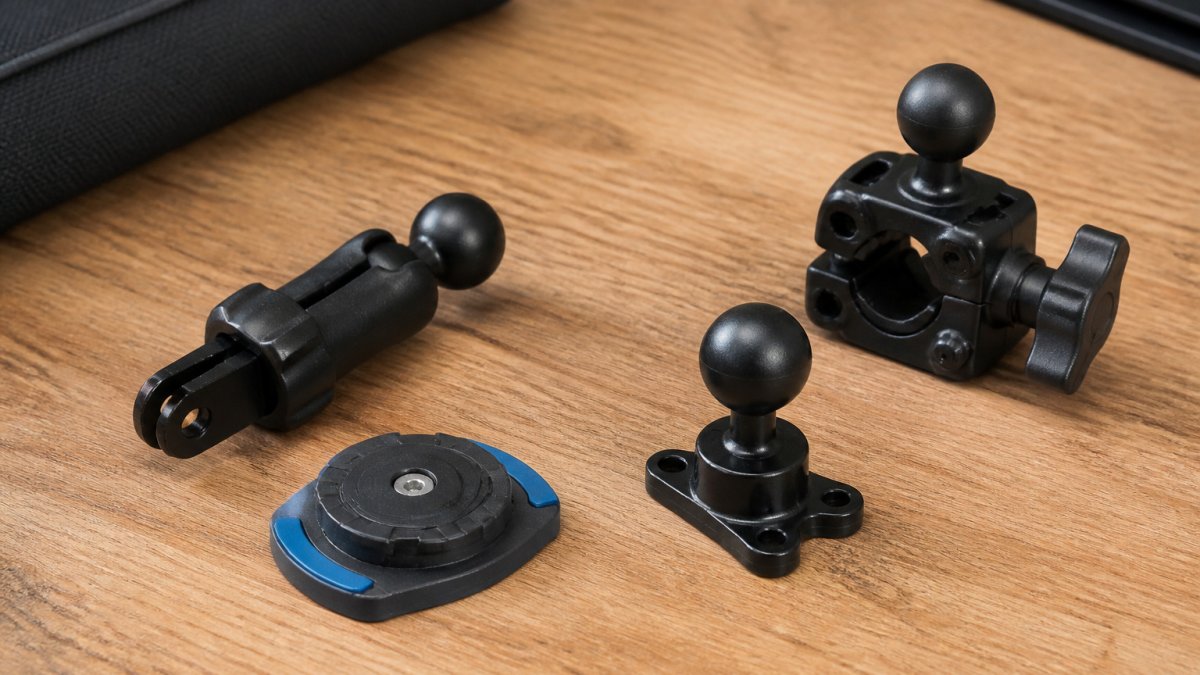
A modular motorcycle mount is a phone holder built from separate parts: a base that attaches to a bike mounting point, an arm or adapter, and a head or cradle that holds the device. Because the parts are interchangeable, you can swap a handlebar clamp for a mirror mount or move a phone between bikes without buying a new setup each time.
How Modular Motorcycle Mount Systems Work
Every modular system has three layers. The base connects to the bike through a clamp, a ball mount, or a bolt-on plate. The middle section, usually an arm or ball joint, sets the height and angle. The top layer holds the device, either through a dedicated case or a universal grip.
The key decision happens at the connection between layers. A locking interface, such as Quad Lock's dual-stage system, uses a case that snaps into a cradle and twists to lock. A universal grip, such as RAM's X-Grip, uses spring-loaded arms that clamp around almost any device. Locking systems usually feel more secure at highway speed. Universal grips usually give you more freedom when you change phones.
Expect to add accessories over time. A base, an arm, and a head are rarely sold as one bundle, so price each layer separately when you compare totals.
Matching a Mount to Your Cockpit: Handlebars, Mirrors and Stems
Your bike decides where a mount can go, and the cockpit layout should drive the system choice rather than brand reputation. Most motorcycles offer at least one of four mounting zones: the handlebar clamp area, the exposed handlebar tube, a mirror stem, or a fork-stem or steering-head location. Each zone has different space, vibration, and clearance characteristics, so measure before you shop.
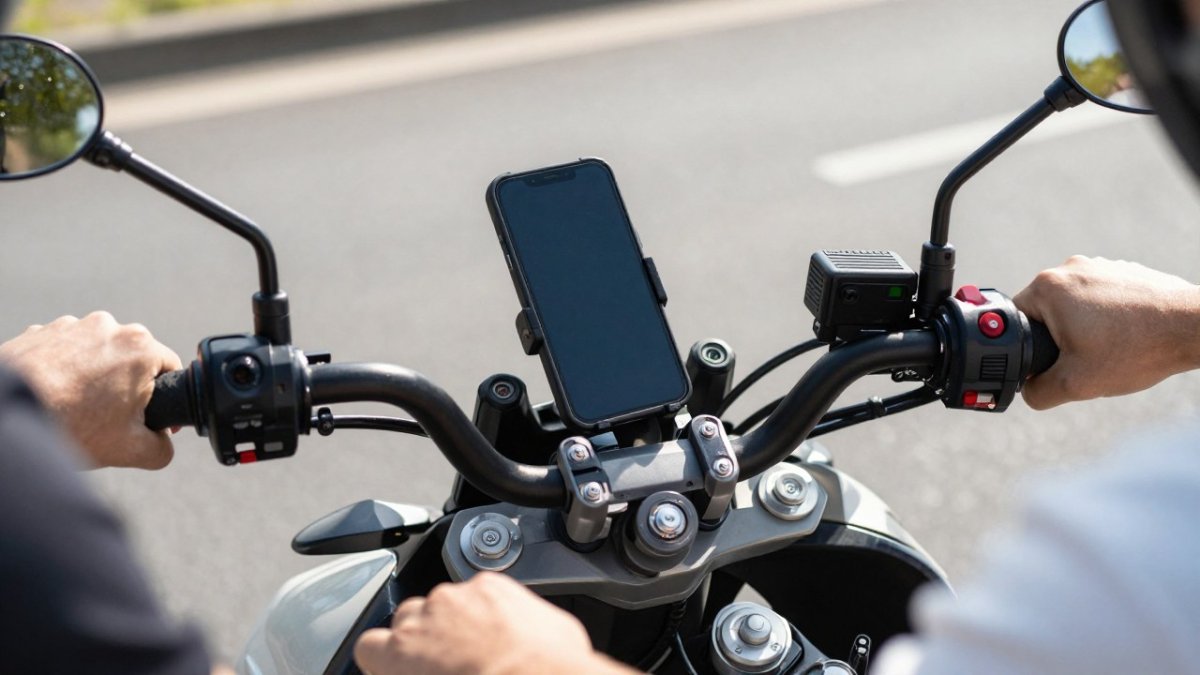
Start with handlebar diameter. Clamps are sized for specific tube diameters, and the common sizes are 7/8 inch (22 mm), 1 inch (25.4 mm), and 1-1/8 inch (28.6 mm). Many adventure and dual-sport bikes use tapered bars that are 1-1/8 inch at the clamp and 7/8 inch at the grips, which means a clamp sized for the grip area will not fit the center section. Mirror stems are similarly sized, often 10 mm or 12 mm, and some are reverse-threaded on one side.
Clearance is the second check. With the bars at full lock, a handlebar mount must not contact the tank, the windscreen, the headlight, or your hand controls. On faired sportbikes the cockpit is crowded and the bars are low, so a stem mount or a small ball mount bolted to the top clamp often fits where a handlebar clamp will not.
Use this decision path by cockpit and use case:
- Sport / sportbike: limited handlebar space and a low, crowded cockpit. Favor a fork-stem mount or a small bolt-on base at the top clamp, keep the head compact, and check clearance at full lock before riding.
- Touring: wide bars, a dash shelf, and long highway miles. A centered handlebar clamp or a mirror mount works well; prioritize a vibration dampener and a locking head for stops.
- Adventure: tapered bars, accessories crowding the cockpit, and mixed surfaces. A 1-1/8 inch clamp at the bar center or a dedicated accessory bar gives room, and a dampened locking head handles washboard and gravel.
- Dual-sport / off-road: high vibration and impact risk. Choose a mount that sits within the bar envelope or behind the windscreen, use a dampener, and verify the base cannot rotate under impact.
Watch out: a mirror mount can add vibration to the image because the stem flexes, and a stem mount can transmit more engine vibration than a rubber-isolated handlebar clamp. Test the position on your typical roads before a long trip.
Our advice is to start with the mounting point you actually have, then choose the system that fits it, not the reverse. Mounting-system selection by cockpit layout matters more than brand reputation, and the same modular base can often be moved between bikes if you buy a second clamp for the new mounting point.
Quad Lock Motorcycle Mount: Locking Security and Ecosystem Lock-In
Quad Lock is built around a locking interface. The case clicks into a cradle with a twist, and the connection feels solid even on rough pavement. Its vibration dampener is a common choice for riders who want to protect phone cameras on longer rides.
The trade-off is ecosystem lock-in. Quad Lock's strength depends on its own cases and accessories, so you may need to replace the case when you change phones. Compare the total cost of the mount, case, and accessories before you buy.
Best for riders who want a secure, low-profile setup for daily commuting and touring and who are comfortable staying within one ecosystem. Skip if you switch phones often or want to use a case you already own.
RAM Mount Motorcycle Systems: Universal Fit and Modular Flexibility
RAM Mounts takes the opposite approach. Its X-Grip cradle uses spring-loaded arms that fit many devices without a special case. Its ball-and-socket adjustment gives you a lot of positioning options, and its composite and stainless steel construction is built to be rugged.
Universal grips like RAM's X-Grip are often one of the more affordable entry points, though prices vary by retailer. The bulk is the main drawback. The cradle is larger than a dedicated locking head, and on a crowded cockpit that can matter.
Best for riders who change devices often or who want a highly adjustable, rugged modular setup. Skip if you need the most compact footprint on a small handlebar.
Best Motorcycle Phone Mount With Vibration Dampener: Protecting the Camera
Vibration is the factor most buyers underestimate, and it is also where most guides stop at "buy a dampener." The mechanism matters: engine and road vibration reaches the mount as high-frequency oscillation, and a rigid mount passes that energy into the phone. Phone cameras use small optical image stabilization (OIS) assemblies with moving lens elements, and sustained high-frequency vibration can degrade or damage those assemblies over time.
Damping and camera protection are related but not identical. A vibration dampener is an isolating layer, usually rubber or an elastomer, between the mount and the device that absorbs some of the oscillation before it reaches the phone. Camera protection is the outcome you want: keeping the OIS assembly within its design limits. A dampener helps, but mounting location and the rigidity of the whole stack also matter.
A common pattern among riders who record video is to combine three choices: a dampened head, a short arm or direct base-to-head connection, and a mounting point away from the highest-vibration zones. Quad Lock offers a vibration dampener as an add-on to its locking heads, These are different mechanisms, so compare how each one isolates rather than assuming any dampener is equivalent.
If you want to assess camera risk on your own bike, use a repeatable check rather than a single ride:
- Record a short video at a fixed resolution and frame rate on a known stretch of road at a steady speed.
- Repeat with the same phone, same mount position, and same route with and without the dampener.
- Compare footage for blur, rolling-shutter wobble, and audible rattle, and check whether the phone's stabilization reports errors.
- Re-check after several weeks of riding to catch wear in the dampener or loosening in the stack.
Watch out: a dampener that has compressed, cracked, or hardened no longer isolates, and a mount that has loosened at the base can transmit more vibration than a new one. Inspect the dampener and every connection point as part of regular maintenance.
If you record video while riding, prioritize a dampener and test the mount on your bike's typical roads before a long trip. If you mainly navigate, a dampener still protects the camera assembly, but the mounting location and a secure, low-flex stack matter just as much.
Motorcycle GPS Mount Security: Retention and Theft Resistance
A mount is only useful if the device stays on it, and a mount you can unclip in seconds invites theft. Locking systems generally resist casual removal better than friction grips. Universal grips rely on spring tension, which holds well but can be released by hand.
For GPS units and phones left on a bike while you stop, consider a locking base or a lock that secures the mount itself. Robert Becker Design builds theft prevention locks for saddlebags, seats, and mounting arms. Riders with a Garmin zumo, Montana, or Monterra unit should also check how the GPS attaches to its bracket.
Watch out: a dedicated locking head does little if the base can be unbolted or the arm can be lifted off the bike. Check every connection point, not just the head.
Total Cost of Ownership and Your Next Mount Decision
Initial price is only part of the cost. Add the case or adapter, any replacement parts, and the cost of switching devices. A cheaper universal system can cost less over five years if you change phones often. A locking system costs more up front but may need fewer extras if you stay with one phone.
Use this simple check:
| Factor | Locking system (e.g., Quad Lock) | Universal grip (e.g., RAM X-Grip) |
|---|---|---|
| Starting price | From $70.00 | From $45.00 |
| Case required | Yes, proprietary or adapter | No |
| Best for | Stable, secure, single phone | Frequent device changes |
| Footprint | Compact | Larger |
Choose a locking system if you keep one phone for several years and want the most secure hold. Choose a universal grip if you change devices often or already own a case you like. Whichever you pick, confirm your bike's mounting point, your phone model, and your theft exposure before you buy.
For current pricing and quotes on Robert Becker Design's own security hardware, check the Robert Becker Design website directly.
Frequently Asked Questions
What should I look for in a motorcycle phone or GPS mount?
Start with the mounting point on your bike: handlebar, mirror or fork stem, and check clearance for your cockpit and controls. Next, confirm your phone or GPS fits the cradle with or without a case, and look for a locking mechanism that holds under road vibration. Check whether the system is modular, so you can change the head or base later without replacing everything. Finally, compare total cost, including adapters, cases and accessories, not just the sticker price of the mount.
Are modular motorcycle mounts compatible with different devices?
Many modular systems are compatible with multiple devices, but the method varies. Universal cradles fit a range of phones without a specific case, while proprietary systems usually require a matching case or adapter for each phone. Before buying, confirm your phone model and whether you need a case, since a bulky case can prevent a secure fit or block camera access.
Do motorcycle mounts need a vibration dampener?
A vibration dampener is useful if you ride long distances or on rough pavement, because engine and road vibration can blur phone cameras and loosen mounts over time. Many mounts offer vibration-dampening accessories or built-in damping. If camera quality matters to you or you ride a vibration-heavy cruiser or dual-sport, prioritize a mount with a dedicated dampener.
How do Quad Lock and RAM Mounts compare for motorcycles?
Proprietary locking systems can be secure and low-profile but usually work best within their own case ecosystem, while universal cradles fit most phones without a special case and can be bulkier. Choose Quad Lock for a locked, streamlined setup on one phone; choose RAM Mounts if you switch devices often or want a rugged, adjustable system.
