
Last Updated: November 23, 2026
Quick Summary
Choosing a motorcycle disc lock comes down to whether you want the lock to make noise or stay quiet and rely on brute resistance. An alarmed disc lock adds an audible alert and motion sensors to the same physical locking pin, while a standard lock offers only steel and a keyway. If you only buy one lock, buy an alarmed disc lock and add a chain later.
- Alarm loudness is often quoted in decibels at one meter, with 100-110 dB typical for a compact siren.
- Start sensitivity mid-range and raise it only if the lot is quiet and sheltered.
- Measure rotor thickness, hole diameter, pin gap, and caliper clearance before buying.
- A reminder cable clipped from lock to handlebar prevents riding off with the lock on.
- For overnight hotel parking, use an alarmed disc lock plus a chain to an anchor if one exists.
Table of Contents
- Alarmed vs Standard Disc Locks: What Changes at the Rack
- Best Motorcycle Disc Lock Picks for Touring Riders
- Motorbike Disc Lock with Alarm: Real-World Usability
- Motorcycle Disc Lock Size and Fit: A Compatibility Checklist
- Disc Lock vs. Chain Lock: When to Use Each
- Disc-Lock Mistakes That Damage Rotors and Cost Rides
- Match Your Lock to Your Parking: A Use-Case Decision Framework
- Protect the Rest of the Bike: Saddlebag, Seat, and GPS Security
- Frequently Asked Questions
Alarmed vs Standard Disc Locks: What Changes at the Rack
Choosing a motorcycle disc lock comes down to one question: do you want the lock to make noise, or stay quiet and rely on brute resistance?
At Robert Becker Design, we build theft prevention hardware for touring bikes.
Below, we break down which lock suits which parking situation, how fit and rotor clearance work, and the mistakes that cost riders a brake rotor.
Best Motorcycle Disc Lock Picks for Touring Riders
The best motorcycle disc lock for a touring rider balances alarm usefulness, rotor fit, and how easily it stows in a saddlebag. Touring bikes park for longer stretches than sport bikes, so portability matters less than deterrent value. Here are three models worth a look, plus the hardware we build for the parts a disc lock cannot protect.
| Lock | Type | Standout Feature | Best For |
|---|---|---|---|
| Xena XX 6 | Alarmed | Rugged steel body, piercing alarm, sensors | Riders wanting an alarm with a proven lock body |
| Oxford Alpha XA14 | Alarmed | Disc-lock format with audible alarm | Budget-conscious alarmed buyers |
| ABUS GRANIT Detecto SmartX 8078 | Smart alarmed | Built-in alarm, Bluetooth, app connectivity | Tech-forward riders who want app alerts |
| Robert Becker Design | Component security | Locks for saddlebags, seats, GPS mounts | Protecting the rest of a loaded touring bike |
Xena XX 6
The Xena XX 6 pairs rugged steel construction with a piercing alarm and motion sensors.
Fit specs and pricing are not always clear from listings, so confirm rotor clearance before you buy.
Best for: riders who want one lock that deters and resists. Skip if: you park somewhere an alarm would annoy neighbors or trigger falsely in wind.
Oxford Alpha XA14 Alarmed Disc Lock
The Oxford Alpha XA14 is a disc lock with a built-in alarm. If you run a plain pin lock and want an audible alert, this is one option to consider.
Test the sensitivity setting of any alarmed lock before you trust it overnight, and read the manual's sensitivity adjustment first.
Best for: first-time alarmed buyers and budget builds. Skip if: you need app alerts or documented certification ratings.
ABUS GRANIT Detecto SmartX 8078
The ABUS GRANIT Detecto SmartX 8078 is the tech-forward pick, combining a disc-lock body and built-in alarm with Bluetooth and smartphone-app connectivity.
Bluetooth locks depend on battery life and app reliability, so check charge levels before a long trip.
Best for: riders who want remote awareness of their bike. Skip if: you want zero app maintenance and pure mechanical simplicity.
Motorbike Disc Lock with Alarm: Real-World Usability
A motorbike disc lock with alarm is only as good as its real-world behavior: how it arms, how loud it is, how sensitive it is, how long the battery lasts, and how it handles weather. The useful question is whether the alarm will still be armed and credible on the third night of a trip.
Arming and disarming behavior
Alarms arm either automatically after a short delay once the pin is inserted, or manually with a key or button sequence. Automatic arming is convenient but can trigger during fitment if you bump the bike; manual arming gives you control but adds a step you can forget. Practice your lock's behavior before you rely on it.
Loudness: what the number means
Alarm loudness is usually quoted in decibels at a stated distance, often one meter; 100-110 dB at one meter is typical for a compact disc-lock siren, and anything quoted without a distance is marketing. What deters is the sudden onset of sound plus the attention it draws, not the peak number.
Sensitivity and false alarms
Sensitivity decides whether you get a useful deterrent or a nuisance you disable after one windy night. Most alarmed locks offer low, medium, and high settings; start mid-range and raise it only if the lot is quiet and sheltered. A bike cover flapping against an armed lock is the most common cause of overnight false alarms, so if you cover the bike, set sensitivity low or skip the alarm.
Battery life and low-battery behavior
Alarmed locks run on coin cells or AA/AAA batteries, and life depends on how often the alarm trips, expect months, not years, from a coin cell in a lock that arms nightly. The important behavior is what happens at low battery: some locks chirp a warning on arm, some silently stop alarming, and some trigger falsely.
Weather resistance
Rain, road spray, and washing are the real test. Look for a stated IP rating or at least a sealed keyway and gasketed battery compartment. Do not arm the alarm while washing the bike, the spray triggers it repeatedly and drains the cell.
A setup routine that works
- Sensitivity: start mid-range and raise it only if the lot is quiet and sheltered.
- Battery: check it before every multi-day trip; a weak cell causes false alarms and missed triggers.
- Placement: mount the lock where motion is real, not where wind rocks the bike cover.
What to verify before you buy
Ask three questions of any alarmed lock: does it state loudness with a distance, does it document sensitivity adjustment, and does it state battery type and expected life? If a listing answers none of those, you are buying on faith. The alarm is a psychological layer, not a physical one, and it only works if it is armed, charged, and set to a sensitivity that matches where you park.
Motorcycle Disc Lock Size and Fit: A Compatibility Checklist
Motorcycle disc lock size and fit is where most returns happen. A lock that does not clear your rotor's holes or fit its thickness is useless, no matter how strong it is. Here is what to measure.
The four measurements that decide fit
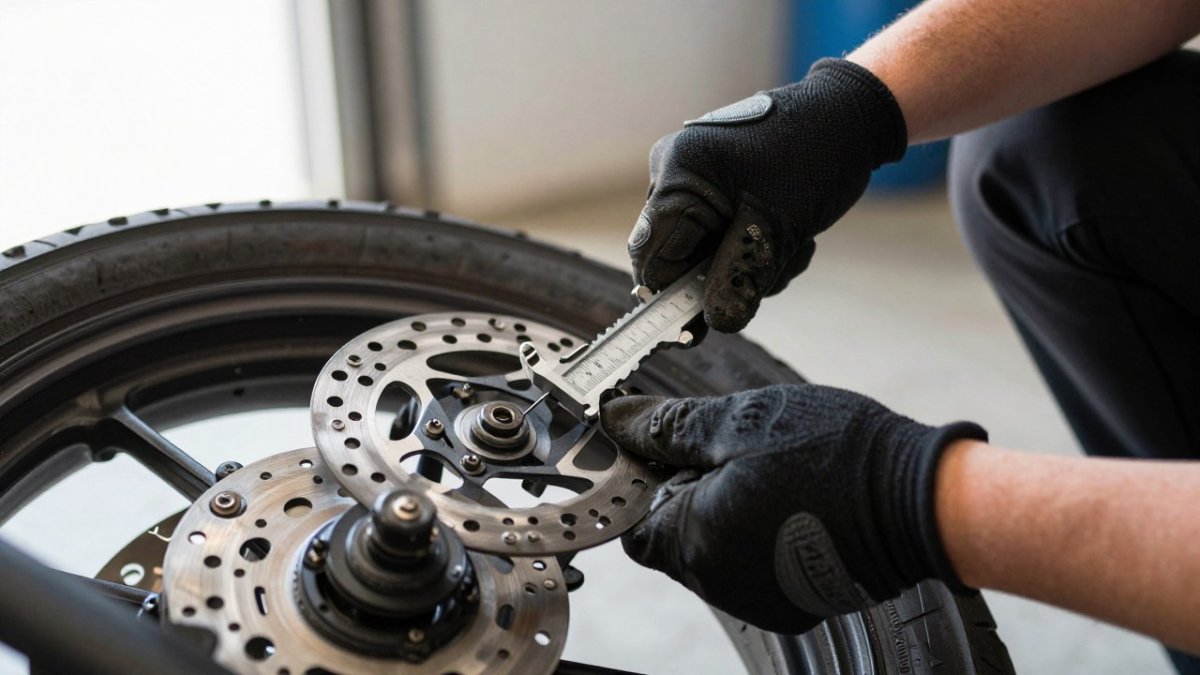
- Rotor thickness. Measure at the friction surface, not the stamped edge, with a caliper or a clean ruler. The lock's jaw opening must exceed your measured thickness with a little room to spare so the pin seats without forcing.
- Locking-hole diameter. Measure the hole's inside diameter and compare it to the pin's outside diameter. A pin that is too fat will not enter; one that is too thin can rattle and lever against the hole edge.
- Pin gap or shackle span. This distance between the pin and the lock body's inner face must be wider than the rotor thickness plus the pin diameter, or the lock will not close around the disc.
- Caliper and spoke clearance. With the lock fitted, turn the wheel lock-to-lock and check that the lock body clears the caliper, fork leg, spokes, and any ABS sensor ring. Clearance at rest is not enough; suspension compression and steering angle change the geometry.
A fit checklist you can run before buying
- Measure rotor thickness at the friction surface with a caliper
- Measure the drilled-hole diameter and compare to the lock pin spec
- Confirm the pin gap exceeds rotor thickness plus pin diameter
Front versus rear: measure both
A common mistake is buying for the front wheel only. Many touring riders lock the rear disc because it is harder to reach and harder to lift, and rear rotors are often thinner and differently drilled than fronts. Measure both before you commit.
When the numbers do not match
If your rotor is unusually thick or your holes are unusually small, do not force the lock. A pin that has to be tapped in will scratch the rotor face and can seize. Look for a lock with an adjustable or oversized jaw, or step down to a lock designed for smaller-displacement discs.
What to bring to the purchase
Write down four numbers before you shop: rotor thickness, hole diameter, pin gap needed, and the tightest clearance point around the caliper. With those in hand, you can rule out most locks from the spec sheet alone.
Disc Lock vs. Chain Lock: When to Use Each
Disc lock vs. chain lock is not a competition; it is a division of labor. A disc lock is fast, portable, and stops a ride-away.
- Disc lock: short stops, quick errands, secondary security on the front or rear wheel.
- Chain lock: overnight parking, high-theft areas, anywhere you can wrap a fixed anchor.
- Cable lock: low-risk, short-duration use only; a deterrent, not real physical resistance.
A disc lock pins the wheel, but a chain to a fixed post can also secure the bike against being lifted away. In a strange city, run a chain to an anchor and a disc lock on the opposite wheel.
Disc-Lock Mistakes That Damage Rotors and Cost Rides
The most expensive disc-lock mistake is riding off with it still on. The lock stops the wheel hard, the bike tips, and you are looking at a bent rotor and a repair bill. A reminder cable is the cheapest insurance you can buy: clip it from the lock to the handlebar so you cannot grab the grip without seeing it.
Other mistakes we see:
- Forcing a lock that does not clear the caliper, which scratches the rotor face
- Ignoring weather resistance, so the pin seizes with rust
- Leaving the alarm armed while washing the bike, triggering it repeatedly
Check the lock's battery life and lubricate the keyway a few times a season.
Match Your Lock to Your Parking: A Use-Case Decision Framework
Match the lock to the parking, not to the brand. Use this framework:
- Street meter, under an hour: standard disc lock on the front wheel.
- Hotel lot, overnight: alarmed disc lock plus a chain to an anchor if one exists.
- High-theft urban garage, all day: alarmed or smart lock with phone alerts, plus a chain.
If you only buy one lock, buy an alarmed disc lock and add a chain later. If you already own a chain, a standard disc lock is the cheaper second layer.
Protect the Rest of the Bike: Saddlebag, Seat, and GPS Security
A disc lock protects the wheels.
Our locks secure factory and aftermarket seats and saddlebags on stock and aftermarket setups, and provide security for mounting hardware and accessories.
The gap in most riders' security is not the wheel; it is everything attached to the bike. A disc lock stops the ride-away, but your saddlebags, seat, and GPS are still exposed.
Frequently Asked Questions
What should I look for when choosing a motorcycle disc lock?
Start with fit: measure your brake disc's thickness and the clearance between the disc and the wheel spokes, since a disc lock must slip over the rotor and still leave room for the shackle. Then match the lock to your parking. An alarmed disc lock adds an audible alert at a hotel rack, while a standard lock saves weight and battery. Check the locking pin diameter, weather sealing, and whether a reminder cable is included. Buy from a seller that lists compatibility, and test the fit at home before you rely on it.
How do I know if a disc lock will fit my motorcycle?
Measure the brake disc's thickness and the gap between the disc and the fork or wheel. A disc lock's shackle opening must clear the rotor, and the lock body must not contact the wheel or spokes when closed. On touring models with large rotors and close tolerances, test-fit the lock in your garage before a trip. If the lock rocks against the wheel or the pin will not pass through the vent holes, it is the wrong size. Keep the packaging until you confirm the fit.
Is an alarmed motorcycle disc lock better than a standard one?
An alarmed disc lock adds a loud siren and motion sensors that can scare off a casual thief and alert you or bystanders. It also brings tradeoffs: batteries to monitor, sensitivity settings that can trigger false alarms in wind, and more weight to carry. A standard disc lock is lighter and simpler but relies on physical resistance alone. For high-theft urban parking, the alarm is worth the extra care; for quick stops in low-risk areas, a standard lock is often enough.
Can a motorcycle disc lock damage the brake rotor?
A disc lock can damage the rotor if you ride off with it attached or if the lock body rubs against the disc while parked. The bigger risk is forgetting the lock and rolling forward, which can bend the rotor or crack the caliper mount. Use a reminder cable from the lock to the handlebar, and set the lock so its body does not rest on the rotor surface. Check the lock's position after installation, and never force a lock that does not sit flush.
Should I use a disc lock with a chain or another lock?
A disc lock and a chain lock serve different jobs. The disc lock stops the wheel from rolling and is easy to carry; a chain lock ties the frame to a fixed anchor, which defeats carrying the bike away. For high-theft parking, use both: a disc lock on the front wheel and a chain through the frame to a rack or post. If you can only carry one, choose based on the threat: wheel rolling versus lifting. Many riders keep a disc lock on the bike and a heavier chain at home or work.
