
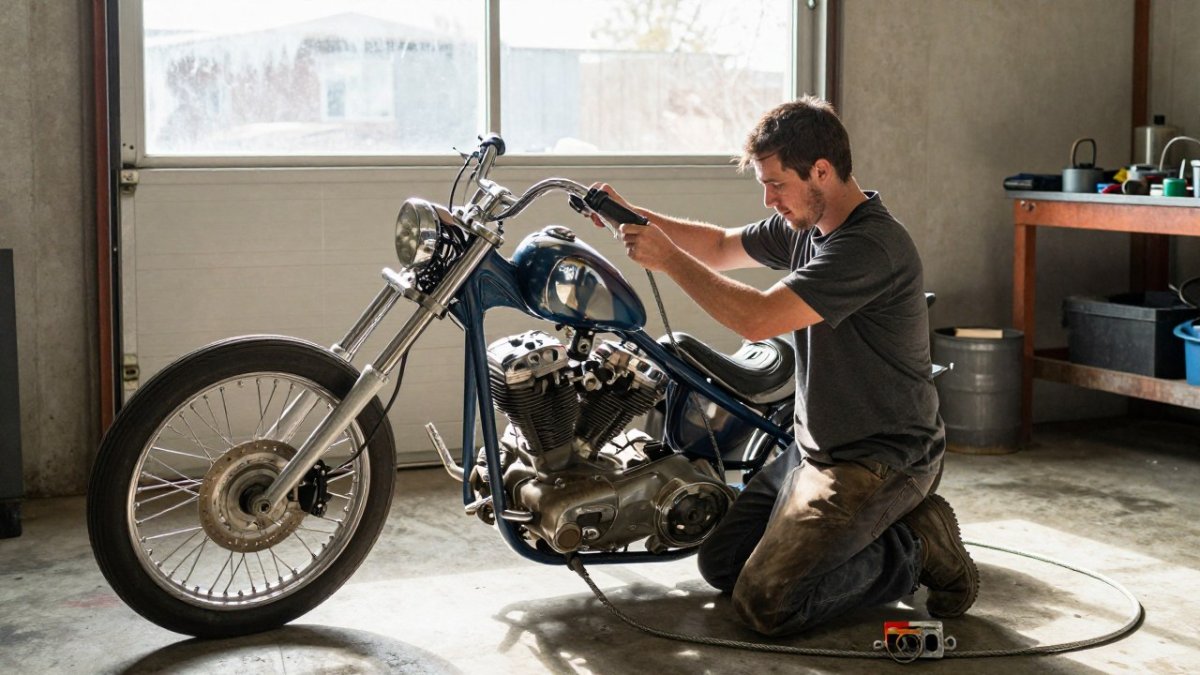
Last Updated: November 16, 2026
Quick Summary
The best security accessories for custom motorcycles are part locks for saddlebags, seats and GPS mounts, plus a fitted disc lock, a hardened chain with a ground anchor, a motion alarm and a hidden GPS tracker. Build custom motorcycle security in layers, starting with the parts most likely to vanish.
- Measure rotor thickness, hole pattern and caliper clearance before ordering a disc lock for custom wheels.
- Install ground anchors into cured concrete, not asphalt, and check shackle diameter against chain links.
- Route chains through the rear wheel and frame gap, using a sleeve to protect custom paint.
- Choose alarms with adjustable sensitivity and a shock-versus-motion distinction to avoid false triggers.
- Match layers to your parking scenario; part locks matter in every scenario, including a locked garage.
Table of Contents
- Why Custom Motorcycles Need a Different Security Setup
- The Best Motorcycle Disc Lock for Custom Wheels and Brakes
- Motorcycle Chain Lock and Ground Anchor Pairings That Fit Custom Builds
- Motorcycle Alarm and Motion Sensor Options for High-Risk Parking
- Motorcycle GPS Tracker Choices for Recovery and Location Tracking
- Protecting Custom Parts, Saddlebags, Seats, and GPS Mounts
- Matching Custom Motorcycle Security to Your Parking Scenario
- Building Your Layered Security Setup Before Your Next Ride
- Frequently Asked Questions
Why Custom Motorcycles Need a Different Security Setup
Custom motorcycles carry value that a standard anti-theft device simply doesn't account for. The best security accessories for custom motorcycles must protect the whole build, not just the frame. A stolen custom part often costs more to replace than the bike's stock components, which is why saddlebag, seat, and mounting arm security matters for custom builds.
A factory Harley-Davidson or Indian touring model has predictable mounting points. An aftermarket build does not. Custom wheels, brake discs, and handlebar setups can make off-the-shelf locks useless.
That's the core problem most guides skip: generic security assumes a generic bike. A custom motorcycle security plan has to fit what's actually bolted to your machine.
The Best Motorcycle Disc Lock for Custom Wheels and Brakes
A disc lock works by sliding a hardened bolt through the brake disc and blocking rotation, so fitment matters for a custom build.
Three things affect how a disc lock fits custom wheels:
- Rotor thickness and hole pattern. Aftermarket rotors vary, and a loose fit gives a thief use.
- Clearance to the fork and caliper. A tight lock can scuff a powder-coated wheel.
- Weather resistance. Street parking means rain, grit, and salt that seize cheap mechanisms.
A common mistake is buying a lock that fits the disc but not the clearance around a custom caliper. Measure both before you order. Look for a D-lock style shackle with a hardened core, and check that any alarm sensor arms reliably rather than triggering on wind.
Motorcycle Chain Lock and Ground Anchor Pairings That Fit Custom Builds
A motorcycle chain lock only stops theft when it's paired with something solid. The chain is the deterrent; the ground anchor is the point of attachment. Skip the anchor and a thief simply lifts the bike into a truck. For a custom build, the harder question is where the chain actually goes without ruining the finish or missing the frame entirely.
Start with the anchor. Install it into cured concrete, not asphalt, and confirm it sits where the chain won't drag on your exhaust or rest against a painted fender. Check the anchor's shackle diameter against your chain's link opening before you drill; a mismatch means the chain won't pass through cleanly.
Chain fitment gets tricky on custom builds for three reasons:
- Nonstandard frame and swingarm geometry. A chain routed around a stock frame gap may not clear a custom swingarm, rearsets, or a belt-drive conversion. Route through the rear wheel and the frame triangle, then test that the chain doesn't pinch brake lines or wiring.
- Finish protection. Powder coat, cerakote, and custom paint scratch easily under a heavy chain. Use a fabric or rubber sleeve, and avoid wrapping the chain around painted tubes; pass it through the wheel and a structural gap instead.
- Storage and weight. Chain cut resistance depends on link hardness and diameter. A thicker chain resists bolt cutters better, but it also weighs more and takes up saddlebag space. A common trade-off is a mid-weight hardened chain for daily carry and a heavier chain that stays at the anchor.
Watch out: a chain that's long enough to reach the anchor from a custom mounting point can also be long enough to give a thief leverage. Keep the run short and the anchor close to where the bike actually parks.
If you rent or park in a shared garage, a portable anchor alternative is a heavy-duty U-lock through the rear wheel and frame, but it's a weaker barrier than a bolted anchor. Treat it as a stopgap, not a permanent layer.
Motorcycle Alarm and Motion Sensor Options for High-Risk Parking
A motorcycle alarm with a motion sensor is generally an early-warning layer rather than a physical barrier. It alerts you and nearby people when the bike moves.
Alarms fall into two rough groups:
- Self-contained disc-lock alarms combine a lock and a siren in one unit, which is easy to move between bikes.
- Hardwired systems tie into the bike's electrical system and can add a tamper alert and an immobilizer function.
False alarms are the real drawback. Wind, passing traffic, and temperature swings set off poorly tuned sensors. Look for adjustable sensitivity and a shock-versus-motion distinction so the alarm ignores a bump but reacts to a lift. On a high-risk street, a loud siren plus a visible lock is a stronger deterrent than either alone.
Motorcycle GPS Tracker Choices for Recovery and Location Tracking
A motorcycle GPS tracker is generally used as a recovery tool rather than a prevention tool.
Trackers come in a few forms worth knowing:
- Hardwired units draw from the bike's battery and hide under bodywork, but installation can void a warranty if done poorly.
- Battery-powered units last months per charge and mount almost anywhere, which suits custom builds you don't want to wire into.
- Subscription trackers add live location tracking and tamper alerts through an app.
The catch: a tracker only helps if it's hidden and charged. A common mistake is mounting one where a thief checks first. Tuck it into a spot that requires tools to reach, and test the app's location accuracy before you rely on it.
Protecting Custom Parts, Saddlebags, Seats, and GPS Mounts
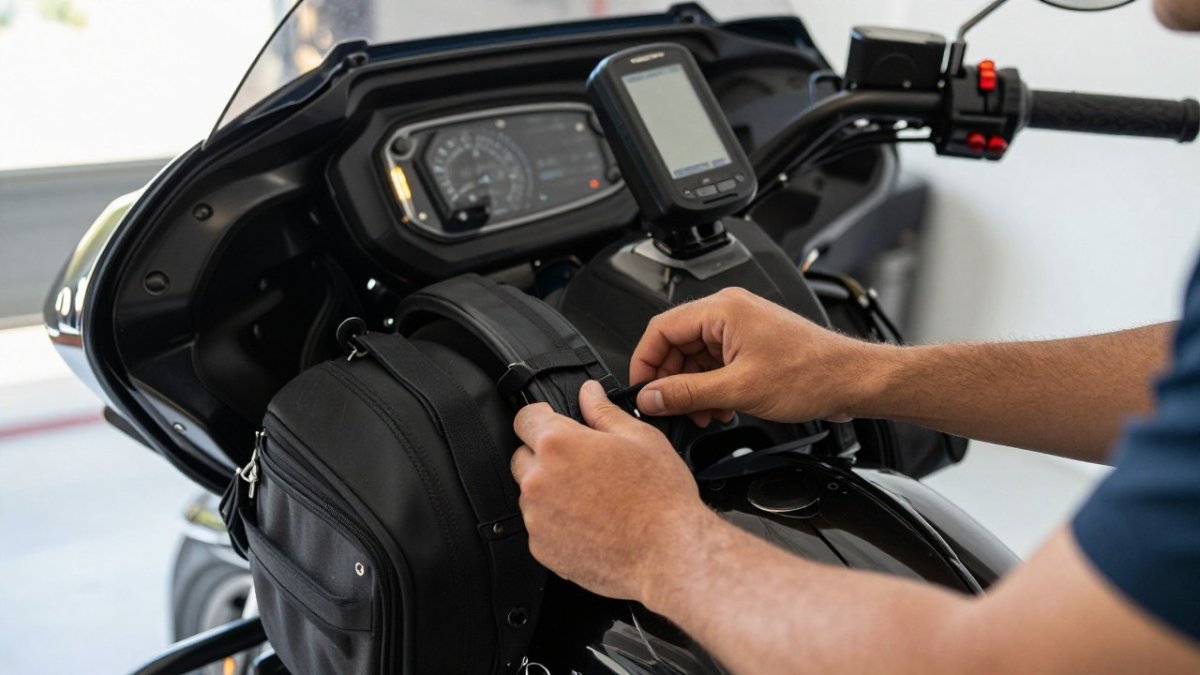
Custom parts are the easiest things to steal and the hardest to replace. A quick-release saddlebag, a solo seat, or a handlebar-mounted GPS can walk away in seconds while the bike itself stays put.
This is where build-specific hardware earns its keep. A dedicated saddlebag lock secures stock and aftermarket bags. A seat lock protects factory and aftermarket seats, including solo seats. A mounting-arm lock helps secure a Garmin zumo, Montana, or Monterra unit.
The thing nobody tells you about custom-part theft: it's often opportunistic, not planned. A thief sees an unsecured GPS mount or a clipped-on bag and takes it. Locking those parts removes the easy grab.
Matching Custom Motorcycle Security to Your Parking Scenario
Security should scale with where you park, not with how much you spent on the build. A garage-kept show bike and a daily rider left on a high-theft street need different setups. Most guides give one generic recommendation; the useful approach is to match layers to the scenario and to the custom parts most exposed in each one.
Use this to match your setup to your situation:
| Parking scenario | Priority layers | Skip | Build-specific note |
|---|---|---|---|
| Locked garage at home | Disc lock, part locks | Ground anchor | Part locks still matter; a garage door is not a lock on a quick-release bag or GPS mount. |
| Apartment lot or driveway | Chain + ground anchor, alarm | GPS tracker alone | Confirm the anchor point is yours to drill; many leases prohibit it, so a heavy portable lock is the fallback. |
| Urban street parking | Disc lock alarm, chain, tracker | Lightweight cable locks | Route the chain through the rear wheel and frame gap to avoid scuffing custom paint. |
| Overnight travel stops | Chain + anchor, alarm, tracker | Nothing; layer all three | Carry a sleeve for the chain and a part lock for detachable luggage. |
| Events and shows | Part locks, disc lock, visible alarm | Heavy chain | Theft at events is often opportunistic part theft, so lock the seat, bags, and GPS mount first. |
| Transport (trailer or truck) | Chain to the trailer, wheel chock, alarm | Ground anchor | Secure the bike to the trailer frame, not just the bed, and lock detachable parts inside the tow vehicle. |
The pattern is simple. The higher the risk, the more layers you stack. Urban parking and high-risk areas call for a physical barrier, an alarm, and a tracker together. For custom-part theft specifically, part locks matter in every scenario, because a bag or GPS disappears whether the bike is in a garage or on the street.
Cost and trade-offs deserve a plain look. A disc lock is the cheapest first layer and the easiest to carry; a chain and anchor cost more and stay put; an alarm adds deterrence but needs tuning to avoid false triggers; a tracker is the most expensive recovery net and the least useful as prevention. Build the setup in that order and add layers as your risk and budget allow.
Watch out: buying one expensive lock and calling it done is the most common failure. Theft prevention is a system, and the custom parts are usually the weakest link.
Building Your Layered Security Setup Before Your Next Ride
Layered security is generally more effective than any single device, because a thief who defeats one layer still faces the next.
Here's the order we'd build it in:
- Lock the parts first. Saddlebag, seat, and GPS-mount locks protect the custom pieces most likely to vanish.
- Add a physical barrier. A disc lock for short stops, a chain and ground anchor for overnight.
- Layer in an alarm. Motion sensing deters and alerts.
- Add a tracker last. It's your recovery net, not your first line.
Check your insurance policy too, and keep receipts and photos of your setup.
Watch out: buying one expensive lock and calling it done is the most common failure. Theft prevention is a system, and the custom parts are usually the weakest link.
Your custom build deserves security that fits it, not a generic lock that fights your aftermarket setup. At Robert Becker Design, we build theft prevention hardware specifically for Harley-Davidson and Indian touring models, from saddlebag and seat locks to Garmin GPS mounting-arm locks, with designs made by riders for riders since 2012. Get started with Robert Becker Design and protect every part of your build, not just the frame.
Frequently Asked Questions
What are the most effective anti-theft devices for custom motorcycles?
The most effective approach is layered custom motorcycle security: a disc lock on the front brake, a chain lock and ground anchor at home, a motion-sensing alarm for street parking, and a GPS tracker for recovery. Alarms and trackers add alerts and location data when a bike is moved.
Is a disc lock or a chain lock better for a motorcycle?
They solve different problems. A disc lock is compact and portable, so it travels easily. A motorcycle chain lock ties the frame to a fixed object, but it is heavy to carry. Use a disc lock on the road and a chain lock plus ground anchor at home for full coverage.
Do motorcycle GPS trackers help recover stolen bikes?
A motorcycle GPS tracker is generally used for recovery because it reports location after a theft. Pair it with a physical barrier like a disc lock or chain. Check that the unit has battery life suited to your parking habits and that installation does not interfere with your custom wiring.
What security accessories work well for custom motorcycles?
Look for accessories that fit your existing mounting points without drilling or cutting. Disc locks sized for your brake rotor, chain locks with a sleeve that protects powder coat, and locks that secure saddlebags, seats, and GPS mounts are the core. Robert Becker Design builds locks for Harley-Davidson and Indian touring models, including Garmin GPS mounting security.
