
Last Updated: November 13, 2026
Quick Summary
Motorcycle insurance can cover stolen seats, but only if you carry comprehensive coverage, since theft is a non-collision loss that liability and collision coverage won't pay for. Comprehensive coverage treats a taken seat as a partial theft claim, subject to your deductible and policy limits.
- Liability and collision coverage pay nothing for a seat taken from a parked bike.
- Comprehensive coverage is often optional once a loan is paid off.
- Factory seats are usually covered as part of the motorcycle; aftermarket seats may be capped.
- File a police report the same day and photograph the empty mounting point.
- If your deductible exceeds the seat's covered value, filing a claim gains you nothing.
Table of Contents
- The Short Answer: Comprehensive Coverage and Stolen Seats
- How Comprehensive Motorcycle Insurance Treats a Stolen Seat
- Motorcycle Accessories Insurance Coverage: Factory vs. Aftermarket Seats
- The Motorcycle Theft Claim Process, Step by Step
- Deductibles, Payouts, and Whether a Seat Claim Is Worth Filing
- Motorcycle Seat Theft Prevention That Actually Works
- Protecting Your Seat Before the Next Claim
- Frequently Asked Questions
The Short Answer: Comprehensive Coverage and Stolen Seats
Yes, motorcycle insurance can cover stolen seats, but only if you carry comprehensive coverage.
Here is the core rule: theft is a non-collision loss. A seat taken from a parked bike never touched another vehicle.
Comprehensive coverage is often optional once a loan is paid off, and requirements vary by lender and policy. If you finance a bike, your lender likely requires it.
Why Liability and Collision Coverage Leave You Exposed
Liability coverage pays for damage you cause to other people and their property (Auto Insurance Basics). It does nothing for your own bike. Collision coverage pays to repair your motorcycle after a crash with a vehicle or object.
That leaves a gap. Riders who skip comprehensive often learn this after a partial theft, when the missing part is small but the replacement cost is not.
How Comprehensive Motorcycle Insurance Treats a Stolen Seat
Comprehensive motorcycle insurance covers theft of the whole bike and theft of parts bolted to it.
Insurers treat it as a partial theft claim. That means the bike was not taken, only a component.
One caveat matters here. If the seat was not secure or the theft looks staged, an adjuster will ask hard questions. Keep your story straight and your paperwork ready.
Partial Theft vs. Full Theft: How Insurers Classify the Loss
Partial theft is the taking of a component, part, or accessory while the motorcycle stays put. Full theft is the taking of the entire motorcycle. The classification changes the claim, not the coverage.
- Partial theft: seat, saddlebags, GPS unit, mirrors, chrome trim
- Full theft: the whole bike, usually hot-wired or hauled away
- Recovered motorcycle: found after a full theft, often stripped of parts
A recovered motorcycle case can blur the line. If your bike comes back missing its seat, the insurer may treat the seat as part of the original theft claim rather than a new one.
Motorcycle Accessories Insurance Coverage: Factory vs. Aftermarket Seats
Motorcycle accessories insurance coverage depends less on what the seat is than on how your policy defines it.
Most policies start from a simple split. Original equipment, the seat that came on the bike from the factory, is treated as part of the motorcycle. Aftermarket and custom equipment is treated as an addition, and additions are where the fine print lives.
How Policy Wording Classifies a Seat
Read the definitions section of your policy before the coverage section. Insurers typically use one of three approaches, and the wording matters more than the marketing name of the coverage.
- Part of the motorcycle. The seat is covered as a component, subject to the same deductible and limits as the rest of the bike. Factory seats usually fall here.
- Accessory or custom equipment. The seat is covered only up to a stated limit, often a low default amount, unless you schedule it or buy an endorsement. Aftermarket seats, heated seats, and seats with backrests commonly land here.
- Excluded unless declared. Some policies exclude non-factory equipment entirely until you list it and pay for the added coverage. A custom seat you never declared may not be covered at all.
A common pattern is that the policy covers the motorcycle and a limited amount of custom equipment, then requires a separate endorsement for anything above that limit. The endorsement may pay actual cash value or a stated value you and the insurer agree on.
Factory, Aftermarket, and Custom Seats in Practice
| Seat Type | How Policies Commonly Treat It | What to Do |
|---|---|---|
| Factory original seat | Covered as part of the motorcycle | Nothing extra in most cases |
| Aftermarket replacement seat | Often treated as custom equipment; may be capped | Save the receipt and ask whether an endorsement is needed |
| Custom, heated, or gel seat | Frequently capped or excluded without a stated value | Request a stated-value endorsement and photos |
| Seat with backrest or rider/passenger mods | Treated as an accessory | Confirm the limit and document the purchase |
Watch out: a receipt proves you bought the seat, but it does not prove the seat was on the bike when it was taken. Pair the receipt with a photo of the seat installed and a note of any model or serial number.
Questions to Ask Your Insurer
Coverage is contract-specific, and no article can promise what your policy says. Ask these questions and write down the answers:
- Does my policy treat a non-factory seat as part of the motorcycle or as custom equipment?
- What is the default limit for custom equipment, and does my seat exceed it?
- Would a stated-value or custom-equipment endorsement change the payout for a stolen seat?
- Is the payout based on actual cash value or replacement cost for the seat?
- Does the deductible apply separately to accessory claims?
If the answers are vague, ask for the policy language in writing. An adjuster's verbal summary is not the contract.
The Motorcycle Theft Claim Process, Step by Step
The motorcycle theft claim process for a stolen seat takes five steps. Move fast, because evidence disappears and adjusters notice delay.
- Report the theft to police. File a report the same day. You will need the report number for your claim.
- Notify your insurer. Call your agent or file online within the window your policy requires. Ask what documents they want.
- Photograph the damage. Show the empty mounting point, any cut straps or broken hardware, and the surrounding bike.
- Gather proof of ownership. Pull the receipt for the seat, your registration, and any photos of the bike with the seat installed.
- Submit the claim and track it. Keep every email and note the claim number. Follow up if you hear nothing within a week.
Documentation That Decides Your Payout
Adjusters pay what they can verify. Weak paperwork is the most common reason a partial theft claim gets trimmed or denied.
- Police report number and copy
- Purchase receipt for the seat or accessories
- Photos of the bike before the theft, seat visible
What most guides miss is the before photo. A picture of your bike with the seat installed proves the part existed and was mounted. Take that photo today, not after a theft.
Deductibles, Payouts, and Whether a Seat Claim Is Worth Filing
A deductible is the amount you pay before the insurer pays. For a relatively low-cost part like a seat, the deductible often decides the whole question.
Run the math before you call. The formula is simple: expected payout equals the covered value of the seat minus your deductible, and that result has to be worth more than the premium risk of filing.
Actual Cash Value vs. Replacement Cost
Payouts are usually based on one of two methods, and the difference can swallow a small claim.
- Actual cash value (ACV) pays what the seat was worth just before the theft, after depreciation. A seat that is several years old may be valued well below the price of a new one.
- Replacement cost pays what it costs to buy a comparable new seat, without subtracting depreciation. This is usually better for the rider but may require a specific endorsement.
A common pattern is that the gap between ACV and replacement cost on a low-cost part is large enough that the claim barely clears the deductible. Ask your insurer which method applies before you file, not after.
A Simple Way to Decide
- Find your comprehensive deductible on the declarations page.
- Get the replacement price for the same or comparable seat.
- Ask the insurer whether payout is ACV or replacement cost, and estimate the covered value.
- Subtract the deductible from the covered value.
- Compare that number to the possible premium effect of filing a claim.
If the result is small or negative, paying out of pocket and saving the claim for a larger loss is often the practical choice. If the seat is custom, heated, or part of a larger partial theft that also took saddlebags or a GPS unit, the combined claim may clear the deductible easily and change the decision.
Watch out: some insurers treat any comprehensive claim, even one below the deductible, as a claim on your history. Ask whether a zero-payout claim would be recorded before you file.
How a Claim Can Affect Your Premium
Filing a small claim can cost more in future premiums than the seat is worth. The effect varies by insurer, state, and your claims history, and comprehensive claims are often treated differently from at-fault collision claims. There is no universal rule, so ask your agent a direct question: would filing this claim change my rate at renewal? Get the answer before you decide.
When Filing Still Makes Sense
A seat claim is more likely to be worth filing when the seat is expensive, when it was declared with a stated value, when the deductible is low, or when the theft took other parts at the same time. It is less likely to be worth filing when the seat is a standard factory part, the deductible is high, and the payout would be modest.
Motorcycle Seat Theft Prevention That Actually Works
Motorcycle seat theft prevention starts with hardware, not hope. A quick-release seat is easy to lift, and thieves know it. Locking the seat to the frame removes the easy win.
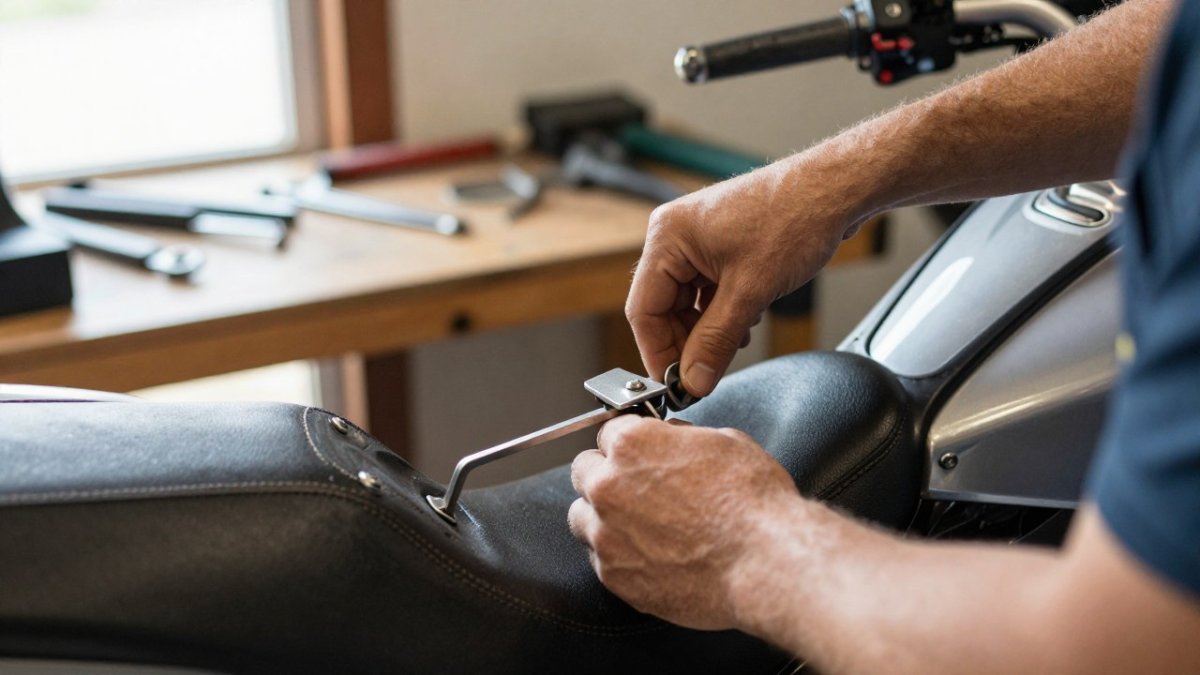
Robert Becker Design makes theft prevention locks for touring motorcycles, including Harley-Davidson and Indian models. Our locks are designed by riders for riders.
- Lock the seat to the frame with dedicated hardware
- Park in well-lit, high-traffic spots
- Use a cover to hide quick-release hardware
Protecting Your Seat Before the Next Claim
The gap between riders who get paid and riders who get denied usually comes down to two things: the right coverage and the right paperwork. Check your policy for comprehensive coverage today. Then photograph your seat, save the receipt, and add a lock so the claim never happens.
Robert Becker Design has made theft prevention hardware for the motorcycle industry since 2012. Our locks for saddlebags, seats, and mounting arms are designed for Harley-Davidson, Indian, and other touring models.
Your seat is only as safe as the hardware holding it down. Get started with Robert Becker Design and secure your seat, saddlebags, and GPS mount with locks designed by riders for riders.
Frequently Asked Questions
Does comprehensive motorcycle insurance cover a stolen seat?
Yes, in most cases. A seat taken from a parked bike is a non-collision loss, which is exactly what comprehensive coverage is built for. The catch is that you need comprehensive on the policy, and your deductible has to be lower than the seat's value for the claim to pay anything. A stock seat is often worth less than a $500 or $1,000 deductible, so run the numbers before you file.
Will my insurance cover stolen aftermarket accessories?
Motorcycle accessories insurance coverage usually extends to aftermarket parts, but only up to the limits written into your policy. Many policies limit custom equipment coverage, and some require you to list high-value items separately. Keep your purchase receipts and photos of the installed part. If your custom seat cost more than the cap, ask your insurer about a coverage endorsement that schedules the accessory at its full replacement cost.
Is it worth filing a claim for a stolen motorcycle seat?
Only if the payout clears your deductible by a meaningful margin. Subtract the deductible from the seat's actual cash value or replacement cost, and weigh that against a possible premium increase at renewal. For a stock seat on a high-deductible policy, paying out of pocket often costs less over time. For an expensive custom seat, a documented claim usually makes sense.
What should I do immediately after discovering a seat theft?
Photograph the bike as you found it, including the exposed mounting area and any damage to surrounding parts. Report the theft to the police and get a report number, then notify your insurer. Gather your purchase receipt, photos of the seat installed, and any aftermarket documentation. Do not move or repair the bike until you have those photos, since the claim process relies on evidence of how the seat was taken.
