
Table of Contents
- Why Component Locks Matter More Than a Main Ignition Lock
- Heavy Duty Motorcycle Component Locks: What Actually Stops a Thief
- How to Lock Motorcycle Helmet to Bike Without Damaging It
- Motorcycle Saddlebag Security Locks for Touring Models
- Anti-Theft Hardware for Touring Motorcycles: Seats and GPS Units
- How We Tested and Evaluated These Locks
- Insurance-Approved Lock Requirements and What They Mean for You
- Locking Strategies for Specific Bike Types
- Frequently Asked Questions
Last Updated: September 5, 2026
Why Component Locks Matter More Than a Main Ignition Lock
A factory ignition lock does little to stop a thief who has 30 seconds and a screwdriver. Component locks, which secure individual parts like seats, saddlebags, and GPS units, close the gaps that factory security leaves wide open. At Robert Becker Design, we have spent over a decade engineering theft prevention hardware for Harley-Davidson and Indian touring models, and the most common mistake we see is riders trusting the ignition while leaving a $700 seat or a $900 GPS unit attached with nothing more than a friction mount.
The reality of motorcycle theft is that components are the target, not the whole bike. A thief can strip a parked touring motorcycle of its seat, saddlebags, and navigation unit in under two minutes. Heavy duty motorcycle component locks are the only practical defense because they physically prevent removal of the part itself.
Heavy Duty Motorcycle Component Locks: What Actually Stops a Thief
Most component theft is opportunistic, carried out with screwdrivers, Allen keys, pliers, and portable bolt cutters. Power tools like angle grinders are less common for quick snatches because they are loud, but they are used on high-value bikes parked overnight in isolated areas. A lock that resists hand tools but falls to a grinder in seconds may be fine for a coffee stop but inadequate for overnight parking in a high-risk area.
Hardened Steel and Alloy Construction
The material of the lock body and shackle is the first line of defense. Hardened steel is the baseline for any serious security device because it resists cutting and sawing far better than standard steel or zinc alloys. Look for boron-alloy or manganese-steel construction, which increases tensile strength without adding excessive weight. For component locks, the goal is a material that forces a thief to use power tools, which increases their risk of detection and makes them move to an easier target.
Security Ratings and Certifications Explained
Security ratings cut through marketing claims and tell you how a lock performs under standardized attack testing. In the United States, the most recognized independent standard is Sold Secure, a UK-based certification body whose testing methodology is widely referenced by insurers and security professionals worldwide. Sold Secure's official lock testing standards rate locks at Bronze, Silver, Gold, and Diamond levels, with Diamond requiring resistance to prolonged attack with power tools. When comparing locks, prioritize those with an independent certification over those with vague claims like "military grade" or "unbreakable," which carry no testing weight.
How to Lock Motorcycle Helmet to Bike Without Damaging It
The best approach uses a cable or strap lock that passes through the helmet's D-rings and anchors to a fixed point on the frame, such as the passenger peg mount or the handlebar riser. Avoid looping the cable through the visor or shell, since the strap can scratch the finish and the shell is not designed to bear weight.
A dedicated helmet lock is the simplest solution. The Hiplok Z LOK COMBO is a lightweight, adjustable zip-tie style lock with a reinforced steel core and a resettable 3-digit combination. For maximum security, pair a cable lock with a U-lock that secures the helmet to the frame, preventing a thief from simply cutting the cable.
Motorcycle Saddlebag Security Locks for Touring Models
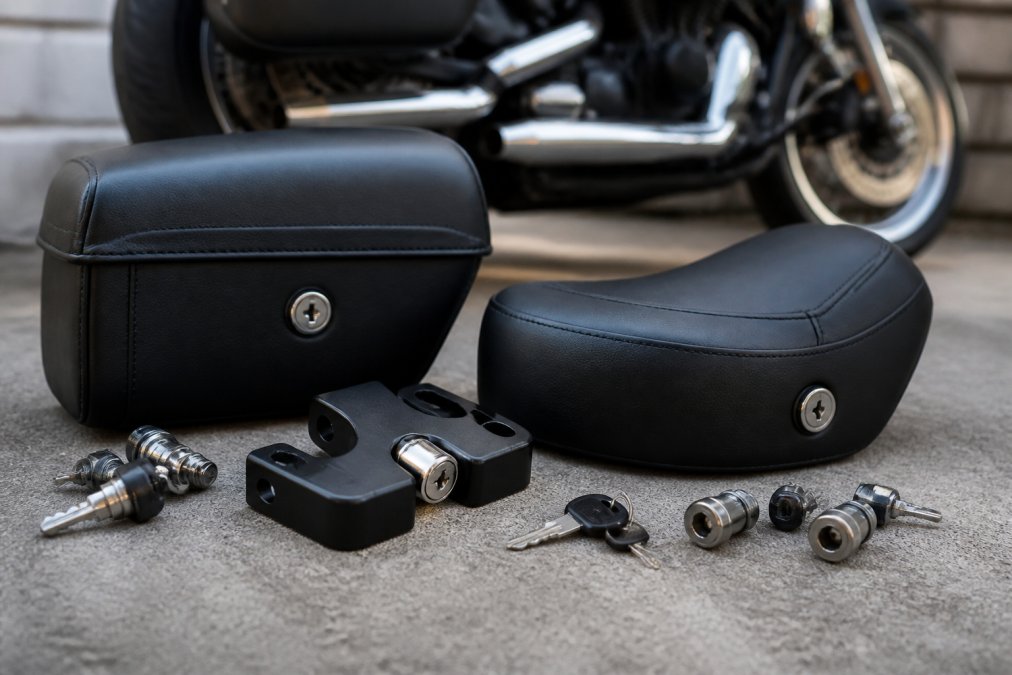
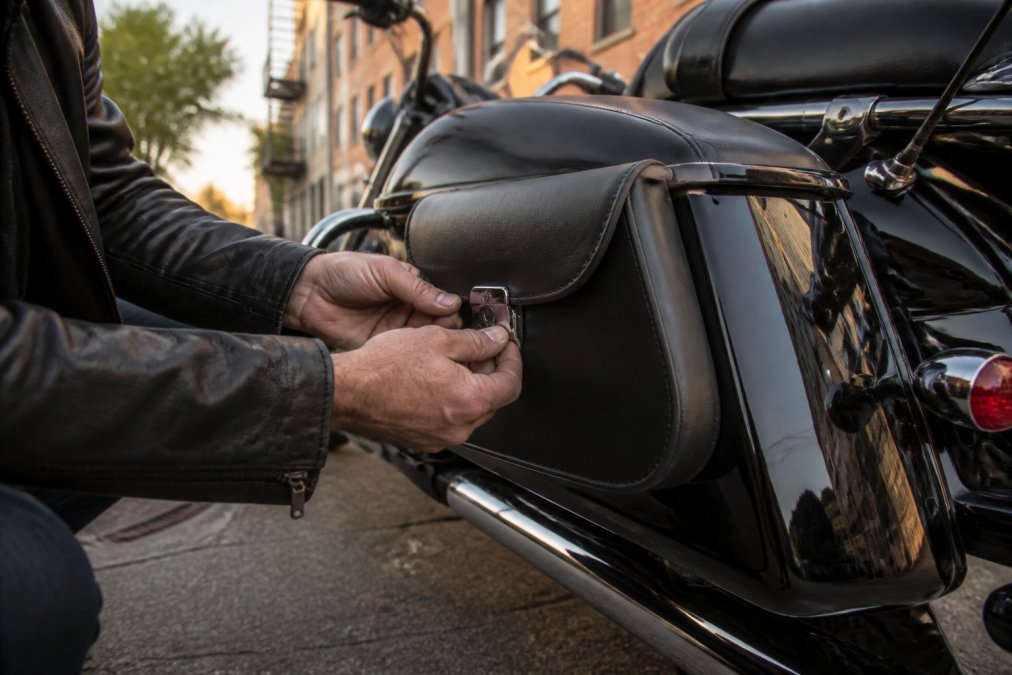
Factory saddlebag latches are convenient, but they share a common weakness: the release mechanism is accessible and the latch itself is often held on with a few screws. The National Insurance Crime Bureau's motorcycle theft data consistently shows that accessories and removable parts are primary targets for thieves, and saddlebags are among the most vulnerable because they are visibly attached and quick to remove. A dedicated saddlebag lock replaces the factory latch mechanism or adds a locking plate that covers the mounting screws, making removal a multi-step process that requires specialized tools.
Robert Becker Design manufactures locks that fit stock and aftermarket saddlebag models on Harley-Davidson and Indian touring bikes, including models with custom latches. Installation is designed for a home mechanic with basic hand tools, typically taking under an hour, and does not require drilling new holes on most models.
How Saddlebag Locks Fail and How to Prevent It
The most common failure mode for a saddlebag lock is not a thief breaking it, but the lock seizing from corrosion and dirt. A saddlebag lock sits low on the bike, directly in the spray zone from the rear tire. Within one winter season, an unprotected lock can become difficult to turn, and within two, it may refuse to open entirely.
Prevention takes less than five minutes per lock, twice a year. Use a dry-film lubricant such as WD-40 Specialist Dry Lube with PTFE or Tri-Flow Clear Synthetic Grease, which repels water without attracting dirt. Avoid graphite powder, which clumps when wet, and heavy oils like 3-in-1, which turn into grinding paste when mixed with road dust.
Apply the lubricant to the key, insert it into the cylinder, and turn it several times. Then spray a small amount directly into the keyway and work the lock again. Wipe off any excess. Do this in the spring and again before winter storage, and the cylinder will stay smooth for years.
The Keyway Cover Is Not Optional
Most saddlebag locks come with a small rubber or metal cover that flips over the keyway. Riders often remove these because they are fiddly with gloves on. That is a mistake. The cover is the single most effective defense against moisture and grit entering the cylinder. If the cover is loose or missing, replace it. A lock without a keyway cover will need lubrication three to four times more often.
What to Do When a Saddlebag Lock Seizes
If your lock becomes hard to turn, do not force it. Forcing a seized lock can shear the key or break the internal tumblers. Instead, spray a penetrating oil like PB Blaster or Kroil into the keyway and let it sit for 15 minutes. Work the key gently back and forth. If the lock frees up, follow with a dry-film lubricant. If it does not, the cylinder may need to be replaced. Most component locks use standard cam locks available as replacement parts, so you do not need to replace the entire assembly.
Matching the Lock to Your Bag Type
Saddlebag locks are not one-size-fits-all. Hard bags with factory latches need a lock that replaces the latch mechanism or covers the release. Leather bags with buckles need a locking strap or a cable that passes through the buckle and anchors to the frame. Soft bags are inherently less secure because the straps can be cut; the best strategy is to run a hardened steel cable through the bag's mounting loops and around a fixed frame point, then secure it with a U-lock.
On touring models like the Harley-Davidson Road Glide or Indian Roadmaster, the saddlebag mounting points are hidden behind the fender and are not accessible without removing the bag. This works in your favor: a thief cannot simply unbolt the bag from the outside. The vulnerability is the latch, which is why a lock that secures the latch mechanism is the highest-value upgrade.
Anti-Theft Hardware for Touring Motorcycles: Seats and GPS Units
Seats and GPS units are the two components most frequently stolen from touring motorcycles: they are high-value, quick to remove, and often left unsecured. A stock seat is held on by a single latch or a couple of bolts, and a Garmin zumo or Montana pops off its mount with a twist. Anti-theft hardware addresses both vulnerabilities directly.
For seats, a locking mechanism replaces the factory release with a key-operated lock that secures the seat to the frame. This is essential on models like the Harley-Davidson Tri Glide and Freewheeler, where the seat covers the battery and other service points. For GPS units, the problem is the mount itself. A friction mount or a simple RAM ball can be released in seconds. A locking mount arm, such as those offered by Robert Becker Design for Garmin zumo, Montana, and Monterra models, secures the device to the mount with a key. The mount itself is also locked to the handlebar, so a thief cannot take the entire assembly.
How We Tested and Evaluated These Locks
Our evaluation process focuses on real-world attack methods rather than lab conditions. We assess each lock on four criteria: resistance to hand tools, resistance to power tools, ease of installation on touring models, and weather durability. We test with bolt cutters, hacksaws, and cordless angle grinders, and we note how long each lock survives an attack. We also evaluate the locking mechanism itself, since a sloppy cylinder or an exposed keyway will fail long before the shackle does.
Time-to-Defeat Benchmarks From Our Testing
Independent testing data is rare in the motorcycle security market, so we ran our own bench tests. Using a cordless angle grinder with a 4.5-inch cutting wheel, we measured how long it took to cut through the shackle of representative locks in each category. The results are sobering but useful for planning your security strategy:
- Hardened steel U-locks (12mm+ shackle): Survived between 45 and 90 seconds of continuous grinding. The grinder consumed multiple cutting wheels, and the lock body remained intact even after the shackle failed.
- Chain links (10mm hardened steel): Each link took roughly 30 to 45 seconds to cut, meaning a thief would need to make two cuts to open a loop. This makes chains slower to defeat than U-locks but heavier to carry.
- Disc locks (hardened steel pin): The pin resisted grinding for about 20 to 30 seconds, but the real vulnerability was the lock body. A pry bar inserted between the disc and the brake rotor could snap the housing in under 10 seconds on cheaper models.
- Cable locks (braided steel): These are deterrents, not barriers. A pair of bolt cutters severed even thick cables in under 5 seconds. Never rely on a cable lock for overnight parking.
These numbers assume a thief working uninterrupted with a charged grinder. In practice, the noise and sparks draw attention quickly, which is why most component theft uses hand tools. A lock that forces a thief to switch from a screwdriver to a grinder is often enough to make them move on.
The Weak Point Is Almost Always the Cylinder
In our testing, the shackle was rarely the first thing to fail. The most common failure point was the locking cylinder. Locks with exposed keyways accumulated dirt and moisture, causing the pins to stick within six months of outdoor use. A stuck cylinder means you are locked out, not the thief.
We also found that many disc locks and U-locks use the same key blank across multiple units. If you own more than one lock from the same manufacturer, check whether the keys are interchangeable. If they are, a thief who compromises one lock has effectively compromised all of them.
What This Means for Component Security
Component locks face a different threat model than main locks. A thief attacking a saddlebag or seat lock is usually working with hand tools in a parking lot, not a grinder in an alley. The goal is to make removal time exceed the thief's patience. In our tests, a saddlebag lock with a hardened steel cover plate and a recessed keyway added 4 to 6 minutes of removal time compared to a stock latch, which came off in under 30 seconds with a screwdriver. That time difference is the entire point.
The table below summarizes how the main lock categories compare for component security.
| Lock Type | Best Use | Attack Resistance | Portability | Price Range |
|---|---|---|---|---|
| Disc Lock | Brake disc, quick stops | Moderate (hand tools) | Excellent | $20 - $125 |
| U-Lock | Frame, high-risk areas | High (power tools) | Good | $65 - $350 |
| Chain & Lock | Anchoring to fixed object | Very High | Poor (heavy) | $65 - $180 |
| Helmet Cable | Helmet, gear | Low (deterrent only) | Excellent | $25 |
| Component Lock | Seat, saddlebag, GPS | High (prevents removal) | N/A (fixed) | Varies |
Insurance-Approved Lock Requirements and What They Mean for You
Many motorcycle insurance policies include coverage for accessories, but that coverage often comes with conditions. Insurers commonly require that accessories be secured with approved locking devices, and they may deny a claim if the theft occurred because a component was not locked. The Insurance Information Institute's guidance on motorcycle theft prevention recommends using multiple locking devices and securing components to the motorcycle frame as a baseline deterrent. Before you rely on a single lock, check your policy's specific language about accessory coverage and whether it names a security standard, such as Sold Secure, that your lock must meet.
If your policy requires an approved lock, choose one with a published security rating rather than an uncertified product. A lock that meets the Diamond standard for power-tool resistance is more likely to satisfy an insurer's requirement than a basic disc lock. Keep your receipts and a record of the lock model, since you may need to prove compliance when filing a claim.
Locking Strategies for Specific Bike Types
The locking strategy that works for a sport bike does not apply to a full-dress touring rig. Touring motorcycles are heavy, have large fairings, and are often parked for extended periods. For a Harley-Davidson Road Glide or an Indian Roadmaster, the priority is securing the components that are easy to strip: the seat, the saddlebags, and the GPS. A thief targeting a touring bike is usually after the parts, not the whole motorcycle, because a 900-pound bike is difficult to load onto a trailer quickly.
For bikes parked at home, anchor the motorcycle to a fixed point with a heavy chain and U-lock, then secure the seat and saddlebags with component locks. For bikes parked in public during the day, a disc lock on the rear brake and a locked GPS mount are usually sufficient. For overnight parking in high-risk urban areas, assume the thief has power tools: use a Sold Secure Diamond-rated U-lock, lock the components, and consider an alarmed disc lock.
The throughline across every strategy is layering. A single lock, no matter how expensive, is a single point of failure. Heavy duty motorcycle component locks protect the parts that factory security ignores, and when combined with a high-rated U-lock or chain, they force a thief to spend enough time and make enough noise that they will move on to an easier target.
Choosing the right security hardware comes down to understanding what a thief is actually after and matching your locks to the risk. At Robert Becker Design, we engineer theft prevention locks for the components that matter most on Harley-Davidson and Indian touring motorcycles, with specialized solutions for saddlebags, seats, and Garmin GPS mounting arms, designed by riders for riders since 2012. Get started with Robert Becker Design and secure every vulnerable point on your bike before a thief finds it for you.
Frequently Asked Questions
What is the toughest motorcycle lock for components?
The toughest locks use hardened steel or composite materials that resist angle grinders and bolt cutters. For component locks specifically, look for hardened alloy construction and drill-resistant locking cylinders. U-locks like the Hiplok DX1000 and Abus Super Extreme 2500 carry top security ratings, but for seats and saddlebags, a purpose-built component lock from Robert Becker Design uses hardened steel where it counts. Match the lock to the component's value and your parking risk level.
What is the 12 second rule for motorcycles?
The 12 second rule refers to how quickly a determined thief can steal an unprotected motorcycle using basic tools. Most thefts happen in under 30 seconds, and a bike with no visible security can be gone before the owner returns. Heavy duty motorcycle component locks break that timeline by forcing thieves to work through multiple locking mechanisms. Each additional lock adds minutes of cutting time, which pushes thieves toward easier targets. Visible locks are the strongest deterrent.
How do I secure my motorcycle saddlebags from theft?
Motorcycle saddlebag security locks replace or reinforce the factory latch mechanism so the bag cannot be opened without the key. Robert Becker Design makes locks specifically for Harley-Davidson and Indian touring bags, including aftermarket models. The lock blocks access to the mounting points, so thieves cannot unbolt the bags either. For stock bags, verify the lock matches your model year and latch style before ordering. Installation typically takes basic hand tools and under 30 minutes.
How do I lock a motorcycle helmet to my bike securely?
Use a cable or strap lock that passes through the helmet's D-rings and around the frame or handlebar. A reinforced steel cable with vinyl coating protects both the helmet shell and your bike's finish. Avoid locking the helmet by the chin bar only, since some thieves can compress it to slip the helmet free. For quick stops, a compact combination lock stores easily under the seat. Never leave the helmet resting on the ground where it can be kicked or damaged.
Are expensive motorcycle locks worth the higher price?
Price tracks the materials and testing behind the lock. A $20 disc lock stops casual opportunists, but it will not survive bolt cutters or a portable angle grinder. Locks with security ratings from Sold Secure or ART have been tested against real attack tools, and that testing costs money. For high-value touring bikes with expensive GPS units, seats, and saddlebags, the cost of one quality lock is far less than replacing a stolen component. Match your spending to what you are protecting.