
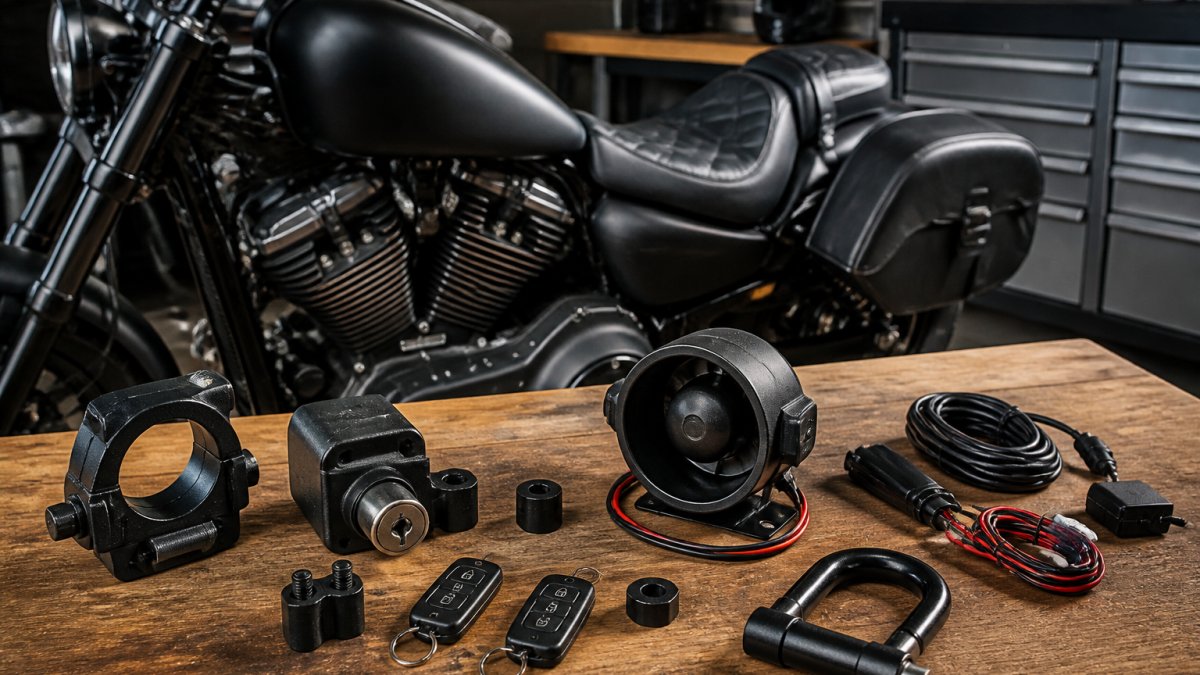
Last Updated: October 29, 2026
Quick Summary
To choose a motorcycle alarm, start with your real threat model: where the bike sits overnight, how long it is out of sight, and what expensive parts are bolted to it. Then pick the layers that match, combining a disc lock or chain with an alarm that has two-way paging, adjustable sensitivity, and a published standby current draw.
- Garaged bikes need deterrence and tamper alerts more than tracking, while street-parked bikes need multiple layers.
- A disc lock stops rolling but fails against lift-and-carry crews, so pair it with an alarm.
- Check for two-way paging, adjustable impact sensitivity, tamper alert, low-power sleep, and a backup battery.
- Plug-and-play harness installs are DIY, but hardwired CAN-bus jobs should go to a shop.
- Confirm any insurance discount in writing before buying, since many carriers offer none.
Table of Contents
- Start With Your Real Threat Model, Not the Spec Sheet
- Types of Motorcycle Alarm Systems and How They Work
- Motorcycle Disc Lock vs Alarm: Which Layer Do You Need?
- Features That Decide Whether an Alarm Is Worth It
- Motorcycle Alarm Installation Guide: DIY vs Professional
- Subscription Costs, Battery Drain, and Insurance Impact
- How to Lock a Motorcycle Helmet to the Bike
- Build Your Security Stack Before You Buy an Alarm
- Frequently Asked Questions
Start With Your Real Threat Model, Not the Spec Sheet
The best motorcycle alarm matches how your bike actually gets targeted, not the longest feature list. Riders who start with a threat model tend to spend less and lose less.
Those answers sort you into one of three profiles:
- Garaged at home, parked in lots at work: You need deterrence and tamper alerts more than tracking.
- Street parking in a dense urban area: You need layers, because a determined thief will defeat any single device.
- Long-distance touring with high-value accessories: You need coverage for the accessories themselves, not just the frame.
A rider who parks in a locked garage and one who leaves a Road Glide on a city street overnight do not need the same system. Buying for the worst case you never face wastes money; buying for the best case you sometimes face costs you a bike.
Types of Motorcycle Alarm Systems and How They Work
Motorcycle alarm systems fall into four practical categories: audible alarms, GPS trackers, two-way paging systems, and mechanical locks. Each addresses a different part of the theft problem, and most riders combine at least two.
Audible Alarms, GPS Trackers, and Two-Way Paging
An audible alarm is a siren-and-sensor unit that sounds when the bike is disturbed. It deters opportunists and amateurs but does nothing against a professional with a van and 90 seconds.
A GPS tracker reports location over cellular connectivity. It does not stop the theft; it helps recover the bike afterward.
Two-way paging sends an alert to a key fob or phone when the alarm triggers.
How Motion and Vibration Sensors Trigger an Alert
Most alarm units use a combination of a vibration sensor and a proximity sensor. The vibration sensor picks up impact and movement, with an adjustable impact sensitivity threshold so a passing truck does not set it off.
The quality difference between a good unit and a cheap one lives almost entirely in how well those thresholds are tuned. Too sensitive and you get false triggers until you disable it; too dull and it sleeps through a lift onto a dolly.
Motorcycle Disc Lock vs Alarm: Which Layer Do You Need?
The honest answer is that a motorcycle disc lock vs alarm comparison is not really a competition, because they defend against different attacks. A disc lock stops the bike from rolling.
| Layer | Stops | Fails Against | Best For |
|---|---|---|---|
| Disc lock | Rolling the bike away | Lift-and-carry, two-man crews | Quick stops, visible deterrence |
| Chain lock | Ride-away, casual theft | Angle grinders, bolt cutters | Overnight street parking |
| Audible alarm | Opportunists, tampering | Professionals, noise isolation | Deterrence and alerting |
| GPS tracker | Nothing directly | Signal jamming, enclosed vans | Recovery after theft |
| Two-way pager | Nothing directly | Range limits | Knowing it is happening |
A disc lock is the cheapest layer and the one most riders skip.
Here is the part most guides miss: the value of a disc lock is not that it is unbreakable.
Features That Decide Whether an Alarm Is Worth It
A worthwhile motorcycle alarm gives you real-time alerts you will actually see, a siren loud enough to draw attention, and a power draw low enough that it will not flatten your battery in a week.
Run this checklist before you buy:
- Two-way paging or app alerts with a range that covers where you park
- Adjustable impact sensitivity so you can tune out false triggers
- Tamper alert that fires when the unit is unplugged or the battery is disconnected
Two features deserve extra scrutiny. Relay attack protection matters on keyless-ignition bikes, because thieves can amplify or capture the fob signal. Voltage monitoring tells you if someone is tampering with the electrical system before they get the bike started.
If a unit has a siren and nothing else, it is a deterrent, not a security system. Price it accordingly.
Motorcycle Alarm Installation Guide: DIY vs Professional
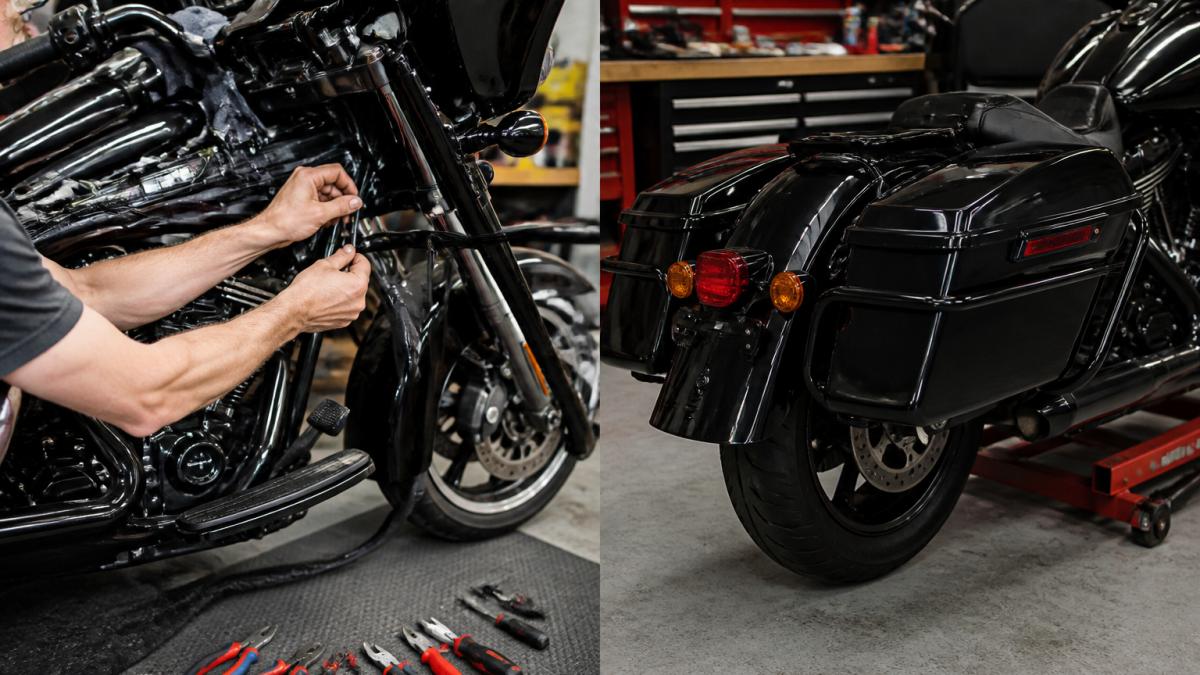
Most riders can handle a basic alarm install with hand tools and a wiring harness, but hardwired systems on CAN-bus bikes are a different job. Decide based on your comfort with your bike's electrical system, not the install price.
Wiring, Harnesses, and CAN-bus Compatibility
A plug-and-play unit with a model-specific installation harness is a genuine DIY job. You connect to the battery, tuck the unit under a seat or side panel, and route the antenna and siren.
A hardwired install on a modern touring bike is not that. CAN-bus electronics carry multiplexed signals, and tapping the wrong wire can throw fault codes, disable a circuit, or interfere with the bike's own security.
Troubleshooting False Triggers After Install
False triggers after install almost always trace to three causes: a sensor mounted too rigidly, a sensitivity threshold set too high, or a wiring connection picking up vibration.
Work through it in this order:
- Loosen the mount. A unit bolted hard to the frame reads every engine vibration as an impact. Mount it with the supplied padding.
- Drop the sensitivity one step at a time. Test by walking past the bike, then by tapping the seat.
- Check your ground connection. A poor ground causes intermittent triggers that look random.
- Confirm the proximity sensor is not facing a walkway. Foot traffic at the edge of range will chirp all night.
Watch out: disconnecting the main battery to "reset" the alarm can wipe the unit's pairing with your fob on some systems. Read the manual's reset procedure before you pull a terminal.
Subscription Costs, Battery Drain, and Insurance Impact
This is where most buyers get surprised after the sale. The hardware price is the visible cost; the recurring plan, battery drain, and insurance paperwork are the hidden ones. Budget all three before you commit.
What a Tracker Subscription Actually Covers
GPS trackers need a cellular connection to report location, and that connection is almost always sold as a recurring plan. Tracker plan pricing depends on the provider, plan tier, and contract term, so check current rates with each carrier before you buy. What you get varies more than the price:
- Cellular data only: the unit reports location and you check an app. Cheapest tier.
- Cellular plus alerting: push notifications, geofence breach alerts, and movement warnings.
- Cellular plus monitoring: a staffed center calls you (and sometimes law enforcement) when the alarm fires. This tier justifies the higher monthly cost.
Ask three questions before you buy: What happens to the hardware if I stop paying? Can I transfer the plan to a new bike? Is there a contract term or early-termination fee? A tracker with a lapsed plan is a brick, and one locked to a two-year contract is a brick you cannot resell.
Battery Drain: What the Numbers Look Like
A motorcycle battery is small compared with a car battery, and a parasitic draw that would be trivial on a car can flatten a bike in a week or two.
A common pattern is a few milliamps in low-power sleep mode and a much higher draw when actively alerting or reporting.
Look for a standby or sleep mode that drops the draw when the bike is parked in a known-safe location, and check whether the unit has a low-voltage cutoff that shuts the alarm down before it strands you.
The Insurance Angle Most Guides Skip
Insurance treatment of alarms and trackers is inconsistent, and that inconsistency is the point. Some carriers offer a premium discount for a professionally installed alarm or a tracked vehicle; many do not, and the discount, when it exists, is often smaller than the hardware cost.
The productive sequence is:
- Call your agent first. Ask whether your carrier discounts for an aftermarket alarm, a GPS tracker, or both, and whether the discount requires professional installation.
- Ask what documentation they require. Some want a receipt and install invoice; some want the model number; some want nothing.
- Get the answer in writing, an email is enough, before you spend money.
- Re-shop the policy. If your current carrier offers nothing, a competitor may. The discount is a policy feature, not a hardware feature, so it is worth a quote comparison.
The financial case for an alarm is stronger on the theft-loss side than the premium side: the deductible you avoid and the bike you keep are worth more than a typical discount. Treat any premium reduction as a bonus, not a reason.
How to Lock a Motorcycle Helmet to the Bike
Helmet security is the accessory-theft problem in miniature, and it teaches the lesson the rest of this guide relies on: an alarm guards the frame, not the things bolted to it. A helmet is expensive, easy to walk off with, and almost never covered by the alarm you just installed.
The safest method is a dedicated helmet lock or a short cable lock run through the helmet's D-ring and secured to a fixed point on the frame. A few practical rules:
- Never hang a helmet by the strap alone on a hook that can be cut or lifted off.
- Run the cable through the D-ring, not the chin bar, so the helmet cannot be slipped free.
- Lock to the frame or a fixed bracket, not to a removable accessory.
Why This Matters for Alarm Buyers
The helmet is the cheapest test case for a question every rider should ask before buying an alarm: what on this bike is removable, valuable, and unguarded? On a touring bike the answer is usually the GPS unit, the saddlebags, and the seat, worth more than the deductible and far easier to carry off than the bike.
That is the principle behind accessory locks: the factory latch keeps the lid closed, but it does not stop someone from opening it.
Build Your Security Stack Before You Buy an Alarm
Buy your layers in order of what actually gets stolen. A motorcycle alarm is one layer in a stack, and it works best when the physical layers around it are already in place.
Then look at the accessories. On a touring bike, the GPS unit, saddlebags, and seat are often worth more than the deductible and far easier to carry off than the bike. Robert Becker Design builds locks for those targets, including mounting arm locks for Garmin zumo, Montana, and Monterra GPS units, saddlebag locks, and seat locks for Harley-Davidson and Indian touring models.
Best for: touring riders who want their accessories protected, not just the frame. Skip if: you only need a siren and nothing on the bike is removable.
Your bike is only as secure as its weakest removable part.
Frequently Asked Questions
What features should I look for in a motorcycle alarm system?
Prioritize adjustable impact sensitivity, a two-way key fob with real-time alerts, and a tamper alert that fires if someone cuts power or lifts the seat. Weather-resistant housings matter on a bike that sits outside. If you park in high-theft areas, add GPS tracking or a monitoring service with a recovery service behind it. Skip alarms with fixed, high sensitivity; they drain the battery and annoy neighbors with false triggers.
Are GPS-enabled motorcycle alarms worth the extra cost?
They are worth it if you park overnight in cities with active theft rings or ride a high-value touring model. GPS tracking gives you recovery odds an audible siren cannot, because a siren only deters. Budget for the subscription-based monitoring fee on top of hardware. If you garage the bike and ride low-risk routes, a layered disc lock plus a good alarm covers most of the same ground for less.
Do motorcycle alarms drain the battery?
Any hardwired alarm draws a small standby current, and a healthy battery handles it. Problems show up when the bike sits for weeks, when sensitivity is set too high, or when the install taps a circuit that stays live. Check voltage monitoring readings if your alarm supports them, and put the bike on a tender during long storage. A unit with a low-power standby mode and a proper installation harness limits battery drain.
Can a motorcycle alarm be installed on any bike model?
Most aftermarket alarms fit any 12-volt motorcycle, but the install gets harder on bikes with CAN-bus wiring, factory immobilizers, or fairing-mounted electronics. Use a model-specific installation harness where one exists, and avoid splicing into data lines. On Harley-Davidson and Indian touring models, plan where the siren and antenna sit before you drill anything. If you are not comfortable with wiring, a shop install protects both the alarm and your factory electronics.
