

Table of Contents
- Why Stock Harley Saddlebag Locks Aren't Enough
- Step 1: Upgrade to Saddlebag Security Bolts
- Step 2: Install a Locking Pin for Quick-Release Bags
- Step 3: Add a Motorcycle Seat Lock for Harley Touring Models
- Step 4: Secure the Latch Mechanism Itself
- How to Prevent Motorcycle Luggage Theft: Habits That Help
- Common Mistakes to Avoid When Locking Saddlebags
- Mistake 1: Ignoring Weight Distribution and Its Effect on Handling
- Mistake 2: Forgetting That a Locked Lid Does Not Mean a Sealed Bag
- Mistake 3: Using a Trunk Liner That Does Not Fit Your Bag
- Mistake 4: Skipping Regular Lock Cylinder Maintenance
- Mistake 5: Treating All Saddlebag Locks as Equal
- Mistake 6: Ignoring the Mounting Points When You Lock the Lid
- Conclusion: Secure Your Saddlebags Before Your Next Ride
- Frequently Asked Questions
Last Updated: September 4, 2026
Harley-Davidson saddlebags are prime targets for thieves because stock latches and locks are often easy to defeat with basic tools. The factory locking mechanism secures the lid but leaves mounting points and latch hardware exposed, making upgraded security a critical first step for any rider who parks in public areas. At Robert Becker Design, we have engineered theft prevention hardware since 2012. Below are seven proven methods to secure your bags.
Why Stock Harley Saddlebag Locks Aren't Enough
The factory lock cylinder on most Harley saddlebags only prevents someone from opening the lid; it does little to stop a thief from removing the entire bag from the mounting bracket. Stock hardware is designed for convenience and assembly speed, not for resisting pry bars or bolt cutters. A simple Allen wrench can loosen the stock bolts in under a minute. Robert Becker Design offers threaded fasteners with a locking cap that can be keyed to match their seat locks and helmet locks, providing the highest level of security available.
This is where layered security comes into play. A motorcycle seat lock for Harley touring models and saddlebag bolts work together to create multiple barriers. The goal is not to make your bike impossible to steal, but to make it take so long that a thief moves on to an easier target.
Step 1: Upgrade to Saddlebag Security Bolts
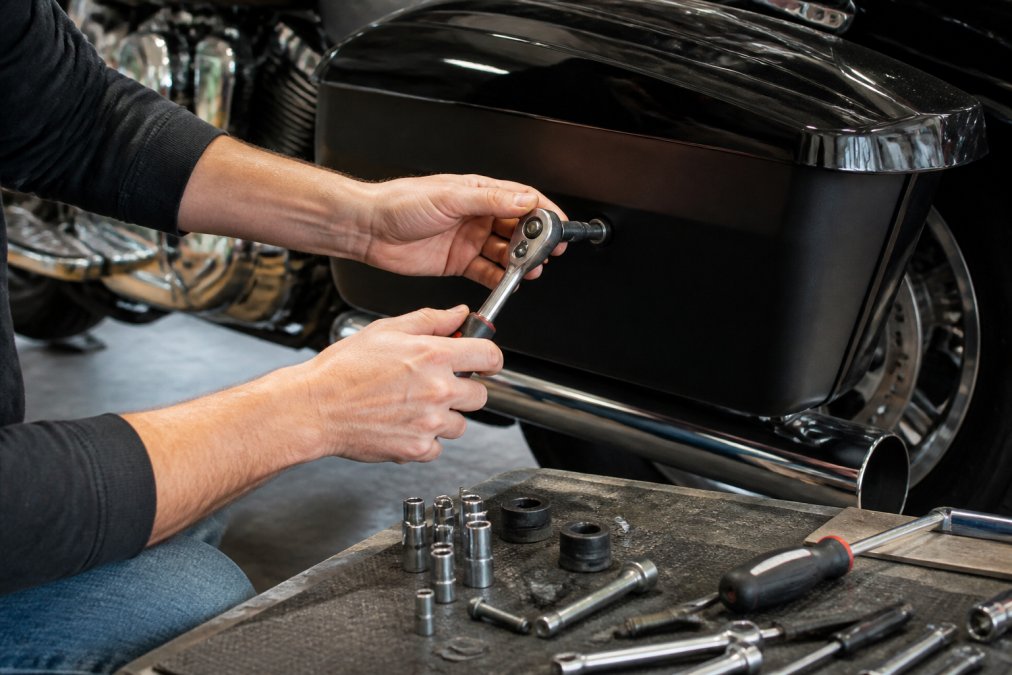
The most effective single upgrade is replacing the stock mounting bolts with hardened security bolts that require a specialized tool to remove. They feature heads that accept only a unique key or bit, so a thief carrying standard hex keys or sockets cannot easily loosen them.
Installation takes about 30 minutes with basic hand tools (revzilla.com). Remove the existing bolts, apply thread lock, and torque them to specification. This swap eliminates the easiest attack vector on your bags.
Step 2: Install a Locking Pin for Quick-Release Bags
If your Harley has quick-release saddlebags, the detachable mounting system is convenient but also a vulnerability, bags can often be lifted off the docking points in seconds without tools. A locking pin replaces the standard release mechanism and requires a key to detach the bag.
Look for a kit that uses a dedicated key rather than a shared master key. Installation is straightforward: remove the factory release pin, slide in the locking pin, and verify that the bag clicks securely into place. This upgrade is essential for riders who park in urban areas or at rallies where opportunistic theft is common.
Step 3: Add a Motorcycle Seat Lock for Harley Touring Models
On some touring models, removing the seat provides access to the saddlebag mounting hardware. A thief who can pop the seat can then unbolt the bags from the inside. A dedicated motorcycle seat lock for harley touring models closes this gap.
The Robert Becker Design seat lock replaces the factory seat latch and requires a key to release the seat. This prevents access to the hardware beneath the seat and protects valuables in the seat compartment. It is compatible with touring models including the Road Glide and Street Glide.
Step 4: Secure the Latch Mechanism Itself
Beyond the mounting points, the latch mechanism on the saddlebag lid is another area where stock hardware fails. Many factory latches can be popped with a flathead screwdriver or a specially shaped tool. A reinforced latch plate or a lock that covers the keyhole adds a layer of defense.
For bags with a central latch, consider a hasp or clamp-style lock that wraps around the latch area. This physically blocks access to the release mechanism. While less elegant than a flush-mounted lock, it is highly effective at deterring casual theft attempts.
How to Prevent Motorcycle Luggage Theft: Habits That Help
Hardware alone will not stop a determined thief, but good habits will make your bike a less appealing target. How to prevent motorcycle luggage theft starts with how you park. Always park in well-lit, high-traffic areas, and if possible, back your bike in so the bags face a storefront window or busy sidewalk.
Beyond parking, consider adding a trunk liner or internal organization system. A visible, organized interior makes it harder for a thief to quickly grab a loose item. When you leave the bike for extended periods, remove any electronics or valuables and take them with you. An empty bag is far less tempting than one that looks full.
The Anti-Theft Angle Competitors Miss: Securing Contents, Not Just the Bag
Most guides stop at locking the lid or the mounting bolts. What they ignore is that a thief who cannot remove the bag will often try to reach inside it, by cutting the leather, prying the latch, or fishing items out through a gap in the seal. Treat the interior as a separate security layer.
Use a locking trunk organizer or liner bag. A rigid or semi-rigid liner that zips shut and has its own lock loop adds a second barrier. Brands like Kuryakyn and Tour Master make liners with YKK zippers that can be secured with a small padlock through the zipper pulls. If a thief pops the lid, they still face a locked liner.
Anchor high-value items to the bag interior. Most touring saddlebags have pre-drilled mounting points or D-rings at the bottom. Use a short cable lock (12 to 18 inches, like the Master Lock 8285) threaded through a helmet or a small locked pouch. This prevents a grab-and-run theft.
Make the bag look empty from the outside. A sagging, bulging saddlebag signals valuables. Use a trunk liner or rigid insert to keep the bag's shape even when it is half-empty. A structured bag is harder to compress and harder for a thief to assess.
Parking Habits That Actually Reduce Theft Risk
Here is what works in practice based on how thieves operate:
- Back into a spot with the bags facing a storefront window or a busy sidewalk. This puts the bags in sight of people who would notice a pry bar or a screwdriver. Thieves avoid working in front of witnesses.
- Park next to a bike that is easier to steal. A bike with no security bolts, no seat lock, and stock latches will attract a thief first. Your layered hardware makes your bike the harder target.
- Use a disc lock on the front brake rotor. This does not secure the bags, but it slows down the entire bike theft process. A thief who cannot roll the bike away in 30 seconds is less likely to spend 5 minutes on your saddlebags.
- Do not park next to a van or a large SUV. These vehicles block sightlines and provide cover for a thief to work on your bags out of view. Leave a gap on at least one side so passersby can see the saddlebags.
The 60-Second Walk-Around Check
Before you walk away from your bike, do a quick 60-second check:
- Confirm the saddlebag lids are latched and locked, not just pushed shut.
- Verify the quick-release pins are in the locked position, not just seated.
- Check that the seat lock is engaged and the seat does not wiggle.
- Zip the trunk liner shut and route the cable lock through the D-ring.
- Look at the bag from the side, if it bulges, redistribute weight or remove items.
This routine takes less than a minute and eliminates the most common failure point: a rider who thinks they locked the bag but only pushed the lid down.
What to Do If You Park in a High-Theft Area Overnight
If you must leave the bike overnight in a hotel parking lot or a public garage, do not rely on the saddlebags alone. Remove the liner or any visible valuables and take them to your room. For the bags themselves, consider a secondary anchor: a heavy-duty chain (like a Kryptonite New York Fahgettaboudit chain) looped through the saddlebag mounting bracket and around a fixed object. This is overkill for a day trip but appropriate for overnight parking in urban areas.
A final habit that pays off: photograph your saddlebags and their contents before a long trip. If theft does occur, you will have a record for insurance claims and police reports. Most riders skip this step and then struggle to document what was lost.
Common Mistakes to Avoid When Locking Saddlebags
A common mistake is using the same key for your ignition and saddlebags. While convenient, a thief who compromises your ignition can open your bags. Use a separate, dedicated key for your security hardware. Another frequent error is neglecting lock cylinder maintenance; dirt and moisture can cause them to seize.
Riders also often overlook weight distribution. Overloading one saddlebag can stress the mounting hardware and make the latches easier to force. Keep heavy items low and centered. Finally, do not assume a locking lid means the bag is secure to the bike, always verify that the mounting hardware and quick-release pins are locked.
Mistake 1: Ignoring Weight Distribution and Its Effect on Handling
Most riders stuff the left saddlebag with tools and the right one with a rain suit, then wonder why the bike pulls to one side. On a Harley touring model, the saddlebags sit behind the rear axle. Uneven weight distribution changes the center of gravity and can make the rear end feel unstable in crosswinds.
Keep the total weight in both saddlebags under 20 pounds combined, and split the load so the difference between left and right is no more than 5 pounds (honda.com). Heavier items, tools, a chain lock, a tire repair kit, should sit at the bottom, close to the mounting bracket. Lighter items like raingear can go on top.
For riders with a trunk, the same principle applies. The trunk is the highest storage point on the bike. Loading it with more than 10 pounds raises the center of gravity and makes the bike feel top-heavy in corners (harley-davidson.com). Keep the trunk for light items and reserve the saddlebags for heavier gear.
Mistake 2: Forgetting That a Locked Lid Does Not Mean a Sealed Bag
A locked saddlebag keeps out thieves, but it does not automatically keep out water. The factory rubber gasket around the lid compresses over time and can crack or flatten, especially after sun exposure. If you find damp gear inside your bag, the gasket is likely the culprit.
Inspect the gasket every spring. Run your finger along the entire edge, if you feel cracks, tears, or flat spots, replace it. Harley-Davidson sells replacement gaskets for most touring saddlebags, and aftermarket options from Kuryakyn fit the same channels. Apply a thin layer of silicone grease twice a year to keep it pliable.
Moisture inside the bag is a separate problem. Even with a good seal, condensation can form when warm air cools overnight. A small silica gel desiccant pack (like the Eva-Dry E-333) absorbs moisture and prevents mildew. Place one in each saddlebag and recharge it monthly.
Mistake 3: Using a Trunk Liner That Does Not Fit Your Bag
Trunk liners and saddlebag liners are not one-size-fits-all. A liner that is too large will not let the lid close fully, defeating the seal and putting pressure on the latch. A liner that is too small shifts around and does not protect your gear.
Measure the interior of your saddlebag before buying a liner. Most Harley touring saddlebags have an interior volume of roughly 1.5 to 2 cubic feet per side. Look for a liner that matches those dimensions. Brands like Tour Master and Cortech make liners in multiple sizes, and Harley-Davidson sells OEM liners shaped for models like the Road Glide and Street Glide.
When you install the liner, make sure it sits flat against the bottom and does not bunch up at the corners. A wrinkled liner creates pressure points that can wear through the bag's interior lining over time.
Mistake 4: Skipping Regular Lock Cylinder Maintenance
Lock cylinders on saddlebags and seat locks collect dust, road grime, and moisture. A cylinder that is not lubricated will eventually stick, creating a security risk, either you cannot lock the bag or you cannot open it.
Use a dry PTFE lubricant (like Tri-Flow) or graphite powder designed for locks. Spray a small amount into the keyhole, insert the key, and turn it several times. Do this every 60 to 90 days, or more often in wet or dusty conditions. Avoid WD-40 or oil-based lubricants, they attract dirt and gum up the cylinder.
Mistake 5: Treating All Saddlebag Locks as Equal
Not all saddlebag locks provide the same level of security. A stock Harley lock cylinder uses a simple disc detainer mechanism that can be picked or raked in under a minute. Aftermarket locks from companies like Robert Becker Design use a more complex keyway and hardened steel components that resist picking and drilling.
When you upgrade your locks, check whether they are compatible with your existing key. Some aftermarket locks can be keyed to match your ignition, which is convenient but reduces security, a thief who compromises your ignition can open your bags. A dedicated key for your saddlebag and seat locks is the safer choice.
Mistake 6: Ignoring the Mounting Points When You Lock the Lid
A locked lid is only half the battle. If the mounting bolts are stock, a thief can remove the entire bag in under a minute with a hex wrench. Always pair a lid lock with hardened security bolts on the mounting bracket.
Before every long ride, check the torque on the security bolts. Vibration can loosen them over time. A quick check with a torque wrench (set to the manufacturer's specification, typically 15 to 20 foot-pounds) takes two minutes and prevents a bag from rattling loose at highway speed.
Conclusion: Secure Your Saddlebags Before Your Next Ride
Theft protection is not about a single gadget; it is about a system of layered defenses that make your harley saddlebags too difficult to steal quickly. Upgrading your mounting bolts, adding a locking pin, and securing your seat with a dedicated motorcycle seat lock for harley touring models will deter all but the most determined thieves. Robert Becker Design builds these locks for riders who park in the real world. Our hardware is designed by an avid Harley rider and fits stock and aftermarket touring models, including Indian motorcycles. Get started with Robert Becker Design and ride with the confidence that your gear stays where you left it.
Frequently Asked Questions
Are Harley-Davidson saddlebags easy to steal?
Stock Harley saddlebags are vulnerable because the factory latches and quick-release mechanisms are often accessible without tools. A thief can open the bag or remove it from the bike in under a minute. Replacing the standard mounting hardware with saddlebag security bolts and adding a locking pin for the release mechanism removes that easy access. These upgrades force a thief to use power tools, which takes time and draws attention. That extra effort usually sends them to an easier target.
What is the best way to lock Harley touring saddlebags?
The best approach uses layered security. Start by replacing the factory mounting bolts with saddlebag security bolts that require a special key or tool to remove. Then install a locking pin on the quick-release mechanism so the bag cannot be detached from the bike. If your touring model has a detachable seat, add a motorcycle seat lock for Harley touring models, since the seat often hides the hardware that releases the bags. Each layer adds time and noise to a theft attempt.
Do I need a security kit for my motorcycle saddlebags?
If you park your Harley in public areas, at work, or overnight outside, a saddlebag security kit is a worthwhile investment. Factory hardware is designed for convenience, not theft resistance. A basic kit typically includes locking pins and security bolts that replace the standard parts. Installation takes about 30 minutes with basic hand tools and does not require drilling or permanent modification. For riders who carry helmets, tools, or electronics in their bags, the protection is worth the cost.
Are aftermarket saddlebag locks worth the investment?
Aftermarket saddlebag locks are worth it when they replace a weak point rather than just adding another key. The most effective upgrades are saddlebag security bolts that use a unique key pattern and locking pins that block the quick-release lever. These address how thieves actually steal bags: by undoing the mounting hardware or release mechanism. Cheaper locks that only secure the latch do not stop someone from removing the entire bag. Focus on upgrades that secure the bag to the bike.
This article was written using GrandRanker