
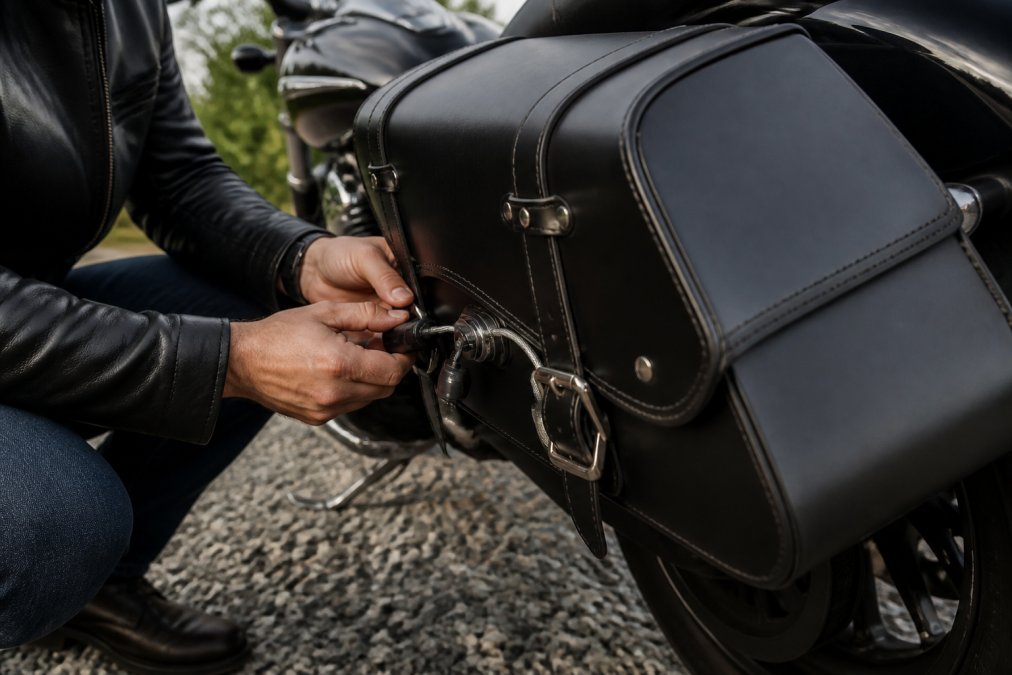
Table of Contents
- Why Saddlebag Theft Happens and What You're Up Against
- How to Secure Motorcycle Saddlebags: Step-by-Step
- Best Motorcycle Saddlebag Security Locks for Hard and Soft Bags
- How to Prevent Saddlebag Theft on Touring Bikes
- Motorcycle Seat Lock for Harley Touring: Securing the Whole Bike
- DIY Modifications and Common Mistakes to Avoid
- Conclusion
- Frequently Asked Questions
Last Updated: September 10, 2026
Why Saddlebag Theft Happens and What You're Up Against
Saddlebag theft is rarely a sophisticated operation. It is almost always opportunistic theft: a thief spots a quick-release latch, pops the bag off in seconds, and walks away with hundreds of dollars in luggage and gear. According to National Insurance Crime Bureau reports on vehicle accessory theft, motorcycle accessory and component theft continues to be a persistent problem in urban parking environments.
At Robert Becker Design, we've studied how thieves defeat factory hardware: stock mounting systems are engineered for convenience, not security. The same quick-release latches that let you remove a bag at a hotel curb let a stranger remove it at a stoplight.
Securing your luggage isn't about one product. It's a layered system: hard mounting points, locking hardware, and visual deterrents working together. Below, we'll show you how to secure motorcycle saddlebags the way professional touring riders do.
How to Secure Motorcycle Saddlebags: Step-by-Step
Securing saddlebags takes 30 to 60 minutes with basic hand tools, no shop needed. The process works for hard cases and soft bags, though the hardware differs.
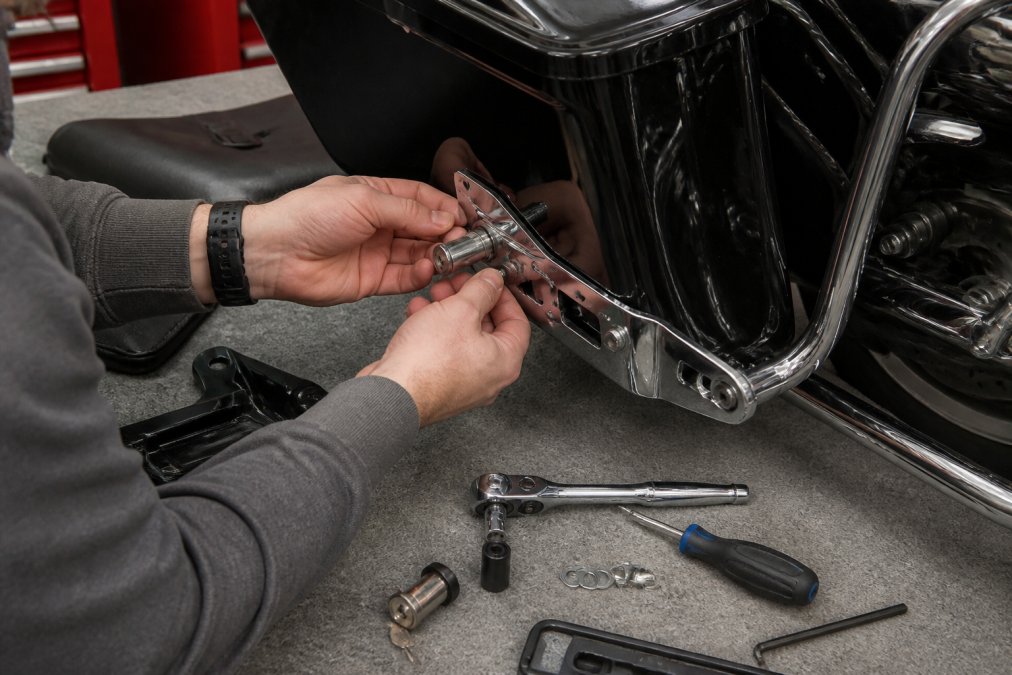
Step 1: Assess Your Saddlebag Mounting Hardware
Start by identifying how your bags attach. Hard cases use quick-release latches or docking hardware; soft bags rely on straps, buckles, or a luggage rack. Note every removable point and check for exposed fasteners a thief could unscrew by hand.
Pay special attention to the quick-release mechanism, where most thefts happen. Common systems each have a known weakness:
- Docking spools and grommets (common on touring hard bags): the bag lifts straight up off two or three posts. If the retention clip is spring-loaded and exposed, a thief can depress it with a flathead screwdriver and lift the bag off in under ten seconds.
- Lever-and-cam latches: a single lever releases the bag. If the lever is not lockable, it is the entire security system.
- Strap-and-buckle soft bags: the buckle is the weak point. A thief with a knife cuts the strap, or simply unbuckles it if the buckle is not locked.
- Bolt-on hard bags: these are the most secure from the factory, but only if the bolts are security fasteners. Standard hex bolts back out with a multi-tool.
Walk around the bike and try to remove each bag by hand, no tools. Time it. If you can do it in under a minute, so can a thief. Write down every fastener size (common sizes are 5mm and 6mm hex, and 10mm and 13mm wrench) so you buy the right hardware the first time.
Step 2: Replace Quick-Release Latches with Locking Pins or Security Bolts
This is the highest-impact upgrade. Swap standard quick-release latches for locking pins or security bolts that require a key or specialized tool, converting a five-second theft into a multi-minute struggle most thieves won't tolerate.
Concrete options, from least to most secure:
- Keyed locking pins: replace the factory pin with a pin that has a keyed head. The bag still comes off with the key, so you keep daily convenience. This defeats the grab-and-go thief but not someone with a pick or a drill.
- Security Torx or hex bolts (the pin-in-head style, often called tamper-resistant Torx or "security bits"): these require a hollow-tip driver that most casual thieves do not carry. They are cheap and effective against opportunity theft. The trade-off is that you must carry the matching bit to remove your own bag.
- Nylon-insert lock nuts (nyloc) on the mounting bolts: the nylon collar resists vibration loosening and makes the nut hard to spin off by hand. Pair these with security bolts for the best result.
- Thread-locking compound on non-removable fasteners: a medium-strength compound stops a bolt from backing out under vibration and adds resistance to hand removal. Use medium, not high strength, or you will not get the bolt out yourself.
A note on torque: over-tightening security bolts is the most common self-inflicted failure. Snug plus a quarter turn is usually enough on saddlebag brackets; stripping threads or cracking the bracket costs more than the lock. If you have a torque wrench, follow the factory spec.
Step 3: Add Cable Locks or Steel Mesh Nets for Soft Bags
Soft bags can't use rigid locking hardware, so thread a security cable through the bag's frame and anchor it to the bike. Steel mesh nets wrap the entire bag and lock at a single point, also protecting against slash-and-grab theft.
What matters is the cable rating, not the lock. A vinyl-coated braided steel cable in the 8mm to 12mm range resists hand cutters; anything thinner is only a delay tactic (peer-reviewed research). Look for motorcycle or powersports ratings, not bicycle, a bicycle-rated cable is typically 4mm to 6mm and cuts in seconds.
For soft bags specifically:
- Run the cable through the bag's internal frame or D-rings, not just the strap, so a thief cannot cut the strap and slide the bag off the cable.
- Anchor to a fixed point on the bike frame or the luggage rack, not to another removable accessory.
- If you use a mesh net, lock it at a single point and make sure the lock body is not exposed to a simple twist attack. A shrouded padlock or a disc-style lock resists shimming better than an exposed shackle.
Step 4: Layer Physical Deterrents with Alarms and Covers
A bike cover hides your luggage from casual view, and a motion-sensing alarm adds noise and attention, the two things a thief wants least. Layer these with your locking hardware rather than relying on any single device.
Two alarm types fit this job: a tilt or motion sensor built into the bike's security system, and a standalone cable alarm that sounds if the cable is cut or the lock tampered with. The standalone cable alarm fits saddlebag protection best because it guards the exact attack point.
Covers work best when fitted and lockable at the bottom. A loose cover gives a thief a look underneath; a fitted cover with a lockable hem keeps bags out of sight and adds a step to the theft.
| Step | What You Do | Time Needed | Theft Risk Reduced |
|---|---|---|---|
| 1 | Assess mounting hardware and time your own removal | 5-10 min | Identifies weak points |
| 2 | Install locking pins or security bolts | 15-20 min | Defeats quick-release theft |
| 3 | Add cable locks or steel mesh nets | 10-15 min | Protects soft bags |
| 4 | Add alarm and bike cover | 10 min | Adds deterrence layer |
Best Motorcycle Saddlebag Security Locks for Hard and Soft Bags
The right lock depends on bag type. For hard cases, locking pins and security bolts that replace factory latches offer the strongest protection because they mount into existing hardware. For soft bags, cable locks and steel mesh nets are the practical choice since there's no rigid structure to bolt into.
Robert Becker Design builds theft prevention locks engineered specifically for touring motorcycles, including specialized locks for saddlebags, seats, and mounting arms. The hardware fits stock and aftermarket mounting points, so there's no drilling or fabricating brackets. The designs come from an avid Harley rider, so the fit reflects how these bikes are actually set up.
For riders on Indian models or newer touring bikes, compatibility matters as much as strength. Confirm the lock is built for your specific mounting system before buying.
How to Prevent Saddlebag Theft on Touring Bikes
Preventing saddlebag theft on touring bikes combines hardware with habits. Touring riders carry more gear and park in unfamiliar places, raising exposure. Riders who avoid theft treat security as a routine, not an afterthought.
Parking Strategies That Cut Theft Risk
Park in well-lit, high-traffic areas where a thief would be seen. Back the bike toward a wall or pillar so the saddlebags sit against a barrier. Overnight, bring removable bags inside. A common mistake is parking in a secluded spot for "safety" from traffic, which gives a thief the privacy they want.
Parking strategy depends on location, since theft patterns differ between urban parking and remote touring stops:
- Urban and event parking: thieves work fast and in volume. Park where a camera or a storefront window faces the bike, and prefer a spot with foot traffic over a quiet corner of a garage. Garage stairwells and elevator lobbies are high-traffic and high-visibility, which is what you want. Avoid the end of a row where the bike is screened from view.
- Overnight hotel and motel lots: request a room with a view of the lot, or park directly under a light and a camera. If the lot is unattended, bring the bags in. This is the single most effective overnight step, and it costs nothing.
- Remote and adventure touring stops: at trailheads, campsites, and rural diners, the threat shifts from quick grab to a thief with time and tools. Here, hardware matters more than visibility. Lock the bags to the bike frame, not just to the mounting bracket, and take the valuables with you even if the bags stay.
- Long-term storage: if the bike sits for weeks, remove the bags entirely and store them indoors. No lock beats an empty mounting bracket.
Psychological Deterrents: Make Your Bike Look Like a Bad Target
Most saddlebag theft is opportunistic, meaning the thief is choosing between your bike and an easier one. Visual cues signaling "this will take time and make noise" push a thief to the next bike. These cost little and work alongside your hardware:
- Visible, oversized locks: a bright, heavy-looking lock on the bag or cable is a signal. A thief reads it as time and risk. A small, hidden lock does not send that signal.
- Deterrent stickers: a small sticker reading "Alarmed" or "GPS tracked" near the bag or on the cover changes the calculation for a casual thief. Use these honestly, alongside a real alarm, so the signal is credible.
- A fitted, locked cover: hiding the bags removes the visual reward. A thief who cannot see what is under the cover has to commit before knowing if it is worth it.
- A dummy camera or a real one: a small camera pointed at the parking spot, or a visible camera housing, adds a witness the thief cannot identify. If you use a real camera, a cheap dash-style or trail camera mounted nearby can capture a face and a plate.
- Parking next to a more attractive target: this is not a joke. If you must park in a risky area, park beside a bike with unlocked, exposed bags. Thieves take the path of least resistance.
Quick-Release Vulnerabilities: Which Systems Fail First
Not all quick-release systems are equally vulnerable, and knowing yours tells you where to spend money. The most theft-prone systems have an exposed, spring-loaded release operable without a key. Systems that hold up have a release that is keyed, shrouded, or requires a tool the thief didn't bring.
To harden a vulnerable system specifically:
- If your bag releases with a lever, add a locking pin or replace the lever with a keyed version.
- If your bag lifts off docking spools, add a locking pin through the spool or a security bolt that blocks the lift path.
- If your bag is held by exposed bolts, swap them for security Torx or pin-in-hex fasteners and add nyloc nuts.
- If your bag uses a strap and buckle, add a cable through the bag frame and lock it to the bike, so cutting the strap does not free the bag.
The goal is not to make the bag impossible to remove. It is to make removal slow, loud, and obvious, so the thief moves on.
Insurance, Documentation, and What to Do After a Theft
Document your luggage and contents with photos and receipts before anything happens, insurers ask for proof of value at claim time. Photograph the bags mounted on the bike, the mounting hardware, and the contents laid out with serial numbers visible. Keep receipts for the bags and high-value contents in a cloud folder, not in the bags.
If a theft occurs, file a police report immediately, most insurers require it (naic.org). Get the report number and officer's name, then notify your insurer with the photos, receipts, and report number together.
Check your policy for whether accessories and luggage are covered under comprehensive coverage or need a separate rider. Two details trip up riders most often:
- Coverage limits on accessories: many policies cap accessory coverage at a fixed dollar amount or a percentage of the bike's value. If your bags and contents exceed that cap, you need a rider.
- Quick-release exclusions: some policies treat quick-release luggage as removable property rather than part of the motorcycle, which can move it under a homeowner's or renter's policy with a different deductible. Review how your bags attach before you assume you are covered.
A common pattern is a rider who documents the bike but not the luggage, then discovers at claim time that the bags were never scheduled. Ten minutes with a phone camera and a folder prevents that.
Motorcycle Seat Lock for Harley Touring: Securing the Whole Bike
A motorcycle seat lock for Harley touring models closes a gap most riders ignore. Seats, especially aftermarket solo seats, are as easy to steal as saddlebags and often worth more. Robert Becker Design makes dedicated seat locks for touring models, including Tri Glide, Freewheeler, and Road Glide 3 trikes, protecting factory and aftermarket seats.
The logic is the same as with luggage: if it unbolts quickly, it walks. A locking mechanism on the seat turns a two-minute removal into a job that requires tools and time. Pair a seat lock with your saddlebag hardware and you've secured the two most commonly stolen components on a touring bike.
DIY Modifications and Common Mistakes to Avoid
DIY security modifications can work well, but a few mistakes undermine the effort. The most common is a cheap padlock on a thin cable, which a thief cuts in seconds. Another is relying on a single deterrent, such as a cover alone, which hides the bag but doesn't stop removal.
Watch for these specific pitfalls:
- Using an Allen head bolt that a thief can back out with a standard multi-tool
- Forgetting to secure the mounting hardware itself, leaving the whole assembly removable
- Skipping documentation, which weakens an insurance claim after a theft
- Ignoring tamper-proof fasteners such as nylon nut designs that resist drill-through
A common mistake is over-tightening security bolts and stripping the mounting threads, which can crack the bracket. Snug is enough.
Conclusion
Saddlebag theft is a problem of convenience, and the fix is to remove that convenience. Locking pins, security bolts, cable locks, and a layered deterrent system turn an easy target into a frustrating one. For riders who want hardware built for the job rather than adapted to it, Robert Becker Design offers theft prevention locks engineered specifically for touring motorcycles, including specialized saddlebag locks, seat locks for Harley touring models, and mounting arm protection. Get started with Robert Becker Design and protect your investment with hardware designed by riders, for riders.
Frequently Asked Questions
Are motorcycle saddlebags easy to steal?
Factory saddlebags on most touring bikes use quick-release latches that can be opened in seconds with no tools. Opportunistic thieves target these because the bags often hold expensive gear. Hard cases with locking mechanisms are harder to steal, but the mounting hardware itself is frequently the weak point. Replacing quick-release pins with locking pins or security bolts makes removal far more difficult and forces a thief to spend time they usually don't have.
What is the best way to lock motorcycle saddlebags?
The most effective approach combines locking pins or security bolts on the mounting hardware with a cable lock threaded through the bag frames and secured to the bike. For soft bags, a steel mesh net or heavy-duty cable lock works well. Hard cases benefit from tamper-proof bolts and a padlock on the latch. Layering two or more deterrents makes the theft take longer, which is often enough to send a thief looking for an easier target.
Do aftermarket saddlebag locks actually work?
Yes, when they address the real vulnerability. Many factory saddlebags rely on quick-release latches that pop open without tools. Aftermarket locking pins, security bolts, and cable locks replace or reinforce those weak points. The key is matching the lock to your specific mounting hardware. Products designed for Harley-Davidson and Indian touring models tend to fit better than universal solutions because they account for factory mounting points and aftermarket accessories.
What are the most effective motorcycle theft deterrents for touring bikes?
A layered approach works best. Start with locking pins or security bolts on saddlebag mounts, add a cable lock or steel mesh net, and use a bike cover to hide luggage from casual view. An alarm system or motion sensor adds a noise deterrent. Parking in well-lit, high-traffic areas and using a fork lock or disc lock rounds out the strategy. No single device stops every thief, but multiple layers make your bike a harder target than the one parked nearby.