
Last Updated: November 5, 2026
Quick Summary
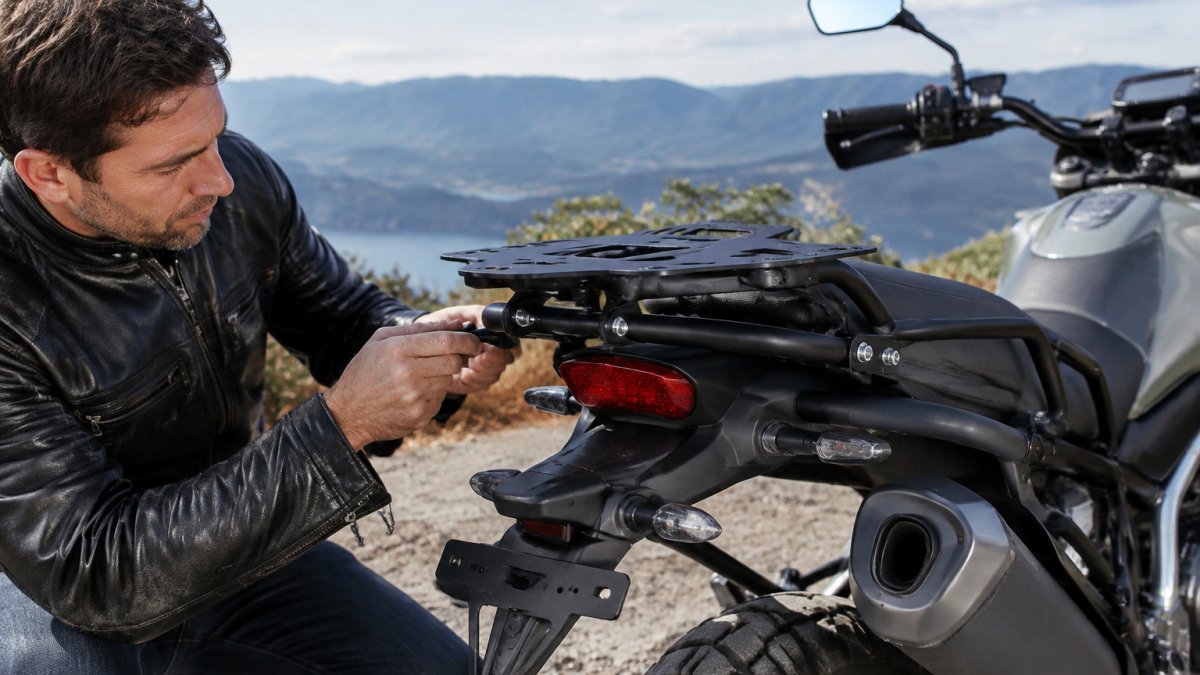
Motorcycle luggage racks are targets for theft because they hold high-value, easily removed parts, and most riders never lock the hardware that holds them on. A rack is a mounting platform for top cases, saddlebags, tank bags, and GPS units, and every one of those items has a buyer. Thieves also exploit quick-release mounts and standard bolts that any socket set can undo.
- Lock every removable accessory to the rack, then replace rack mounting bolts with security fasteners.
- Security Torx, one-way screws, and locking fasteners slow removal compared with standard hex bolts.
- Installing locking fasteners takes basic tools and about 20 minutes per rack.
- Match security layers to parking duration, from brief stops to long-term unattended storage.
- Lock the bag to the bike, not just the bag's own zipper, since thieves target the mount.
Table of Contents
- Why Motorcycle Luggage Racks Are Targets for Theft
- How to Prevent Motorcycle Accessory Theft at the Rack
- Motorcycle Rack Security Bolts and Tamper-Resistant Fasteners
- Motorcycle Luggage Theft Prevention: Parking and Layering
- Motorcycle Saddlebag Locks and Protecting Removable Cargo
- Security Trade-Offs and Failure Modes to Know
- Choosing Rack Security Hardware That Fits Your Bike
- Frequently Asked Questions
Why Motorcycle Luggage Racks Are Targets for Theft
Motorcycle luggage racks are targets for theft because they hold high-value, easily removed parts, and most riders never lock the hardware that holds them on.
This guide covers why racks get hit, how thieves work, and how to lock yours down.
The short version: a rack is a theft hotspot because it is exposed, predictable, and usually bolted on with standard fasteners that any socket set can undo.
High resale value and demand for quick-release hardware
Thieves follow demand. Touring riders spend real money on luggage systems, and the parts move fast on the resale market.
Quick-release mounts make this worse. They are designed for convenience, which means they are designed to come off fast.
The rack itself is also valuable.
Here is what makes a rack attractive:
- Removable accessories clipped on with quick-release mounts
- Standard bolts holding the rack to the frame
- Exposed attachment points with nothing covering them
That combination is why motorcycle luggage racks sit near the top of the list for accessory theft.
How to Prevent Motorcycle Accessory Theft at the Rack
Start with the parts that come off easiest. If a top case or tank bag lifts off without a key, it will leave without one.
Next, look at the rack's own mounting hardware. Standard hex bolts are the weak link. Anyone with a socket set can back them out.
A practical order of operations:
- Lock every removable accessory to the rack.
- Replace rack mounting bolts with security fasteners.
- Use a chain or cable lock to tie the rack to a fixed object.
- Remove valuables and small bags entirely.
- Park where people can see the bike.
The National Insurance Crime Bureau tracks vehicle and accessory theft patterns, and the pattern holds: opportunity drives theft more than skill does.
Motorcycle Rack Security Bolts and Tamper-Resistant Fasteners
Motorcycle rack security bolts are often overlooked, but the fastener is only half the story.
Start by identifying which rack type you have, because each one fails differently.
- Bolt-on racks attach with fixed brackets and standard hex or Torx bolts threaded into the frame, subframe, or a dedicated mounting plate. They are the most secure design when the fasteners are upgraded, because there is no release mechanism to defeat. The weak link is the bolt head itself.
- Quick-release racks use a latch, pin, or keyed detent so the rack lifts off for cleaning or storage. That convenience is the vulnerability: a thief who knows the release tab, or who can reach the latch with a pick or a firm pull, can have the rack off in seconds. Quick-release hardware is the first thing to lock or replace on a touring bike.
- Integrated and factory racks are often molded into the tail section or bolted through plastic panels. They are harder to remove whole, but the exposed bolts and the accessory mounts on top are still easy targets, and plastic panels can be pried or broken to reach the hardware underneath.
Then map the attachment points.
Tamper-resistant fasteners come in a few common types:
- Security Torx with a center pin that blocks standard bits
- One-way screws that drive in but cannot be backed out
- Locking fasteners with a keyed head
The goal is not to make the rack impossible to steal. It is to make it slower and more conspicuous than the rack beside it with standard hex bolts.
Installation guide for locking fasteners
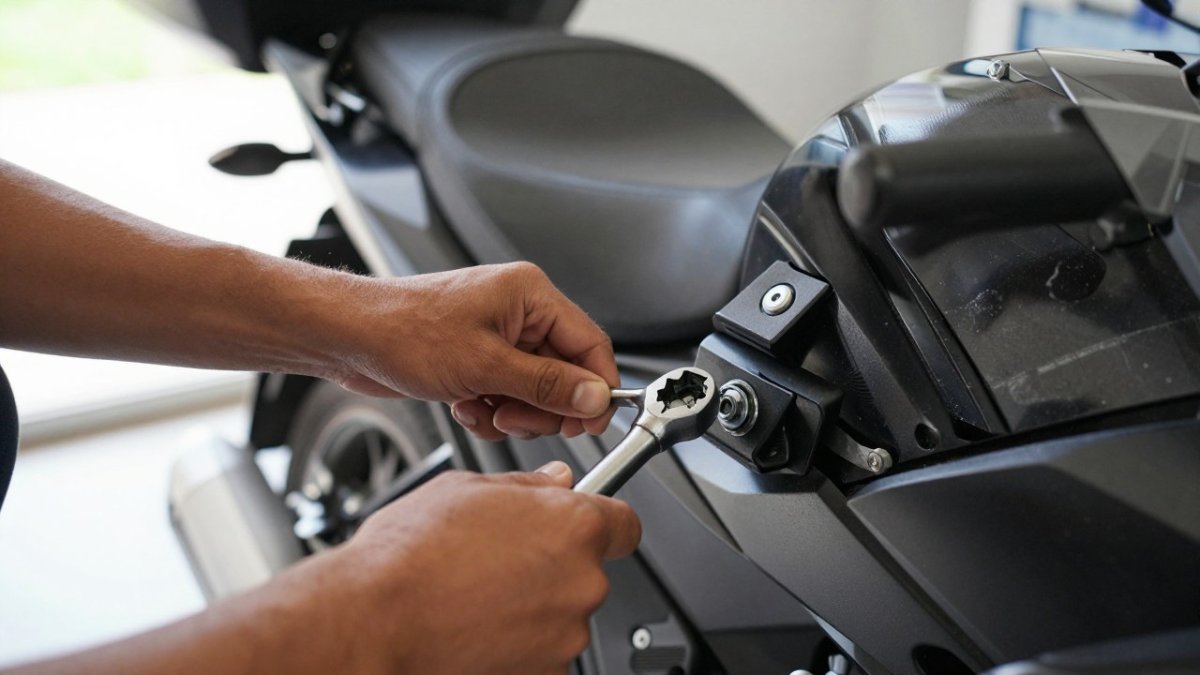
Installing locking fasteners takes basic tools and about 20 minutes per rack. You do not need a shop, but you do need to work carefully, because a stripped security bolt is a problem you cannot undo with the same ease as a standard one.
What you need:
- Replacement security bolts sized to your rack
- The matching security bit or key
- A socket wrench or driver
Steps:
- Remove the existing bolts one at a time so the rack stays aligned and you do not lose the mounting position.
- Clean each threaded hole of dirt and old thread-locker with the rag.
- Apply a small drop of thread-locking compound to the new bolt. More is not better; excess compound can seize the bolt permanently.
- Hand-thread the security bolt into place to avoid cross-threading.
- Torque it to the rack maker's spec, not tighter. If you do not have a spec, snug plus a quarter turn is a reasonable ceiling for most M6 and M8 rack bolts.
- Confirm the rack is snug with no wobble, then check the other attachment points.
- Keep the security bit on your keyring, not in the bike's tool kit. A bit left under the seat is a bit a thief can use.
Watch out: over-tightening a security bolt can strip the head, and then you cannot remove it either.
If you would rather not source individual bolts, Robert Becker Design builds locking hardware for saddlebags, seats, and mounting arms.
Motorcycle Luggage Theft Prevention: Parking and Layering
Motorcycle luggage theft prevention comes down to two things: where you park and how many layers stand between a thief and your gear. A locked rack in a dark corner still loses to an unlocked rack under a streetlight, and the right number of layers depends on how long the bike sits and who can see it.
Park strategically. Choose well-lit parking with foot traffic and, where possible, a camera in view. Back the bike in so the rack side faces the open, visible area.
Use parking duration and location as a decision framework:
- Brief stops (under 15 minutes), high-traffic lot or street: the main risk is opportunistic grab-and-go. Lock or remove the top case and tank bag, keep the rack hardware locked, and park where people pass. A disc lock is optional here; visibility does most of the work.
- Medium stops (15 minutes to a few hours), public lot or restaurant: add a cable lock through bag handles and the rack, and a chain or disc lock if you carry one. Park near the entrance or under a light, and take valuables with you rather than leaving them in a locked bag.
- Overnight parking, hotel or apartment lot: layer everything. Chain the frame to a fixed object, cable the luggage to the rack, use the rack's security fasteners, and park under a light or camera if one exists. Empty the bags so there is nothing worth taking, and consider a cover, which hides what is mounted and slows a casual thief.
Then layer the defenses to match:
- A disc lock on the front wheel to stop the roll-away
- A chain lock through the frame and around a fixed object
- A cable lock threaded through luggage handles and the rack
The longer the bike sits unattended, the more layers you want, and the more the rack itself needs to be locked to the frame rather than just the bags locked to the rack.
Match your security layers to how long and where the bike sits.
| Parking situation | Duration | What to do |
|---|---|---|
| High-traffic lot or street | Under 15 minutes | Lock or remove top case and tank bag; keep rack hardware locked |
| Public lot or restaurant | 15 minutes to a few hours | Add cable lock through bag handles and rack; take valuables |
| Hotel or apartment lot | Overnight | Chain frame to fixed object, cable luggage, empty bags, consider cover |
| Unattended storage | Long term | Treat like overnight plus tracker or alarm and indoor or fenced storage |
Motorcycle Saddlebag Locks and Protecting Removable Cargo
Motorcycle saddlebag locks close the easiest theft path on a touring bike. Saddlebags, tank bags, and top cases are the first things a thief checks, because they often hold phones, tools, and gear, and because they lift off fast.
Lock the bag to the bike, not just the bag's own zipper. A locked bag that unclips from the rack is still gone.
For removable cargo:
- Use saddlebag locks on stock and aftermarket bags
- Run a cable lock through bag handles and the rack frame
- Take tank bags and small bags with you
A common mistake is locking the bag shut but leaving the quick-release mount open. Thieves target the mount, not the zipper.
Security Trade-Offs and Failure Modes to Know
Every security choice carries a trade-off, and knowing the failure modes helps you pick the right mix. More security means more time at every stop. Less security means more risk.
The main trade-offs:
- Convenience versus time. Quick-release hardware is fast for you and fast for a thief.
- Weight versus coverage. Heavy chain locks stop more, but you have to carry them.
- Cost versus layers. One expensive lock beats nothing, but two cheaper layers often beat one.
Failure modes to watch:
- A lock that binds to a removable part instead of the frame
- Security bolts that strip because they were over-torqued
- Cables cut in seconds because they were thin
The real difference between a setup that works and one that fails comes down to whether the lock connects the valuable part to something that cannot walk away.
Choosing Rack Security Hardware That Fits Your Bike
Choosing rack security hardware starts with fit. A lock that does not match your mounting points is a lock you will not use.
At Robert Becker Design, we build theft prevention hardware for Harley-Davidson, Indian, and other touring models, including locks for saddlebags, seats, and mounting arms.
What to check before buying:
- Bolt size and thread pitch match your rack
- Clearance for your bags and top case
- Compatibility with stock and aftermarket mounts
If you are coming from a generic lock setup, expect a small learning curve on installation. Basic tools handle it.
For broader guidance on securing a bike, the Motorcycle Safety Foundation covers rider safety and theft awareness, and the Insurance Information Institute explains how coverage and documentation help after a theft.
Frequently Asked Questions
Are motorcycle luggage racks easy to steal?
Many factory and aftermarket racks attach with standard hex bolts and quick-release mounts, which means a thief with a basic tool set can remove one in under a minute. Racks that use quick-release hardware are the easiest target because no tools are needed at all. Swapping standard bolts for tamper-resistant fasteners and adding a locking mechanism raises the time and noise required, which is usually enough to push an opportunistic thief to an easier bike.
Can luggage rack mounting bolts be replaced with security fasteners?
Yes, in most cases. Match the thread pitch and length of your existing bolts, then install tamper-resistant bolts or locking fasteners at every attachment point, including the ones hidden under the seat or behind the saddlebags. Use a thread-locking compound so vibration does not loosen them on the road. Check torque against your model's service manual, and re-check the fasteners after the first few rides to confirm nothing has shifted.
What is the best deterrent for motorcycle theft?
Layering beats any single device. Park in a well-lit, high-traffic spot and lock the bike to a fixed object with a chain or disc lock, then add rack-specific hardware: security bolts on the mounting points, locks on saddlebags and quick-release mounts, and a cover to hide what is attached. A GPS tracker helps with recovery but does not stop the theft itself. Visible security is the point, because thieves pick the bike that looks like more work.
Should I remove a motorcycle luggage rack when it is not in use?
Removing the rack entirely is impractical for most touring riders, and repeated removal wears the mounting threads. A better routine is to strip the rack when you leave the bike: take off top cases, tank bags, and saddlebag contents, and lock or remove any quick-release accessory. If you park in a high-theft area for long stretches, a removable rack with a locking base is worth considering, since an empty, locked rack gives a thief far less to take.
Theft of motorcycle luggage racks is a preventable problem, and the fix starts with the hardware holding your gear on. Robert Becker Design builds locking hardware for saddlebags, seats, and mounting arms, designed by riders for touring bikes. Shop All and lock down your rack before the next ride.
