

Last Updated: November 8, 2026
Quick Summary
In the motorcycle alarm vs disc lock for storage decision, a disc lock is a physical immobilizer that stops the bike from rolling, while an alarm is a detection and deterrence device that only works if someone is close enough to hear it. Most storage setups need the lock first and the alarm second.
- A disc lock clamps through the front brake rotor so the wheel cannot complete a rotation.
- Fit the lock high on the rotor so the bike cannot be rolled before it hits the caliper.
- A wired alarm draws from the motorcycle battery, which can go flat during long storage.
- A cover over an armed motion-sensitive alarm is a common false-alarm generator.
- A reminder cable loops from the lock to the grip so you cannot ride off with it fitted.
Table of Contents
- Motorcycle Alarm vs Disc Lock for Storage: The Core Difference
- How a Disc Lock Stops a Motorcycle From Rolling Away
- Alarm Deterrence: What an Audible Alert Actually Does
- Choosing the Best Motorcycle Disc Lock for Your Storage Setup
- When a Motorcycle Disc Lock With Alarm Makes Sense
- Why a Motorcycle Disc Lock Reminder Cable Saves Your Forks
- Motorcycle Disc Lock How to Use It Correctly Every Time
- Layered Security: Pairing a Disc Lock With Saddlebag and GPS Locks
- Frequently Asked Questions
Motorcycle Alarm vs Disc Lock for Storage: The Core Difference
The core difference in the motorcycle alarm vs disc lock for storage decision is this: a disc lock is a physical immobilizer, while an alarm is a detection and deterrence device.
For storage, that distinction matters more than any spec sheet. A bike parked in the same spot for weeks is not being watched.
The short answer: a disc lock belongs on every stored motorcycle because it defeats the simplest theft method. An alarm adds a layer that works only if someone is close enough to hear it.
| Factor | Disc Lock | Alarm System |
|---|---|---|
| Primary job | Prevents rolling | Alerts and deters |
| Stops a roll-away | Yes | No |
| Works unattended | Yes | Depends on a listener |
| Power needed | None | Battery or bike power |
| False alarm risk | None | Real |
| Best for | Every storage setup | Short stops, busy areas |
Below, we break down where each device earns its place, how to choose the best motorcycle disc lock for your setup, and how to layer both without wasting money.
How a Disc Lock Stops a Motorcycle From Rolling Away
A disc lock clamps through the drilled holes of the front brake rotor. Once it is on, the wheel cannot complete a rotation, so the motorcycle cannot be pushed, wheeled, or rolled out of a parking space.
That is the whole mechanism, and it is why the device works.
Two limits matter. First, a disc lock does nothing against lifting. Second, placement matters.
Watch out: a disc lock fitted at the bottom of the rotor gives a thief a running start before the lock hits anything. Fit it high and the wheel barely moves.
Alarm Deterrence: What an Audible Alert Actually Does
An audible alert works as a deterrent only when someone is within earshot and cares enough to act. In a busy parking structure or hotel lot, a triggered alarm creates attention.
It also helps to separate two devices buyers routinely conflate. A standalone motorcycle alarm system is wired to the bike, draws from the motorcycle battery, and may include shock, tilt, ignition, and perimeter sensors, plus a two-way remote or GPS module. An alarmed disc lock is a self-contained unit with its own battery, clamped to the rotor, that sounds a siren when the wheel moves.
Where a standalone alarm system earns its keep
- The bike sits in a shared garage or attended lot where a manager, attendant, or neighbor will actually look
- The bike is ridden regularly, so the motorcycle battery stays charged and the alarm stays armed
- You want ignition or tilt detection in addition to noise, and you want the siren tied to the bike rather than to a removable puck
- You can mount the siren and sensor where a thief cannot reach them quickly
Where an alarmed disc lock earns its keep
- The bike is parked for hours, not weeks, and you want one device that immobilizes and announces
- You cannot or will not tap into the motorcycle's wiring
- You want the alarm to travel with the lock rather than stay with the bike
Where both underperform
Long-term storage is the weak spot for any battery-powered alarm. A disc-lock alarm running on a coin cell or small rechargeable pack will drain over weeks, and a dead alarm protects nothing.
Watch out: a cover over an armed motion-sensitive alarm is a common false-alarm generator.
The practical response question
Before you rely on noise, ask who is supposed to hear it and what they are supposed to do. In a busy lot, a bystander looks and the thief leaves. In a private garage, often nobody hears it.
Choosing the Best Motorcycle Disc Lock for Your Storage Setup
The best motorcycle disc lock for storage is the one that fits your rotor, resists cutting and drilling, and gets used every single time. Fit comes first. Rotor thickness and hole pattern vary across models, so check the lock's opening against your own rotor before buying, especially on aftermarket brake setups.
Then judge resistance and portability together. A heavier lock with a hardened shackle resists attack better but weighs down a jacket pocket. For storage, weight is a non-issue, so favor resistance. For daily riding, portability wins.
- Rotor fit: measure thickness and hole size before ordering
- Material: hardened steel over cast metal
- Lock mechanism: a disc-style or pick-resistant cylinder, not a simple keyway
- Weather sealing: a covered keyway keeps water and grit out
- Carry options: a pouch or holster reduces the chance you leave it home
One honest limitation: no disc lock is unpickable or uncuttable. For a broader look at how ratings work, the Sold Secure testing standard explains how locks are graded against real attack methods.
When a Motorcycle Disc Lock With Alarm Makes Sense
A motorcycle disc lock with alarm makes sense when your storage spot is exposed to foot traffic but not to long idle periods or weather extremes.
By location
- Private locked garage: A plain disc lock plus a cover does most of the work. The alarm adds little because no one is nearby to respond, and a motion-sensitive unit under a cover is a false-alarm machine. Spend the difference on a chain and ground anchor if the garage is detached or shared.
- Shared apartment or condo garage: The strongest case for an alarmed disc lock. Foot traffic is constant, residents and staff are nearby, and a siren turns a quiet wheel-away into an event. Pair it with a secured cover that does not flap.
- Outdoor street or driveway parking: Use both layers. A disc lock or alarmed disc lock stops rolling; a chain to a fixed object stops lifting; a cover hides the setup. Expect weather and battery to be the long-term weak points.
- Attended or paid lot: An alarmed disc lock plus a visible reminder cable is a reasonable single-device answer. The attendant is the listener the alarm depends on.
By duration
- Minutes to a few hours: An alarmed disc lock is at its best. The battery is fresh, the siren is armed, and someone is likely within earshot.
- Overnight: Still workable, but turn sensitivity down and secure the cover. This is where false alarms start costing you neighbors.
- Weeks: The alarm battery becomes the limiting factor. Check the unit's stated standby time and test it before you rely on it. A plain disc lock plus a cover plus a fixed anchor is the more reliable stack.
- Seasonal storage: Treat the alarm as a device to disable or remove, not to leave armed for months. A wired system can flatten the motorcycle battery; a disc-lock alarm can drain its own cell and sit silent. Store the bike locked, covered, and anchored, and re-arm when riding resumes.
Weather, battery, and long-term reliability
Outdoor and extended storage raise questions the spec sheet rarely answers. Look for a covered keyway and sealed electronics on the lock body, and check whether the alarm's battery is user-replaceable or rechargeable.
Insurance and local rules
Do not assume a disc lock or alarm changes your premium. Insurers vary, and many require a specific approved lock or a fixed anchor rather than any lock.
The trade-off to accept
Combined units are usually tuned to trigger on movement, and a stiff wind, a passing truck, or a neighbor brushing past can set them off. Adjust sensitivity down before you leave it armed overnight.
Why a Motorcycle Disc Lock Reminder Cable Saves Your Forks
A reminder cable is the cheapest insurance in motorcycling. It loops from the lock to the handlebar or throttle, so you cannot ride off without seeing it.
The sequence is brutal and common. A rider fires the engine, releases the clutch, and the front wheel locks instantly. The bike tips. The repair bill covers far more than any lock costs.
Use a bright cable, coil it through the lock body, and hook the free end over the grip. Some riders run the cable through the brake lever instead, which physically blocks the lever from being pulled.
Motorcycle Disc Lock How to Use It Correctly Every Time
Using a disc lock correctly takes about fifteen seconds and follows the same six steps every time. The routine matters more than the device, because a lock left in a saddlebag protects nothing.
- Park on firm ground with the front wheel straight
- Fit the lock high on the front rotor, through a drilled hole
- Check that the lock clears the caliper through a full range of wheel movement
- Attach the reminder cable to the lock and loop it over the grip
- Confirm the lock is fully engaged and the key removed
- Cover the bike if it sits overnight
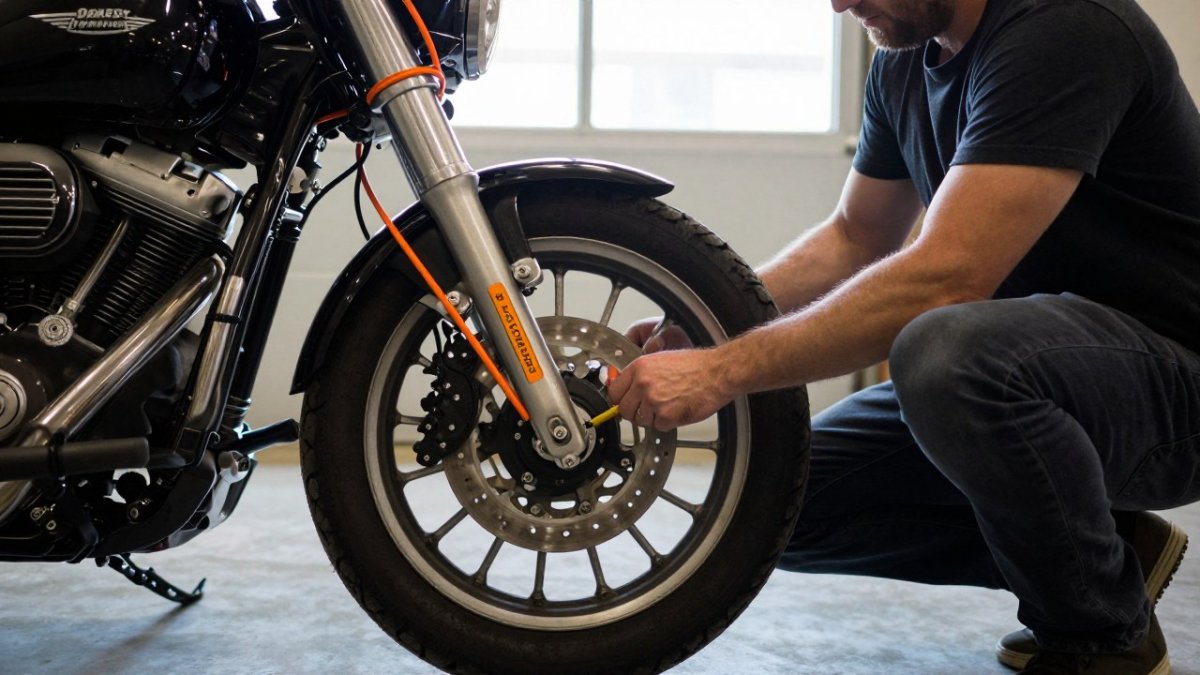
The placement step is where most riders go wrong. For official guidance on securing a bike against theft, the National Insurance Crime Bureau vehicle theft resources publishes practical prevention advice worth reading once.
Layered Security: Pairing a Disc Lock With Saddlebag and GPS Locks
Layered security means each device covers a weakness the others leave open, and storage is where layering pays off most. A disc lock stops the bike from rolling.
Those parts are the easy targets. A saddlebag opens in seconds with the right tool, a GPS unit lifts off a mount faster still, and a solo seat comes off with basic hand tools.
Robert Becker Design builds locks for saddlebags, seats, and mounting arms. The logic is straightforward: lock the bike, then lock the parts worth taking.
Storage security is a decision about time and attention, not about buying the loudest device on the shelf. If your bike sits where people pass, add the alarm.
Frequently Asked Questions
Can thieves break a disc lock?
A determined thief can defeat most disc locks with an angle grinder or by lifting the front wheel and rolling the bike on the rear. The lock's job is to buy time and make noise, not to be unbeatable. A hardened disc lock slows a cut attempt and forces the thief to work in the open. Pairing it with a chain and a cover removes the easy lift-and-roll route, which is why layered security beats any single device.
Are alarmed disc locks worth it for long-term storage?
For outdoor parking or a shared garage, yes. A motorcycle disc lock with alarm adds movement detection and a loud audible alert on top of the physical lock, so tampering draws attention immediately. For a locked private garage where nobody hears the siren, the alarm adds little and the physical lock does the work. Match the device to the location: alarm where people are nearby, plain disc lock where they are not.
Can you leave a motorcycle disc lock on while it is stored?
Yes, a disc lock can stay on for months during storage. Check two things before you walk away: that the lock sits clear of the brake caliper and ABS sensor ring, and that the battery in an alarmed unit still has charge. Cheap alarm batteries drain in weeks and a dead siren is a silent lock. Test the alarm monthly and keep a reminder cable on the bar so you never ride off with the lock still fitted.
Should you use a disc lock and a chain together?
Use both when the bike sits outside overnight. The disc lock stops the wheel turning and the chain ties the frame to a ground anchor or immovable object, which blocks the lift-and-carry method. Add a motorcycle cover to hide what is fitted and a GPS or saddlebag lock for the accessories thieves target. Each layer covers a gap the others leave open, and the total cost is far below a theft deductible.
