
Last Updated: November 12, 2026
Quick Summary
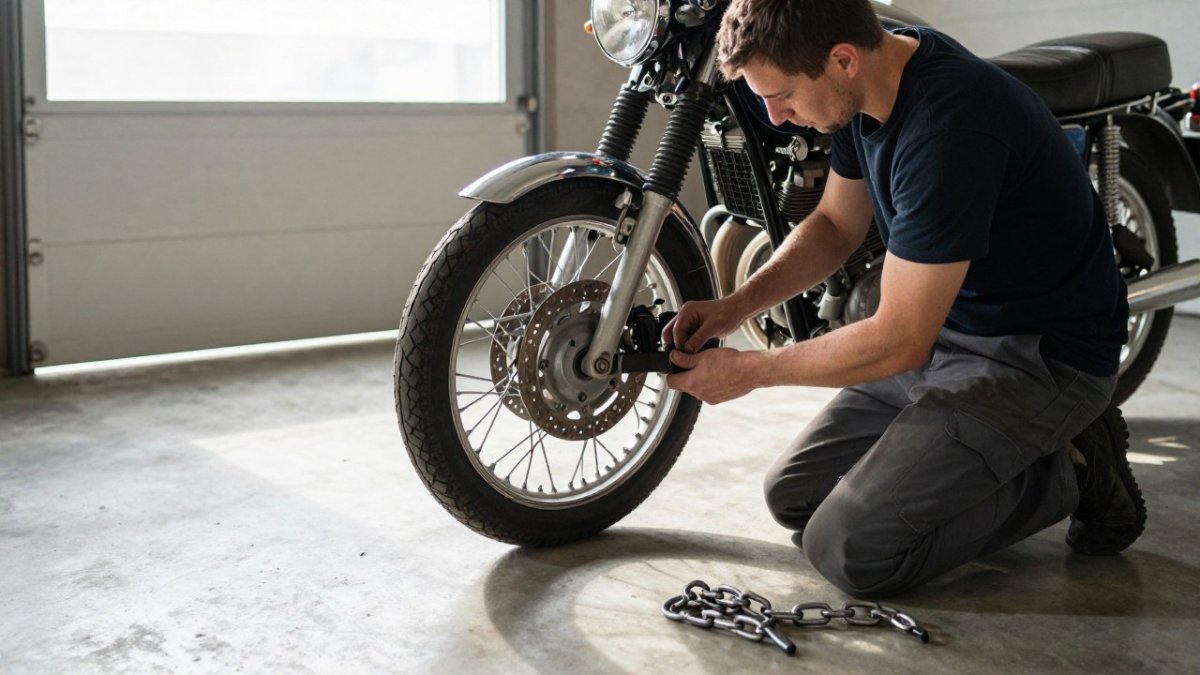
Maintain motorcycle security through winter by lubricating lock cylinders with graphite or dry lubricant, keeping chains clean and off the ground, and testing alarms monthly since cold drains batteries fast. Anchor the bike to something immovable, layer a chain lock, disc lock, and cover, and check the cover and locks monthly for tampering.
- Fill the tank nearly full and add fuel stabilizer so less air means less condensation inside.
- Remove the battery or connect a smart battery tender, never a trickle charger that never shuts off.
- Use a breathable cover rather than a tarp, which can trap condensation underneath.
- Move the bike slightly each month to shift the tires' contact patch and prevent flat spots.
- Use a reminder cable with a disc lock so you do not ride off with it attached.
Table of Contents
- Start With a Complete Motorcycle Winter Storage Checklist
- Motorcycle Battery Maintenance During Winter
- How to Secure a Motorcycle in a Garage
- Motorcycle Security Maintenance Tips for Locks and Alarms
- Outdoor Storage: Weather Protection and Theft Prevention
- Build a Winter Maintenance Schedule and Inspection Routine
- Motorcycle Spring Startup Checklist
- Shop Winter Security Hardware for Your Touring Bike
- Frequently Asked Questions
Start With a Complete Motorcycle Winter Storage Checklist
Winter storage is where next season's riding costs get decided. At Robert Becker Design, we build theft prevention hardware for touring bikes, so we think about winter differently: it is not just maintenance season, it is the longest stretch your motorcycle sits unattended.
Below is a full motorcycle winter storage checklist. Work through it in order, and you will start spring with a machine that is ready to ride.
- Wash and dry the bike completely
- Fill the tank and add fuel stabilizer
- Change the engine oil
The details matter more than the list. Here is how each step actually works.
Clean, Dry, and Inspect Before You Store
Dirt holds moisture against metal, and moisture means rust. Wash the bike, then dry it fully before storage. Pay attention to the chain, brake calipers, and the underside of the fenders.
While it is clean, walk around it. Look for:
- Worn brake pads
- Loose fasteners
- Cracks in the sidewall
Fix small problems now. They get bigger after months of sitting.
Fuel, Fluids, and Tire Pressure
Fill the fuel tank nearly full. A full tank leaves less room for air, and less air means less condensation inside the tank.
Change the engine oil before storage. Used oil carries acids and water that sit against engine parts all winter.
Check tire pressure and inflate to the manufacturer's spec. Cold temperatures drop pressure further, so start at the higher end of the range.
Motorcycle Battery Maintenance During Winter
Battery maintenance is the step most riders skip, and it is the number one reason bikes fail to start in spring. A battery that sits discharged for months can sulfate and lose capacity for good (Battery University).
You have two options:
- Remove the battery and store it indoors in a cool, dry place.
- Leave it in the bike and connect a battery tender.
Either way, disconnect the battery terminals first. Clean them with a terminal brush and apply a light coat of dielectric grease to slow corrosion.
Connect a smart battery tender, not a trickle charger that never shuts off. A tender monitors voltage and only charges when needed. Check the leads are not pinched and the unit sits where it cannot get wet.
How to Secure a Motorcycle in a Garage
To secure a motorcycle in a garage, anchor it to something immovable, lock the wheels, and make the bike harder to move than the next one on the block. A garage door is not security. Thieves know how to open them.
Work in layers:
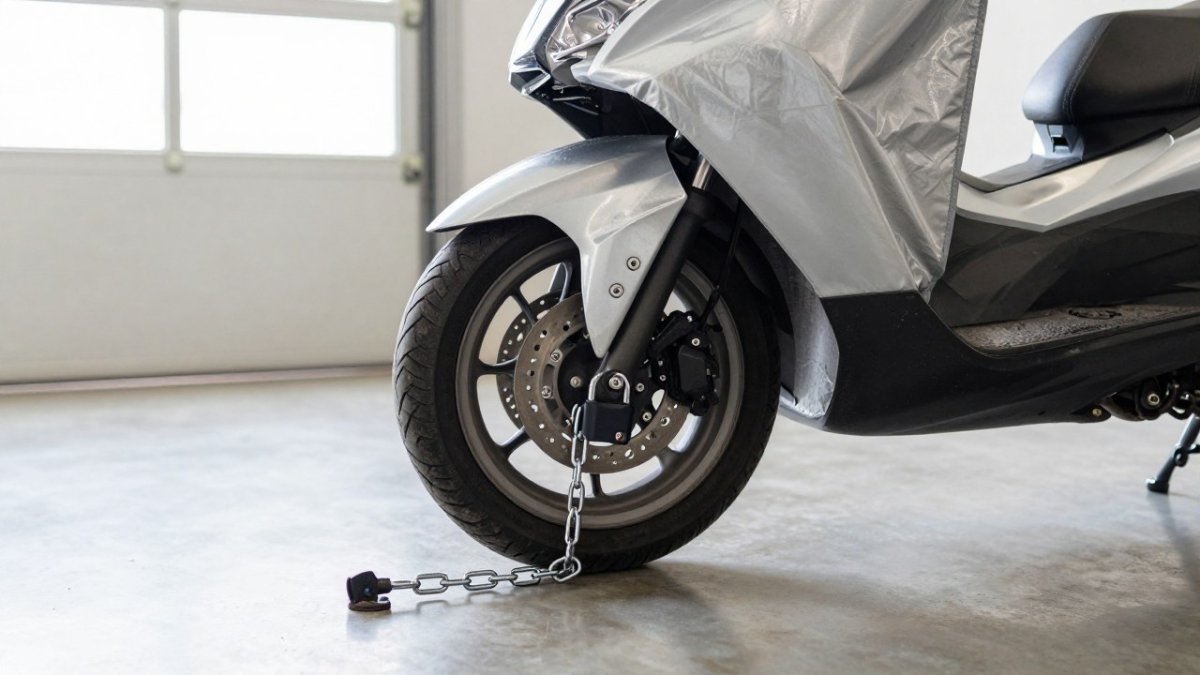
- Ground anchor bolted into concrete
- Chain lock through the frame or swingarm
- Disc lock on the front wheel
Ground Anchors, Chain Locks, and Disc Locks
Each device slows a thief in a different way, and layering them adds time.
| Device | What It Stops | Best Use |
|---|---|---|
| Ground anchor | Lifting and carrying the bike away | Permanent garage or patio mounting |
| Chain lock | Riding or rolling the bike off | Frame or swingarm, anchored to a fixed point |
| Disc lock | Rolling the bike at all | Front wheel, visible deterrent |
| Alarm | Quiet tampering | Backup layer after locks |
A chain lock is only as strong as what it is attached to. Wrap it around a frame tube, never a brake line or a detachable part. Keep the chain off the ground so a thief cannot get use with a tool.
Motorcycle Security Maintenance Tips for Locks and Alarms
Security hardware needs care, or it fails when you need it most. These motorcycle security maintenance tips keep locks working through the cold months.
Lubricate lock cylinders with a graphite or dry lubricant before winter. Wet oils attract grit and gum up in low temperatures.
Check alarm batteries and test the siren. Cold drains batteries fast.
Watch out: a disc lock left on the front wheel is easy to forget.
Outdoor Storage: Weather Protection and Theft Prevention
Outdoor storage raises the stakes on both weather and theft. Moisture and visibility are both concerns, and details such as cover fit, airflow, drainage, and tamper resistance all affect how a bike comes through winter.
Cover Fit and Breathability
Use a breathable motorcycle cover rather than a tarp, which can trap condensation underneath. A breathable cover lets vapor escape while blocking rain and sun. Fit matters as much as fabric: a loose cover flaps in wind, scuffs paint, and pools water in low spots; a too-tight cover traps moisture against the seat and tank. Look for a cover sized to your model with elastic hems, a snug fit around the mirrors, and vents that let air move.
Surface, Drainage, and Airflow
Park on a hard surface if you can. Gravel and grass hold moisture against the tires and make the bike easier to tip. Concrete or asphalt sheds water and gives a stable footing for locks and anchors. Avoid low spots where water pools; if the only option is a spot that collects runoff, build up a small gravel pad or use a rubber mat so the tires and kickstand are not sitting in standing water.
Theft Prevention Outdoors
For theft prevention, add a second lock outdoors. Anchor the bike to a fixed post or ground anchor, and keep the cover on so a passerby cannot easily see what is underneath. An alarm adds a layer that a cover alone cannot. Outdoors, the goal is to make the bike harder to move and less attractive to target than the next one on the block:
- Ground anchor set in concrete or a heavy fixed post, with a chain lock through the frame or swingarm.
- Disc lock on the front wheel, with a reminder cable so you do not ride off with it attached.
- Cover that hides the make, model, and any accessories, and that is secured at the bottom so it cannot be lifted to inspect the bike.
Watch out: a cover that is not secured at the bottom can be lifted in seconds to reveal what is underneath, so use grommets and a cable or strap to keep the hem down. Also check that the cover does not trap the alarm or block its siren, and that locks are not resting on the ground where a thief can get leverage with a tool.
Tamper Resistance and Visibility
Outdoor bikes are visible, so reduce what a passerby can learn. Park with the cover on and the locks low and tight. If you use a chain, keep it off the ground so it cannot be used as a lever. Check the cover and locks monthly for cuts, loosened anchors, or signs of tampering, and replace any cover that has torn or lost its water resistance.
Build a Winter Maintenance Schedule and Inspection Routine
A stored bike still needs attention. Set a routine and stick to it. The most useful schedule is split into three phases, before storage, monthly during storage, and spring startup, so each task has a clear trigger and nothing gets skipped because it was not on a list.
Before-Storage Phase
Complete these once, in order, before the bike sits:
- Wash and dry the bike completely, then inspect for worn brake pads, loose fasteners, sidewall cracks, and chipped paint.
- Fill the tank nearly full, add fuel stabilizer, and run the engine briefly so treated fuel reaches the fuel system.
- Change the engine oil so used oil does not sit against engine parts all winter.
Monthly Inspection Routine
Set a recurring reminder and work through this list each month:
| Task | Frequency | Why It Matters |
|---|---|---|
| Check battery tender | Monthly | Catches a failed charger early |
| Inspect cover and locks | Monthly | Spots damage or tampering |
| Check tire pressure | Monthly | Prevents flat spots from sitting low |
| Look for rust or moisture | Monthly | Catches corrosion before it spreads |
| Test alarm and siren | Monthly | Cold drains batteries fast |
| Start engine briefly | Every 4-6 weeks | Circulates oil and fuel |
Move the bike slightly each month to shift the tires' contact patch if you cannot lift it off the ground. Flat spots form when a tire sits in one spot under load for months. Keep a written log, a simple note on your phone works, so you can see patterns like a tender that keeps failing or a cover that keeps soaking through.
Security-Specific Checks
Security hardware needs its own routine, because it fails silently. Each month, confirm the ground anchor is still tight, the chain is off the ground, the disc lock is seated, and the cover is secured at the hem. Test the alarm and replace its battery if the siren sounds weak. If anything has been tampered with, move the bike to a different spot and add a layer before the next storage period.
Spring Startup Phase
The spring startup checklist is where winter prep pays off. Do not just fire it up and ride:
- Check tire pressure and look for flat spots.
- Inspect the battery and charge it fully.
- Check fuel for staleness and top off if needed.
- Test brakes before you ride.
Start the engine and let it idle. Listen for anything unusual. Then take a short, slow ride close to home before any long trip. Watch out: a disc lock left on the front wheel is easy to forget, so use a reminder cable and do a final walk-around before you ride off.
Motorcycle Spring Startup Checklist
The motorcycle spring startup checklist is where winter prep pays off. Do not just fire it up and ride.
- Check tire pressure and look for flat spots
- Inspect the battery and charge it fully
- Check fuel for staleness and top off if needed
- Test brakes before you ride
Start the engine and let it idle. Listen for anything unusual. Then take a short, slow ride close to home before any long trip.
Shop Winter Security Hardware for Your Touring Bike
Winter is the longest stretch your bike sits still, and that is exactly when theft and corrosion do their damage. A solid routine covers the maintenance side.
Do not leave your investment exposed for months. Get started with Robert Becker Design and lock down your touring bike before the cold sets in.
Winter storage rewards the rider who plans ahead.
Frequently Asked Questions
What maintenance should I do on my motorcycle during winter?
Clean and dry the bike, fill the tank and add fuel stabilizer, change the engine oil, check tire pressure and inflate to the recommended level, remove the battery and connect it to a battery tender, and lubricate locks and cables. Apply a breathable cover and inspect the bike every few weeks for condensation or pest damage.
How can I secure my motorcycle during winter storage?
Use a layered approach: a ground anchor with a hardened chain lock, a disc lock on the front wheel, and an alarm or GPS tracker. Park in a locked garage when possible. If storing outdoors, choose a well-lit spot, use a breathable cover, and remove valuables like GPS units and saddlebag contents.
Should I lubricate motorcycle locks before winter storage?
Yes. Cold weather and moisture can cause lock cylinders to seize. Apply a graphite-based or silicone lubricant to the keyhole and moving parts of disc locks, chain locks, and ignition switches. Avoid oil-based lubricants that attract dirt. Test each lock with the key before storage to confirm smooth operation.
How often should I check on a motorcycle in winter storage?
Inspect the bike every two to three weeks. Check for condensation under the cover, verify the battery tender is working, confirm tire pressure has not dropped, and look for signs of pests or corrosion. Start the engine briefly if conditions allow, or turn it over manually to circulate oil.
