
Last Updated: October 26, 2026
Quick Summary
The three best motorcycle security tips for touring are to layer locks that deter and anchor the bike, to choose parking spots matched to the risk, and to add trackers and alarms for recovery. Motorcycle security works by making theft take time, noise, and risk, so a thief moves on to an easier target.
- Fit a disc lock on the front wheel to stop roll-away theft in hotel lots.
- Chain the frame or rear wheel to a fixed object for overnight anchoring.
- At campsites, chain to a tree, picnic table frame, or fence post.
- A GPS tracker is a recovery tool and needs its own power source.
- After a theft, report to police immediately with plate, VIN, and tracker data.
Table of Contents
- Why Three Motorcycle Security Tips Cover Most Touring Theft Risk
- Tip 1: How to Secure a Motorcycle While Traveling With Locks That Actually Slow Thieves
- The Best Motorcycle Locks for Travel: Weighing Strength Against Luggage Space
- Tip 2: Safe Motorcycle Parking Overnight at Hotels, Campsites, and Street Spots
- Tip 3: Trackers, Alarms, and Protecting Luggage, GPS, and Seats
- Your Motorcycle Security Checklist for Touring: What to Do Before and After a Theft
- Gear Up Before Your Next Overnight Stop
- Frequently Asked Questions
Why Three Motorcycle Security Tips Cover Most Touring Theft Risk
Three motorcycle security tips for touring work because theft is a crime of opportunity, not a movie-style heist. Most touring bikes get taken from hotel lots, campsites, and street spots while the rider sleeps. At Robert Becker Design, we build locks for touring models.
Motorcycle security is the practice of layering visible deterrents, physical anchors, and tracking devices so a thief must spend time, make noise, and take risks to move your bike. Below: how to build them, what gear earns its luggage space, and what to do if the worst happens.
A single chain cannot anchor a bike if there is nothing to chain it to.
The Three Layers: Deter, Anchor, Track
Think of security as three jobs, not three products.
- Deter: Make the bike look like a bad target. Locks on the disc, a covered seat, a visible chain.
- Anchor: Tie the bike to something that will not move. A post, a rail, a sturdy rack.
- Track: Know where the bike is if it disappears. A GPS unit or a hidden tag.
Skip any layer and you leave a gap. A determined thief probes for the weakest one.
Tip 1: How to Secure a Motorcycle While Traveling With Locks That Actually Slow Thieves
Learning how to secure a motorcycle while traveling starts with one honest question: how long will your lock delay a thief? Your goal is to make theft less convenient.
- Fit a disc lock on the front wheel. It is small, light, and stops the roll-away theft that plagues hotel lots.
- Carry a chain or D-lock for anchoring. Loop it through the frame or rear wheel and around a fixed object.
- Use both whenever you can. Two devices mean two cuts, two tools, and twice the time.
- Park nose-in where possible. A bike wedged between cars and a wall is harder to lift into a van.
Chain, Disc Lock, or Both?
Both, if your luggage allows. A disc lock is easy to carry but easy to defeat if the bike can be lifted. A chain adds real strength but adds weight and bulk. The table shows the trade-offs.
| Device | Strength | Portability | Best Use |
|---|---|---|---|
| Disc lock | Medium | Excellent | Quick stops, cafes, short errands |
| Chain lock | High | Poor | Overnight anchoring to a fixed object |
| D-lock | High | Fair | Overnight stops with a solid anchor |
| Padlock and cable | Low | Excellent | Luggage and cover ties only |
Watch out:
The Best Motorcycle Locks for Travel: Weighing Strength Against Luggage Space
The best motorcycle locks for travel balance strength against the space they steal from your saddlebags. A lock that stays home protects nothing.
Weight matters on a loaded touring bike.
Robert Becker Design makes locks for saddlebags, seats, and mounting arms for Harley-Davidson, Indian, and other touring motorcycle models.
Tip 2: Safe Motorcycle Parking Overnight at Hotels, Campsites, and Street Spots
Choose a parking spot, then consider the security measures to match the situation.
Match Your Layers to the Parking Risk
Think in four parking situations, each with a different minimum setup.
- Monitored garage or fenced lot: Steering lock, disc lock, and cover. The camera and gate do the heavy deterrence; your job is to avoid being the easiest bike inside the fence. Skip the chain only if there is genuinely nothing to anchor to.
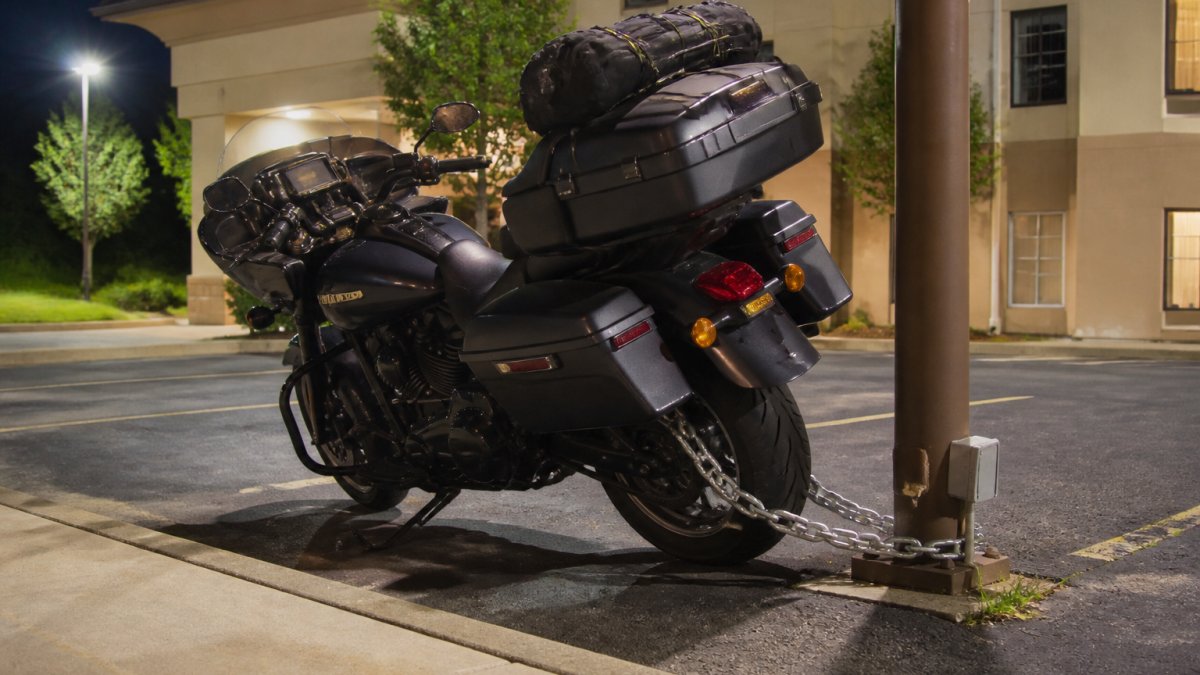
- Hotel or motel street lot: Steering lock, disc lock, chain to a fixed rail or post, and cover.
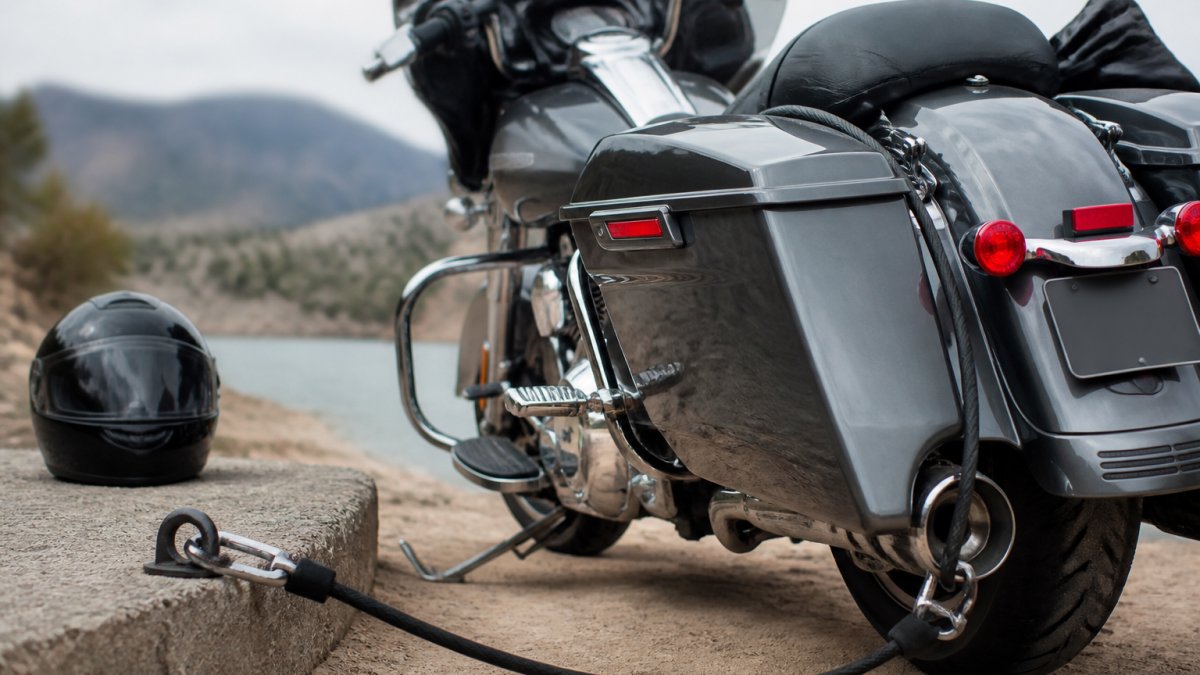
- Remote campsite: Chain to a tree, picnic table frame, or fence post, plus disc lock, motion alarm, and cover.
- Brief rest stop or cafe: Disc lock and steering lock, bike in sight if possible. You are defending against a roll-away or a quick lift, not a prepared crew.
A simple rule: consider the length of the stop and how many people are watching when choosing security measures.
A Stop-by-Stop Overnight Routine
Run the same sequence every night so it becomes automatic.
- Scout before you unload. Walk the lot first. Look for light, cameras, foot traffic, and a fixed object to chain to.
- Pick the spot, then park nose-in. A bike wedged between cars and a wall is harder to lift into a van than one parked in the open.
- Set the steering lock as a baseline deterrent before anything else.
- Fit the disc lock on the front wheel to stop the roll-away.
- Chain the frame or rear wheel to the fixed object you scouted.
- Lock saddlebags and remove the GPS faceplate. Loose accessories are what most opportunists actually grab.
- Cover the bike so prying eyes cannot study your mounts, luggage, or tracker placement.
-
- Photograph the parked setup and note the location. This takes ten seconds and matters if you need to report a theft.
Hotel and Motel Stops
Ask for a room facing the lot, and park under a light or camera. Loop your chain through a fixed rail or post if one exists, and cover the bike. If the lot has no anchor, park where the bike cannot be lifted easily and set the disc lock.
Campsites and Remote Stops
Lock two bikes together if you ride in a group, and chain to a tree, picnic table frame, or fence post. Keep valuables like your GPS and helmet inside the tent.
Street Parking and Brief Stops
Street parking is the highest-variability situation. Park in visible, well-lit locations near people or cameras, and avoid spots where a bike can be lifted into a van out of sight. For brief stops, keep the bike in view. At night, treat a street like a hotel lot: chain to a fixed object and cover the bike.
Watch out:
Tip 3: Trackers, Alarms, and Protecting Luggage, GPS, and Seats
Trackers and alarms handle the layer locks cannot: recovery and warning. A GPS tracker helps police recover a stolen bike, though recovery is never guaranteed. A motion sensor alarm scares off casual thieves and wakes you at the campsite. Hidden tags like an AirTag add a cheap backup, but they rely on nearby phones and are easy to find.
Alarms and Motion Sensors
A motion sensor alarm is a deterrent first and a notification second. It works best where noise carries and a thief cannot tell whether anyone is watching, which is why it earns its keep at campsites and quiet street spots. Look for one you can arm and disarm quickly, because a fiddly device gets skipped after a long day.
GPS Trackers and Location Tracking
A GPS tracker is a recovery tool: it tells you where the bike went, not how to stop it leaving. Choose one with its own power source or backup battery so it keeps reporting if the bike's battery is disconnected, and confirm the subscription and coverage area before your trip. Keep the login and device ID reachable from the road.
Hidden Tags as a Backup
Hidden tags like an AirTag are cheap and easy to stash, but they depend on nearby phones to report a location and are easy for a thief to find and discard. Use one as a backup to a real tracker, not as your only tracking layer.
Protecting Luggage, GPS, and Seats
We designed our locks to secure GPS units, factory and aftermarket seats including solo seats, and saddlebags. Remove the GPS faceplate, lock saddlebags closed, and keep valuables inside the tent or room.
Watch out:
What to Do After a Theft or Attempted Theft
Act fast.
- Confirm it is gone and secure the scene. Note the time, location, and anything disturbed.
- Report to police immediately. Give them the plate, VIN, make, model, color, and any distinguishing accessories.
- Share tracker data. If you have a GPS tracker, give police the live location and the device ID. If you use a hidden tag, share its last known location.
- Call your insurer. Start the claim and ask what documentation they need. Photos of the parked setup and proof of ownership speed this up.
- Post the details and photos to local rider groups. Riders spot bikes that police do not, and a quick share widens the net.
- Preserve your documents. Keep proof of ownership, insurance, and registration accessible for reporting and claiming.
Your Motorcycle Security Checklist for Touring: What to Do Before and After a Theft
This motorcycle security checklist for touring keeps the routine simple.
- Park in a well-lit, visible spot near people or cameras
- Set the steering lock as a baseline deterrent
- Fit the disc lock on the front wheel
- Chain the frame or rear wheel to an immovable object
- Lock saddlebags and remove the GPS faceplate
- Cover the bike to conceal accessories
- [ ]
- Photograph the parked setup and note the location
If a theft happens, report it to police and your insurer immediately.
Gear Up Before Your Next Overnight Stop
That is where we come in. Robert Becker Design has built theft prevention hardware for touring riders since 2012, designed by riders for riders. Our locks secure GPS units, saddlebags, and seats for Harley-Davidson, Indian, and other touring motorcycle models. Get started with Robert Becker Design.
Frequently Asked Questions
How do you secure a motorcycle while touring?
Use three layers. First, lock the bike to something immovable with a chain or D-lock through the frame or rear wheel. Second, add a disc lock. Third, park in a well-lit, visible spot and cover the bike if you can. Carry the locks with you, since a lock left at home protects nothing.
Should you use a disc lock and a chain together?
Yes. A chain and a disc lock are two different devices. The best motorcycle locks for travel are the ones you will actually carry, so pick a chain length and weight you can live with in your luggage.
Where should you park a motorcycle when traveling?
Choose a place to park overnight, such as a garage, a fenced lot, or a spot under a light near a hotel entrance or security camera. At campsites, you can park close to your tent and lock the bike to a fixed object. On the street, you can choose a well-lit location with foot traffic and loop the chain through a solid anchor point such as a steel post.
What should you do if your motorcycle is stolen while traveling?
Report it to the police immediately. Notify your insurance company. Photograph the scene and note anything unusual. Afterward, review your motorcycle security checklist for touring.
