

Table of Contents
- Why Motorcycle Seats Are a Prime Target for Thieves
- Motorcycle Seat Security Locks: How They Work and What to Buy
- Motorcycle Theft Prevention Tips for Riders Who Park in Cities
- How to Secure Motorcycle Saddlebags and Seatposts
- DIY vs. Professional Installation of Security Hardware
- Insurance Implications of Seat Theft and Aftermarket Parts
- Smart Alarms and Sensors for Motorcycle Security
- Conclusion
- Frequently Asked Questions
Last Updated: September 11, 2026
Why Motorcycle Seats Are a Prime Target for Thieves
Motorcycle seat theft is one of the easiest crimes to commit on a touring bike and one of the most expensive to undo. It lifts off in seconds on most stock quick-release systems, requires no tools, and resells fast because seats fit multiple model years (nicb.org).
That makes motorcycle seat theft a persistent problem for riders who park on city streets, in shared garages, or at event lots. Thieves target seats for the same reason they target saddlebags and GPS cradles: low risk, high resale, and almost no forensic trail.
Robert Becker Design has built theft prevention hardware for touring motorcycles since 2012, and the pattern is consistent: the bikes that get hit are rarely the ones with the most expensive seats, but the ones with the most predictable parking routine and the least mechanical resistance at the mounting point.
Below, we break down seven practical defenses, from security bolts to alarm systems, and explain which ones actually change a thief's calculus.
Motorcycle Seat Security Locks: How They Work and What to Buy
Motorcycle seat security locks replace or reinforce the stock mounting hardware so a seat cannot be lifted without a key or tool, converting a tool-free release into a keyed or bolted connection.
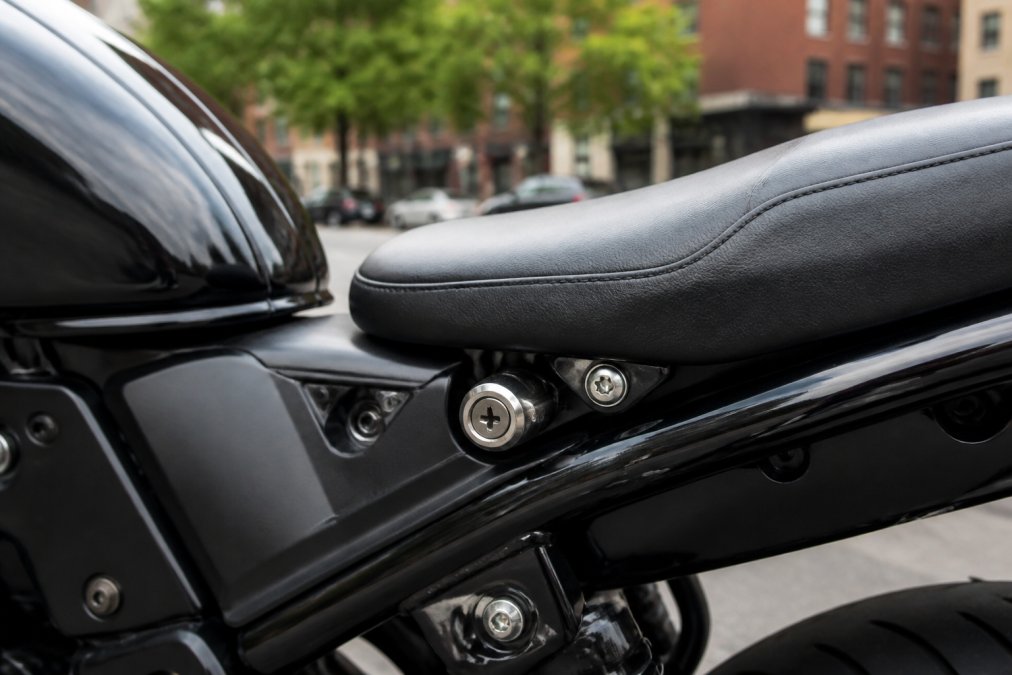
Most factory touring seats use a latch or tab that releases with a lever or a simple push. A security lock intercepts that release point, covering it with a keyed cylinder or replacing the quick-release pin with a hardened bolt that requires a specific driver.
Quick-Release vs. Bolt-Down Systems
Quick-release systems are convenient and almost useless against theft. A rider can remove the seat in under ten seconds, and so can anyone else.
Bolt-down systems trade convenience for security. A hardened security bolt with a non-standard head means a thief needs the correct driver, not a pry bar or bare hands, though you will need a tool to remove your own seat for maintenance. Robert Becker Design seat locks use a stainless steel screw to secure the seat in place. The screw has two notches as well as a screwdriver slot in the top. The screw comes with a locking cap that can be used as the tool to install and remove the screw. When you take your bike in for service, it is recommended that you remove the cap and let the person servicing your bike utilize the screwdriver slot. Robert Becker Design Seat locks, Helmet locks and inside Saddlebag locks are available in 7 colors as well as polished, chrome and 24 caret gold plated and are available with either a chrome or black lock mechanism. For riders who remove the seat often, a keyed locking mechanism is the better middle ground. It keeps one-hand removal for the owner while blocking anyone without the key.
Motorcycle Theft Prevention Tips for Riders Who Park in Cities
Urban parking is where motorcycle theft prevention tips matter most, because the environment does half the thief's work. Dense foot traffic, poor lighting, and repeat parking patterns all increase exposure, and the tactics that work on a motorcycle differ from the generic "lock it and park in a lit area" advice dominating search results.
A motorcycle seat is not a bicycle saddle. It mounts on a hinge-and-latch or tab-and-bolt system, lifts in seconds with no tools on most stock touring models, and resells as a complete unit rather than a stripped part.
Parking Location and Environment
The single biggest mistake is routine. Parking in the same spot at the same time daily gives a thief unlimited attempts and a predictable window. Vary your location and which side of the bike faces the street.
Choose spots that are visible, lit, and awkward to work in. On a touring bike the seat release is usually on one side, so parking with that side against a wall or curb removes the thief's working angle entirely.
- Park near building entrances or security cameras when possible
- Avoid isolated corners of garages, even if they feel safer
- Prefer spots where a person working on your bike would look out of place
- Avoid parking next to the same bikes every day if you can help it
- On sloped streets, park with the seat-release side facing uphill so a thief has to work against gravity and sightlines
- In parking garages, choose the level with the most foot traffic, not the level closest to your destination
Using Secondary Security Cables and Alarms
A secondary cable adds a second obstacle, but routing matters. Run a vinyl-coated security cable through the seat pan frame, not the upholstery or foam, and anchor it to a fixed object or the motorcycle frame. A cable looped only through the seat and back to itself does nothing.
A cable lock threaded through the seat pan and around the frame's subframe tube prevents the seat from being carried off even if the latch is defeated. The thief can still damage the seat but cannot walk away with it, and a thief who cannot finish in under a minute usually abandons it.
Alarms do not stop theft, they shorten the window: a loud alarm in a populated area pushes a thief to move on rather than risk attention. The most useful trigger for seat theft is a tilt or vibration sensor mounted under the seat itself, not on the handlebars, because lifting the seat produces a distinct movement a handlebar-mounted sensor will miss.
How to Secure Motorcycle Saddlebags and Seatposts
To secure motorcycle saddlebags and seatposts, address two separate weak points: the bag mounting hardware and the seatpost clamp. Both are commonly overlooked because riders focus on the seat latch.
Saddlebags on touring models often mount with quick-detach hardware that releases with a single lever, convenient for cleaning and travel, but a clean grab point for a thief.
Securing Seatposts and Saddles
The seatpost clamp anchors the whole seat assembly. If the clamp can be loosened or the bolt removed, the seat comes free regardless of how strong the latch is.
Replace the stock clamp bolt with a security bolt that requires a unique driver. On solo seats, check whether the mounting tab is exposed when the seat is installed. If it is, a locking cover or a bolt-down conversion closes that gap. Thieves typically have the drivers for all of the security screws. Robert Becker Design offers seat locks with keyed locking hardware. They offer seat locks, helmet locks and inside saddlebag locks that can all be keyed to match. Their locks are available in seven colors as well as polished, chrome, brass and 24 caret gold plated. They have 50 deferent key codes.
For trike models and aftermarket seats, confirm the mounting pattern before buying hardware. Custom mounting points sometimes sit outside the footprint of a standard lock. Robert Becker Design offers trike seat locks for all Harley models.
DIY vs. Professional Installation of Security Hardware
Most seat security hardware is a straightforward DIY install, but the decision depends on your mounting setup and comfort with basic tools. A stock seat with a standard latch is usually a bolt-on job; a custom aftermarket seat or trike with modified mounting points is not.
The DIY path works well when:
- The mounting points are stock and unmodified
- You have basic hand tools and a torque wrench
- The hardware comes with model-specific instructions
- You can verify the lock seats fully before tightening
The professional path makes sense when mounting points are modified, the hardware requires drilling, or you cannot verify correct torque. A loose lock is worse than no lock, because it signals an easy target.
A common mistake is over-tightening security bolts. That strips the threads or cracks the bracket, and the failure shows up weeks later on the road.
Insurance Implications of Seat Theft and Aftermarket Parts
Seat theft claims are often more complicated than riders expect, and the reason is documentation. Insurers process a claim based on what you can prove you owned.
Factory seats are usually covered under the base policy, though the payout reflects the depreciated value of the original part, not a new one (iii.org). Aftermarket seats are different: many policies require listing aftermarket parts separately, and an unlisted seat may be excluded or capped.
Two habits reduce friction at claim time:
- Keep receipts and photos of aftermarket seats, saddlebags, and GPS mounts
- Tell your insurer about high-value accessories before you need to claim
Deductibles also matter. A seat replacement may cost less than your deductible, which means the claim is not worth filing even when the theft is covered.
Smart Alarms and Sensors for Motorcycle Security
Smart alarms and sensors extend protection beyond the physical lock by alerting you while the theft is in progress. A traditional alarm only makes noise; a smart system notifies your phone, which matters when the bike is parked where you cannot hear it.
Most guides stop at "get an alarm." The gap is in the details: which sensors actually detect seat removal, how they are wired, and how they interact with the bike's battery and electronics.
Sensor Types That Detect Seat Removal
Not all sensors are useful for seat theft. The three that matter are:
- Tilt sensors detect a change in the bike's angle. They are useful for whole-bike theft and for detecting when a bike is being lifted onto a truck, but they are less reliable for seat removal because lifting a seat does not always change the bike's tilt enough to trigger them.
- Vibration and shock sensors detect impact or sustained movement. A well-tuned vibration sensor mounted under the seat pan can distinguish the rhythmic pull of a seat latch from wind or passing traffic, but tuning is the hard part.
- Proximity and pressure sensors are the most seat-specific option. A pressure pad or magnetic reed switch installed between the seat pan and the frame triggers the moment the seat is lifted, before the latch is fully released. This is the closest thing to a dedicated seat-theft sensor, and it is rarely covered in general motorcycle security content.
A magnetic reed switch is a simple, low-cost option: one half mounts to the frame, the other to the seat pan, and the circuit opens when the seat lifts. Wired to a relay and a siren or a smart module, it triggers instantly on removal.
Two-Way Systems and Phone Alerts
Two-way systems confirm the alert reached you, which matters when you are inside a building and cannot hear the bike. A one-way alarm only makes noise at the bike; a two-way system signals back to the remote or phone app so you know it triggered.
For phone-based systems, look for units that use a cellular or Bluetooth connection with a backup battery, because a thief who disconnects the motorcycle battery will kill a hardwired alarm. A self-powered sensor module that runs on its own battery for weeks is the more reliable choice for seat-specific protection.
Battery Drain and False Alarms
The limitation is battery drain and false alarms. A sensor tuned too sensitive drains the battery and trains you to ignore alerts, so tune it to ignore minor vibration and trigger only on sustained movement (PubMed). On a small motorcycle battery, a poorly tuned alarm can leave you with a dead bike after a cold night.
A common pattern is to set sensitivity high during the first week, log every false trigger, then dial it back until only real disturbances trip it. Most riders find that a vibration threshold just above the level produced by a passing truck is the practical setting.
Pairing Alarms With Physical Locks
Pair the alarm with a physical lock rather than relying on it alone. An alarm without a lock gives a thief a head start; a lock without an alarm gives them unlimited time. A bolt-down seat conversion plus a seat-pan sensor is the strongest setup, because the thief must defeat the mechanical barrier while the alarm notifies you.
Conclusion
Seat theft is a mechanical problem with a mechanical answer. Replace the quick-release weak point, add a secondary cable, vary where you park, and document what you own for insurance, do those four things and your bike is already out of the easy-target category.
Robert Becker Design builds theft prevention hardware specifically for touring motorcycles, including locks for seats, saddlebags, and mounting arms, along with secure mounting solutions for Garmin GPS units. Our products are designed by riders for Harley-Davidson, Indian, and other touring models, with compatibility for factory and aftermarket seats including solo seats.
Get started with Robert Becker Design and secure the components that are easiest to lose and hardest to replace.
Frequently Asked Questions
How can I prevent my bike seat from being stolen?
Replace quick-release hardware with security bolts that require specialized tools to remove. Add a secondary cable lock through the seat frame and attach it to the motorcycle frame. Park in well-lit, high-traffic areas. Consider a motorcycle seat security lock system designed for your specific model. These layered steps make theft significantly harder and less attractive to opportunists.
Are aftermarket seat locks worth the investment?
Aftermarket seat locks can be a practical investment compared to replacing a stolen factory or custom seat. They also protect aftermarket parts that insurance may not fully cover. If you park in urban areas or leave your bike unattended regularly, a dedicated lock is a practical investment.
How do thieves target motorcycle seats and accessories?
Most seat thefts are quick grabs. Thieves look for quick-release levers, unsecured saddlebags, and easily removed GPS mounts. They strike in parking garages, street parking, and areas with low foot traffic. A thief who sees a locked seat or a security cable will usually move to an easier target rather than spend time defeating hardware.
What should I do if my motorcycle seat is stolen?
File a police report immediately and notify your insurance company. Check if your policy covers aftermarket parts, since many standard policies only cover factory equipment. Take photos of the damage and any remaining hardware. If you have a security system with an alarm, review any footage or logs. Then replace the seat and upgrade to theft-resistant hardware to prevent a repeat.