
Quick Summary
Motorcycle electronics theft is common because GPS units and similar gear can be pulled off a mount in seconds. The best prevention is removing the unit when parked, hardening the mount with tamper-resistant fasteners and locks, and layering devices to match your parking risk.
- Remove the GPS unit and disconnect its power cable whenever you park.
- Replace standard hex or Phillips mount fasteners with pin, spline or security Torx heads.
- Lock the bike to a steel post or ground anchor, not a loose railing.
- Set a PIN on your GPS so a thief cannot easily reset or use it.
- After a theft, photograph the scene, report it to police and notify your insurer.
Table of Contents
- Why Motorcycle Electronics Are Such a Common Target
- Step 1: Remove and Secure Your GPS Unit When Parked
- Step 2: Harden Your Motorcycle GPS Mount Security
- Step 3: Layer Motorcycle Anti-Theft Devices by Parking Situation
- Hardware Security vs. Software Settings: Covering Both
- What to Do After a Theft or Attempted Theft, Including Insurance Coverage for Accessories
- Booking Your Next Step: Securing Your Touring Setup with Robert Becker Design
- Frequently Asked Questions
Why Motorcycle Electronics Are Such a Common Target
A GPS unit can be pulled off a handlebar mount in seconds, which is one reason motorcycle electronics theft is so common.
NHTSA motor vehicle theft resources
Most electronics theft happens fast and with little noise. A thief who knows what to look for can remove a unit before a rider comes back from lunch.
Watch out: A bracket that looks secure can still be removed with basic hand tools if the fasteners are standard hex bolts.
Step 1: Remove and Secure Your GPS Unit When Parked
The simplest way to stop motorcycle electronics theft is to take the unit with you. Removing it takes less than a minute on most mounts. Keep it in a jacket pocket, a tank bag or a hotel room when you stop for the night.
Follow these steps each time you park:
- Power off the unit and disconnect the power cable
- Lift the GPS off its mount and store it out of sight
- Coil and tuck loose cables so they cannot be yanked
If you cannot remove the unit, lock the bike in a well-lit area and keep it visible from a distance. Thieves prefer quiet, dark spots where they will not be seen.
Step 2: Harden Your Motorcycle GPS Mount Security
A mount that stays on the bike all day needs stronger hardware, but "stronger" only means something if you know how a thief actually defeats a mount. Most mount thefts do not involve picking a lock.
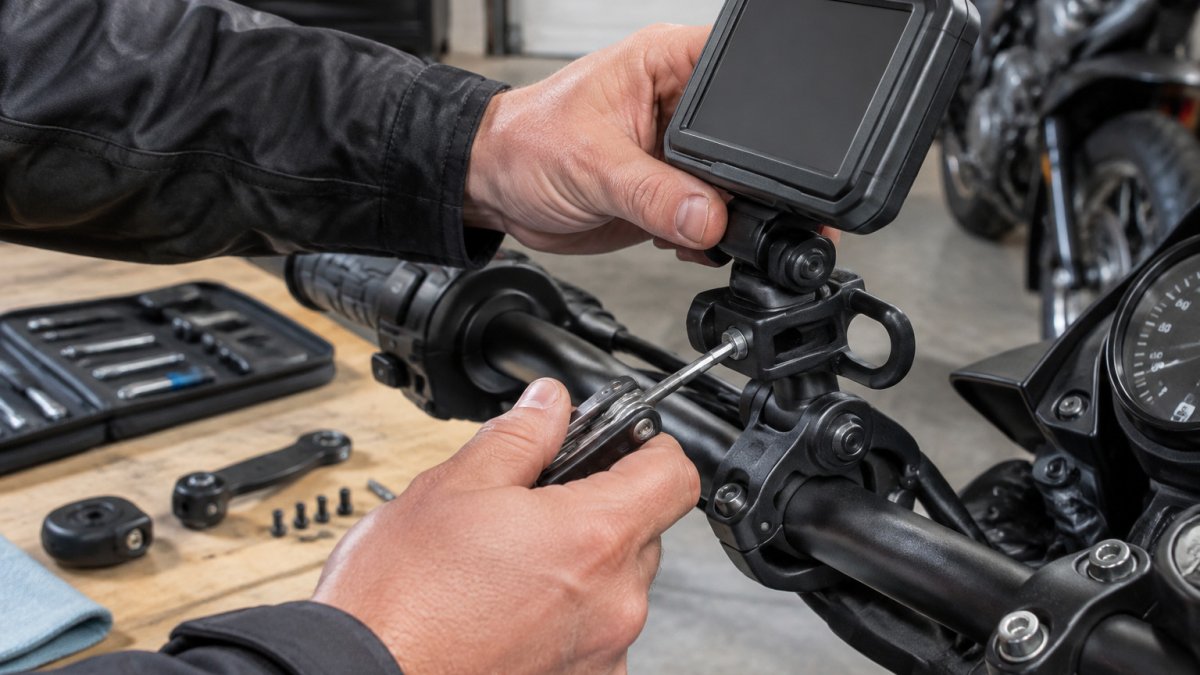
Think about four things: how the mount attaches to the bike, what holds the unit in the cradle, what keeps the fasteners from backing out, and what stops a thief from simply cutting or unclipping the whole assembly.
How mounts actually get defeated
A common pattern in reported thefts is that the thief ignores the lock and attacks the connection. Watch for these weak points on your own setup:
- Standard hex or Phillips fasteners on the base or arm, which a common wrench or driver turns in seconds
- Quick-release cradles and RAM-style arms that pop off with a thumb screw or lever, leaving the base behind
- Exposed power and audio cables that can be yanked, cut, or used to pull the unit free
Walk around your bike and try to remove your own mount with your bare hands and a basic tool roll. Whatever comes loose is what a thief will target first.
Choosing tamper-resistant fasteners
Standard bolts can be loosened with a common wrench. Tamper-resistant fasteners use pin, spline, or security Torx heads that need a matching bit to turn. Swapping regular bolts for these fasteners makes casual theft meaningfully harder, but only if you also control the bit.
Check these points when you shop:
- Pin, spline, or security Torx heads instead of plain hex heads
- Stainless or hardened steel construction so the head does not strip under torque
- Thread lock or a locking washer to stop loosening from vibration
Watch out: A security fastener with the matching bit stored under the seat is no better than a standard bolt, because the thief who gets into the bike gets the tool too.
Using a locking mount or cable reminder
A locking mount holds the unit in the cradle with a key or combination. A cable reminder is a looped steel cable that connects the unit to the bike; it also warns you if you try to ride off with the unit still tethered.
- A locking cradle stops a quick grab but does not stop a thief from unbolting the base if the base fasteners are standard.
- A cable reminder stops a walk-away grab but can be cut with common hand tools if the cable is thin and exposed.
- A locking arm or collar that secures the arm to the base closes the gap that a cradle-only lock leaves open.
Use a locking mount if you leave the unit on the bike often. Use a cable reminder if you want a quick visual check before you ride.
Weather, vibration, and maintenance
Hardware that survives a thief still has to survive the road. Vibration loosens fasteners, and weather seizes locks.
Shop tip: Test the lock with a firm pull before you leave the driveway, and re-check it after the first long ride when vibration has had a chance to work on the fasteners.
The table below sums up the weak points thieves target on a GPS mount and the matching fix for each.
| Weak point | Why it fails | Fix |
|---|---|---|
| Standard hex or Phillips fasteners | Common wrench or driver turns them in seconds | Pin, spline, or security Torx heads |
| Quick-release cradles and RAM-style arms | Pop off, leaving the base behind | Locking arm or collar on the base |
| Exposed power and audio cables | Can be yanked, cut, or used to pull the unit free | Cable reminder or hidden routing |
| Plastic or thin stamped brackets | Flex and crack when pried | Sturdier brackets, checked for flex |
| Lock secures unit, not cradle | Whole assembly walks away | Lock the cradle to the bike |
Step 3: Layer Motorcycle Anti-Theft Devices by Parking Situation
No single device stops every thief. A layered plan matches your protection to where you park. A bike in a locked home garage needs less than a bike parked overnight on a city street.
Start by rating your parking situation as low, medium or high risk:
- Low risk: A locked home garage with a closed door
- Medium risk: A secured lot, gated area or building with cameras
- High risk: Street parking, hotel lots or busy event areas
For higher risk parking, combine several measures:
- A disc lock or brake lock to stop the wheel from rolling
- A hardened chain or U-lock anchored to a fixed object
- An alarm or motion sensor that alerts you to movement
Lock the bike to something heavy and immovable, such as a steel post or ground anchor. A chain looped through a loose railing will not slow a thief down.
Hardware Security vs. Software Settings: Covering Both
Protection has two sides. Hardware security uses physical locks, mounts and fasteners. Software security uses settings on your GPS, phone apps and alarm systems.
Hardware keeps the unit from being removed. Software makes it harder to use or track a stolen unit.
Use both together. A tough mount does little good if the unit can be unlocked and reset with no password.
What to Do After a Theft or Attempted Theft, Including Insurance Coverage for Accessories
Prevention is only part of the picture. What you do in the first hour after a theft or attempted theft can affect whether a tracker helps and whether an insurer pays. Act in this order.
First 15 minutes: secure the scene and preserve evidence
- Do not move or clean the bike more than necessary. Note the time, place, and what is missing, and photograph the mount, cables, and any tool marks before you touch them.
- Check for damage to mounts, cables, and the bike itself, and photograph that too.
- If a tracker or GPS app is active, open it now and capture the last known location and timestamp with a screenshot. Location data ages quickly, and a screenshot preserves what the app showed at that moment.
- Note the serial number and model of the missing unit. If you do not have them written down, check the original box, receipt, or the manufacturer's registration email.
First hour: report and notify
- Report the theft to the police and get a report number. Give the officer the serial number and any tracker location data; some departments will act on a live location, and a report number is usually required before an insurer will process a claim.
- Notify your insurer and open a claim. Tell them exactly what was taken, whether it was factory-installed or aftermarket, and whether you have receipts and serial numbers.
- If the unit has a remote lock, wipe, or find-my feature, use it. Locking the device remotely can reduce resale value and may help identify the thief if the device is later powered on.
Watch out: Do not confront a thief or try to recover the unit yourself based on a tracker ping. Share the location with police and let them handle it; tracker-based confrontations are how recoveries turn into confrontations.
Insurance coverage for accessories
Coverage for electronics varies by policy, and the difference between factory and aftermarket gear matters. Many standard motorcycle policies cover parts that came with the bike, while aftermarket GPS units, cameras, and add-ons may need a separate rider or added coverage.
The Insurance Information Institute motorcycle insurance guide explains common coverage options and the difference between actual cash value and replacement cost.
Deterrence versus recovery
Be clear about what each device does. Locks, fasteners, and alarms are deterrence: they raise the effort and noise of a theft and make your bike a less attractive target. Trackers are recovery: they do nothing to stop the theft but may help locate the bike or unit afterward. Neither is a guarantee. A tracker hidden in a saddlebag is found quickly; one wired into the bike's harness and placed where a thief will not look in the first minutes is more useful.
After an attempted theft
An attempt is a warning. If you find a pried mount, a cut cable, or a lock that has been tampered with, treat it as a rehearsal: replace the damaged hardware, add a second layer (security fasteners plus a locking cradle plus a cable), and change where you park if you can. Report the attempt to police as well; a pattern of attempts in one location is useful to law enforcement and to your insurer if a theft follows.
Booking Your Next Step: Securing Your Touring Setup with Robert Becker Design
Protecting your GPS and accessories is easier when you start with the right hardware. Robert Becker Design has specialized in theft prevention locks and security devices for motorcycles since 2012. Our products are designed for Harley-Davidson and Indian touring models, including locks for saddlebags, seats and mounting arms.
Pricing depends on the product, quantity and delivery options. Visit our website for current prices or to request a quote.
Frequently Asked Questions
What are the best anti-theft devices for motorcycles?
The most effective approach combines a physical deterrent with a locking mount for electronics. Disc locks and heavy-duty chain or U-locks that anchor the bike to an immovable object make it harder to roll away. For electronics like a Garmin zumo or Montana, a locking mount or a cable reminder keeps the unit from being quickly lifted. Layering two or three of these measures is more effective than relying on one. Pricing for specific products varies by model and quantity, so check the Robert Becker Design website for current prices or a quote before you buy.
How can I secure a motorcycle GPS unit when I park?
Remove the GPS unit from its mount whenever you leave the bike unattended, especially overnight or in shared parking. Store it in a saddlebag or your pocket, and if you cannot remove it, use tamper-resistant fasteners and a locking mount. Keep the unit out of sight, since a visible device is a common reason for a quick smash-and-grab. Be sure to also remove the power cable if it is hard-wired so a thief cannot easily pull the unit from the harness.
Does motorcycle theft insurance cover stolen GPS devices and accessories?
Coverage depends on your policy and how the item is classified. Many standard motorcycle policies cover factory equipment, while aftermarket accessories such as GPS units may need to be listed separately or added through an endorsement. Before a loss, review your declarations page, ask your agent specifically whether aftermarket electronics are covered, and keep receipts and serial numbers. Documenting your accessories now makes any future claim far easier to process.
Can a motorcycle alarm help prevent electronics theft?
An alarm with a motion sensor can alert you or nearby people when someone tampers with the bike, which often discourages a thief who wants a quick, quiet job. Alarms do not physically stop theft, so they work best combined with removing the GPS unit and using a locking mount. Some riders also add GPS tracking to help recover stolen gear, though tracking complements rather than replaces physical security.
