
Last Updated: October 23, 2026
Quick Summary
Protecting expensive motorcycle parts involves installing security hardware on high-value components like GPS units, saddlebags, seats, and engine guards to prevent theft and damage. Start with parts that are expensive to replace and quick to remove, such as GPS units costing $300-$700 that detach in under ten seconds, then secure saddlebags, seats, and drivetrain components with keyed locks and frame sliders.
- Engine guards and crankcase covers prevent thousands in repair costs by shielding engines from debris, weather, and impacts.
- Frame sliders absorb crash energy and protect the frame from ground contact, costing far less than frame replacement or repair.
- Prioritize security by replacement cost multiplied by removal speed: a $500 part removable in five seconds deserves protection before a $150 part requiring tools.
- GPS locking cradles, saddlebag locks, and seat locks are model-specific and install in 5 to 30 minutes with basic hand tools.
- Layered security combining locking hardware, strategic parking in well-lit areas, and a motorcycle cover deters thieves more effectively than any single method.
Table of Contents
- Why Protecting Expensive Motorcycle Parts Matters
- Engine and Crankcase Protection
- Frame, Chassis, and Impact Protection
- Chain, Drivetrain, and Bodywork Security
- Motorcycle Theft Prevention for High-Value Accessories
- Using Motorcycle Accessory Locks and Cover Security
- Preventing Motorcycle Parts Theft Through Strategic Parking
- Installation, Maintenance, and Cost Considerations
- Frequently Asked Questions
Why Protecting Expensive Motorcycle Parts Matters
Motorcycle theft is a real threat.
At Robert Becker Design, we've spent over a decade helping riders protect their investments. The solution isn't complicated: install the right security hardware on the parts that matter most.
This guide covers protecting expensive motorcycle parts on touring models: which components deserve protection first, how to install security devices, and what to expect in durability and cost.
Engine and Crankcase Protection
Engine damage costs thousands to repair. A crankcase cover protects the engine block from road debris, weather, and impacts. Without one, gravel and salt spray accelerate corrosion inside the engine.
Why crankcase protection matters:
- Shields the engine from flying debris on highways
- Reduces moisture and salt exposure during winter riding
- Prevents expensive internal damage from impacts
Most touring riders install engine guards first.
For protecting expensive motorcycle parts, start here. Engine replacement or major repair can exceed $5,000. A good crankcase cover and engine guard cost far less and prevent catastrophic damage.
Frame, Chassis, and Impact Protection
Frame damage doesn't always show until it's too late. Cracks weaken the entire structure and can make the bike unsafe to ride.
Frame sliders protect expensive motorcycle parts by transferring crash energy away from the frame; they slide along the ground instead, taking the hit.
What frame sliders do:
- Absorb impact during a crash or tip-over
- Protect the frame from ground contact
- Keep the bike more rideable after a low-speed accident
Installation takes about an hour with basic hand tools, on both sides of the frame near the engine.
Chain, Drivetrain, and Bodywork Security
The chain and sprockets take constant abuse from the road; salt, sand, and moisture accelerate wear.
Bodywork and fairings protect the components underneath. Aftermarket fairings are expensive, and thieves target them because bolt-on panels can be lifted off in seconds without tools.
Protecting expensive motorcycle parts here means:
- Installing a quality chain guard to reduce wear
- Using security bolts on removable fairings
- Adding frame sliders to absorb impact
For protecting expensive motorcycle parts on your drivetrain, focus on the chain: a good guard prevents damage and extends time between replacements.
Motorcycle Theft Prevention for High-Value Accessories
Removable accessories are theft targets because they are valuable, visible, and often detach without tools.
Prioritize by replacement cost multiplied by removal speed: a $500 part that lifts off in five seconds deserves attention before a $150 part that requires tools. Most touring riders find this order matches their exposure:
- GPS and navigation units, Garmin Zumo, Montana, and Monterra units typically retail between $300 and $700 depending on model and bundle. They mount on a visible arm, release with a single latch or thumbscrew, and are gone in under ten seconds. A keyed locking cradle that replaces the factory release is the highest-return security purchase for most riders.
- Saddlebags and top cases, A quality aftermarket saddlebag set runs $400 to $800, and factory Harley-Davidson or Indian bags can exceed that. Many detach from their mounting spools with a single lever or latch. A locking latch replacement or bolt-through lock prevents removal without a key.
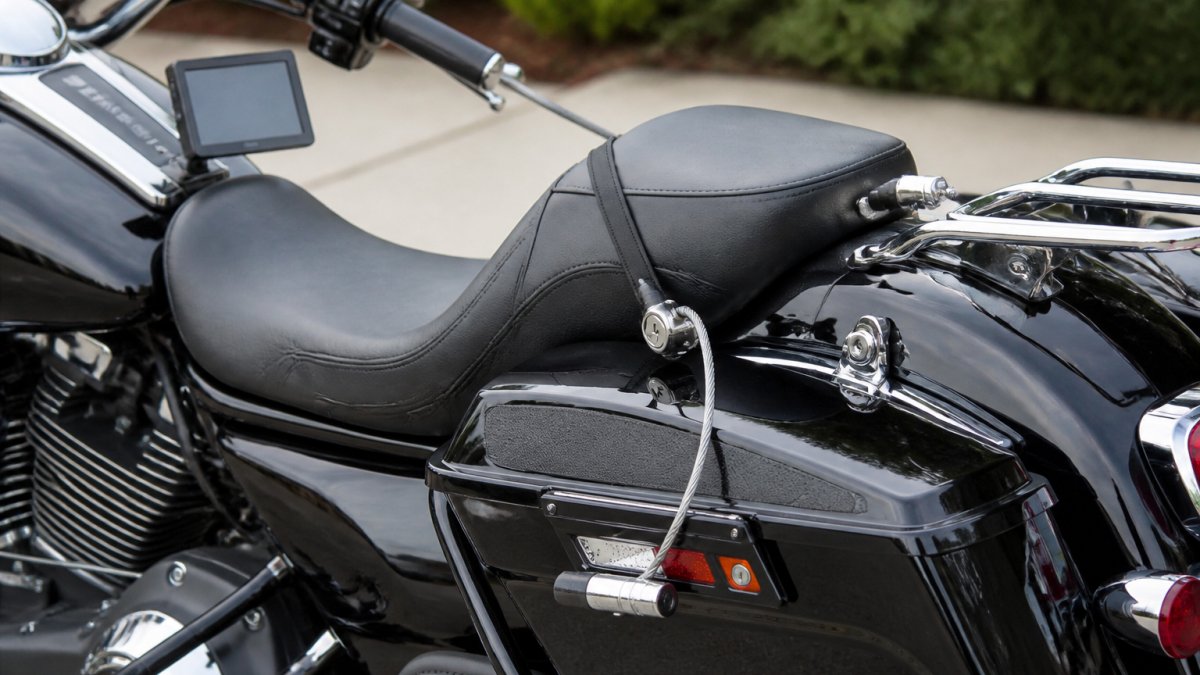
- Seats, Aftermarket and solo seats commonly cost $250 to $600. Most lift off after removing one or two fasteners, or with a keyed factory latch that is easily defeated. A seat lock that threads through the mounting points stops casual lift-off.
- Auxiliary lighting and electronics, Driving lights, dashcams, and phone mounts range from $50 to $400. Use locking mounts or security fasteners that require a specific tool to remove.
The mechanism matters as much as the label. A lock that secures the release lever is only as strong as the lever; one that replaces the release mechanism entirely removes the easy path. Look for keyed, drill-resistant cylinders and hardened steel where the lock meets the mount. Visible hardware also deters: thieves scanning parked bikes tend to move to the one without locks.
Fitment is the other half. Harley-Davidson and Indian touring models use different mounting systems, and aftermarket bags and seats vary further.
Treat security as layered rather than absolute.
Prioritize protection by replacement cost and how quickly thieves can remove each component.
| Accessory | Typical Cost | Removal Time | Recommended Lock |
|---|---|---|---|
| GPS units (Garmin Zumo, Montana, Monterra) | $300-$700 | Under 10 seconds | Keyed locking cradle |
| Saddlebags and top cases | $400-$800+ | Single lever or latch | Locking latch replacement |
| Aftermarket and solo seats | $250-$600 | One or two fasteners | Seat lock through mounting points |
| Auxiliary lighting and electronics | $50-$400 | Varies | Locking mounts or security fasteners |
Using Motorcycle Accessory Locks and Cover Security
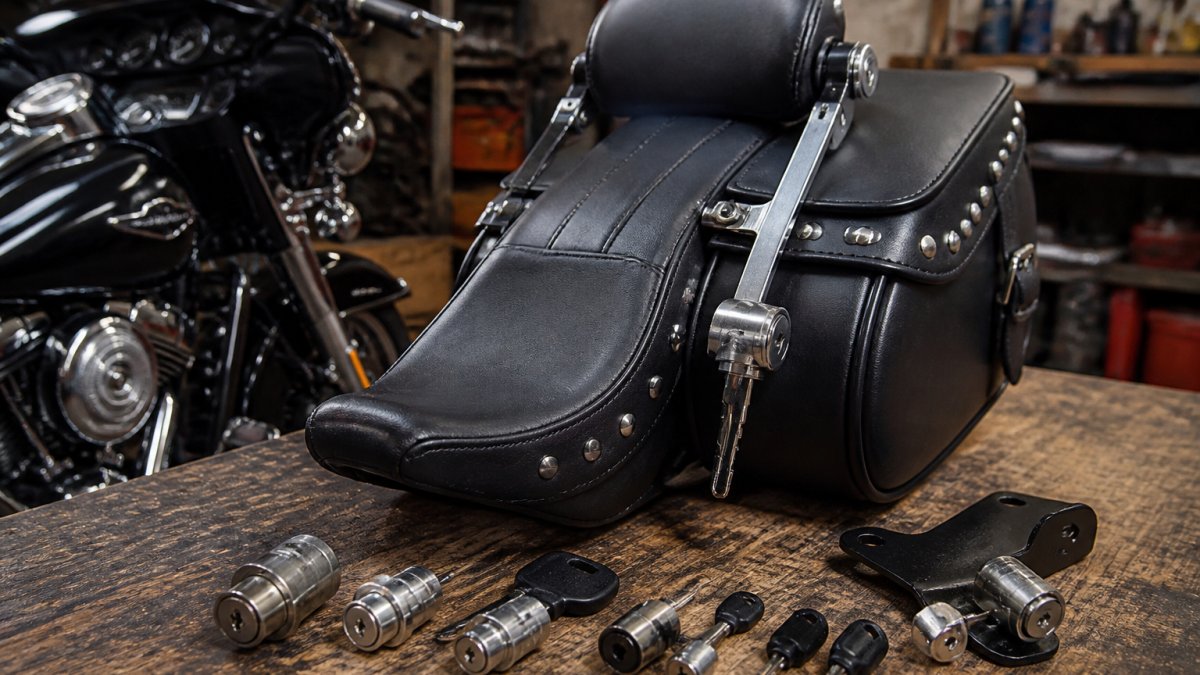
Specialized motorcycle accessory locks fit the unique mounting points on touring bikes, securing saddlebags, seats, and GPS units without drilling new holes or modifying your bike.
Robert Becker Design makes locks engineered for this purpose, fitting Harley-Davidson, Indian, and other touring models with factory and aftermarket mounting systems.
Steps for securing accessories:
- Identify removable components on your bike
- Choose locks compatible with your motorcycle model
- Install locks on saddlebags and seats
- Test removal to confirm everything is secure
- Keep keys accessible but separate from the bike
Saddlebag and Seat Locking
Saddlebags represent significant investment. A good saddlebag set costs $400-800. Factory Harley and Indian saddlebags are even more expensive. Thieves know this and target them specifically.
A saddlebag lock prevents removal without the key. Most bolt through the mounting points where the bag attaches to the frame; installation takes 15-30 minutes with basic tools.
Seats are equally vulnerable: solo seats, aftermarket seats, and comfort upgrades are easy to remove.
GPS Unit and Electronics Protection
GPS theft is common in urban areas. Garmin Zumo, Montana, and Monterra units mount on the handlebars or fairing, visible, valuable, and gone in seconds.
A GPS lock prevents removal without tools.
Phone mounts, dashcams, and auxiliary lights need the same treatment: locking hardware or secure mounts that require tools to remove. Protecting expensive motorcycle parts means securing every removable component.
Preventing Motorcycle Parts Theft Through Strategic Parking
Where you park matters as much as what locks you use.
Smart parking strategies:
- Park near store entrances or security cameras
- Choose well-lit, high-traffic areas
- Park next to other motorcycles when possible
A motorcycle cover hides what's on your bike. Thieves can't see if you have GPS, premium saddlebags, or aftermarket seats.
For protecting expensive motorcycle parts during storage, use a quality cover. It also protects against weather and UV damage.
When parking in high-theft areas, combine multiple strategies. Use a cover, park in a visible location, and install locking hardware on removable components.
Installation, Maintenance, and Cost Considerations
Most security hardware installs at home with basic hand tools, but the details determine whether a protector stays put in a crash or loosens on the road. This section covers what to expect for installation, how to inspect protective parts over time, and how to weigh protector cost against the repair it prevents.
Installation: tools, torque, and cautions
A typical installation kit includes an adjustable wrench or socket set, Allen keys, a torque wrench, and medium-strength threadlocker.
Torque matters more than most riders expect. Fasteners that hold engine guards, frame sliders, and locking brackets should be tightened to the manufacturer's specified value with a torque wrench. Under-tightening lets a guard shift under load; over-tightening can strip aluminum threads or crush mounting bosses.
Typical installation times for a competent home mechanic:
- Engine guards: 1 to 2 hours, often requiring removal of lower fairing panels and use of existing frame mounts.
- Frame sliders: 30 to 60 minutes, with one side at a time so the bike stays supported.
- Saddlebag and seat locks: 15 to 30 minutes, usually bolt-through or latch-replacement designs.
Maintenance and inspection
Protective parts are only effective if they are intact and tight. A simple inspection routine after every few rides and after any tip-over catches most problems early:
- Fasteners: Check torque on guard, slider, and lock mounting bolts. Vibration loosens hardware over time, and a loose guard can rotate into the engine or bodywork.
- Cracks and deformation: Inspect guards, sliders, and locking brackets for cracks, bends, or stress marks. A slider that has been down once may be compromised and should be replaced rather than reused.
- Corrosion: Clean road salt and debris from locks and hardware, then apply a light lubricant to key cylinders. Seized locks get forced open, which defeats their purpose.
Cost versus repair economics
The case for protection is easiest to see when you compare protector cost with repair cost. Engine case replacement or major engine repair commonly runs into the thousands of dollars; a quality engine guard and crankcase cover cost a fraction of that.
The trade-offs deserve equal attention. Engine guards and sliders add width and can reduce cornering clearance on some models. Large guards may restrict airflow to the engine or complicate access for oil changes and valve checks.
Robert Becker Design offers security solutions designed by riders for riders. Our locks fit touring motorcycles without modification. When protecting expensive motorcycle parts matters, choose hardware built for the job.
Frequently Asked Questions
How can I protect expensive motorcycle parts from theft?
Protecting expensive motorcycle parts requires a multi-layered approach: use dedicated locks on saddlebags, seats, and GPS units; install engine guards and frame sliders to prevent impact damage; park in well-lit, high-traffic areas; use a full motorcycle cover when parked long-term; and consider chain locks through the frame to a fixed object. Combine physical barriers with strategic parking choices for maximum security.
Are motorcycle accessory locks worth the investment?
Yes, motorcycle accessory locks are worth the investment, especially if you own high-value components like Garmin GPS units, aftermarket seats, or premium saddlebags. A single stolen GPS unit or saddlebag contents can cost hundreds or thousands of dollars. Quality locks designed specifically for motorcycles provide reliable security at a fraction of replacement costs, offering peace of mind during urban parking and overnight trips.
What is the most expensive part on a motorcycle to replace?
Engine components, transmissions, and frame damage represent the most expensive repairs on motorcycles, often costing $2,000 to $5,000 or more. Aftermarket accessories like premium GPS units ($400-$700), custom seats ($800-$2,000), and high-end saddlebags ($500-$1,500) are also valuable theft targets. Protecting these components through guards, covers, and locks prevents costly replacements and downtime.
Do motorcycle covers help prevent theft?
Motorcycle covers provide two layers of protection: they shield your bike from weather and road debris, reducing paint and component damage, and they obscure the view of valuable accessories, making your motorcycle a less obvious theft target. A heavy-duty cover combined with locks on saddlebags and GPS units significantly reduces theft risk, especially when parking overnight or in high-theft urban areas.
