
Last Updated: October 29, 2026
Quick Summary
Protecting touring bike gear from theft means layering independent locks so every removable item is slower to take than the next bike over. Lock the frame to a fixed anchor, cable both wheels, lock saddlebags at the mount, and carry your helmet, GPS, phone, and documents with you.
- Thieves take GPS units and phone mounts first, then helmets, saddlebag contents, and the bags themselves.
- A U-lock or heavy chain is the only layer that stops a serious attack, so carry it always.
- Replace quick-release skewers with locking skewers and run a cable through both wheels and the frame.
- For a five-minute stop, the minimum is taking small valuables, locking the frame, and locking or carrying the helmet.
- After a theft, photograph the scene and file a police report before calling your insurer.
Table of Contents
- Why Loaded Touring Bikes Are a Prime Theft Target
- Layered Security and Risk-Based Lock Choices
- Motorcycle Luggage Security: Locking the Frame, Wheels, and Hard Cases
- Motorcycle Saddlebag Locks: Securing Panniers and Removable Gear
- Motorcycle Helmet Lock and GPS Security for Stops and Overnight Parking
- A Stop-by-Stop Security Routine for Touring Riders
- Motorcycle Theft Prevention Tips: Parking, Visibility, and Deterrence
- What to Do After a Theft or Attempted Theft on the Road
- Frequently Asked Questions
Why Loaded Touring Bikes Are a Prime Theft Target
A loaded touring bike is the easiest mark on the street. Not because the motorcycle itself is more valuable than a sportbike, but because everything strapped to it is removable, resellable, and gone in under a minute.
Thieves know this. A parked touring rig advertises its contents. Saddlebags bulge. A GPS unit sits on its mount. A helmet hangs from the bars.
That gap is your vulnerability. Close it and the loaded bike becomes a much worse target than the one two spaces down.
What Thieves Take First From a Loaded Bike
The order is predictable. GPS units and phone mounts go first because they pop off in seconds and resell cleanly. Helmets follow, then saddlebag contents, then the bags themselves. Quick-release wheels and seats come next.
Most riders lock the bike and walk away from a small fortune in accessories. The fix isn't a bigger lock. It's a layered system that makes every removable part slower to take than the next bike over.
| Target | Why It's Hit First | Primary Defense |
|---|---|---|
| GPS and phone mount | Pops off in seconds, easy resale | Locking mount or removal |
| Helmet | Hangs in the open, no tools needed | Helmet lock or carry it |
| Saddlebag contents | Soft bags, quick zipper access | Saddlebag locks and packing discipline |
| Saddlebags themselves | Detach from stock and aftermarket rails | Locking hardware at the mount |
| Seat | Quick-release or single bolt | Seat lock |
| Wheels | Quick-release skewers | Locking skewers plus a cable |
Layered Security and Risk-Based Lock Choices
No single lock stops a determined thief, and anyone selling you one is selling fiction. Layered security is the practice of stacking independent barriers so that defeating one still leaves the thief facing another, and it's the only approach that holds up across a full touring trip.
Think in three lock classes and know what each actually buys you:
- Primary anchor lock (U-lock or heavy chain): the only layer that stops a serious attack. A quality U-lock with a hardened shackle and a double-locking mechanism resists cutting and prying; a heavy chain with a hardened square-link design resists bolt cutters better than cable but weighs more. This is the lock you never leave home without on a loaded bike.
- Secondary cable or lightweight chain: routes through wheels, frame, and bag mounts to stop the grab-and-run thief. Cable is light and packable but cuts with hand tools, so treat it as a delay layer, not a primary lock.
- Frame lock (ring lock) with a plug-in chain: common on touring setups because it mounts to the frame and secures the rear wheel instantly; the plug-in chain extends it to an anchor. It is fast for short stops but is not a substitute for a U-lock overnight.
Match the stack to the risk tier, and be honest about duration and location:
- Quick stop, low risk (rural store, 5-10 minutes): frame lock engaged, helmet and GPS carried. One layer, because the exposure is short and witnesses are nearby.
- Meal stop, moderate risk (town center, 30-60 minutes): U-lock through the frame to a fixed anchor, cable through both wheels and the frame, GPS and phone removed, bags locked at the mount.
- Overnight, high risk (city, campsite, hostel): everything above plus saddlebag locks, seat lock, and a cover if you carry one. Ask about indoor or monitored storage first; hardware is the fallback, not the plan.
The logic is simple. Each layer buys time, and time is the one thing a thief cannot manufacture. A bike that takes four separate tools and ten noisy minutes to strip gets abandoned for the unprotected one two spaces down.
Motorcycle Luggage Security: Locking the Frame, Wheels, and Hard Cases
Motorcycle luggage security starts with the frame, because a lock that only secures a removable part secures nothing. The frame is the one component a thief cannot unbolt and walk off with, so every lock in your system should ultimately anchor to it.
Locking the Frame to an Immovable Object
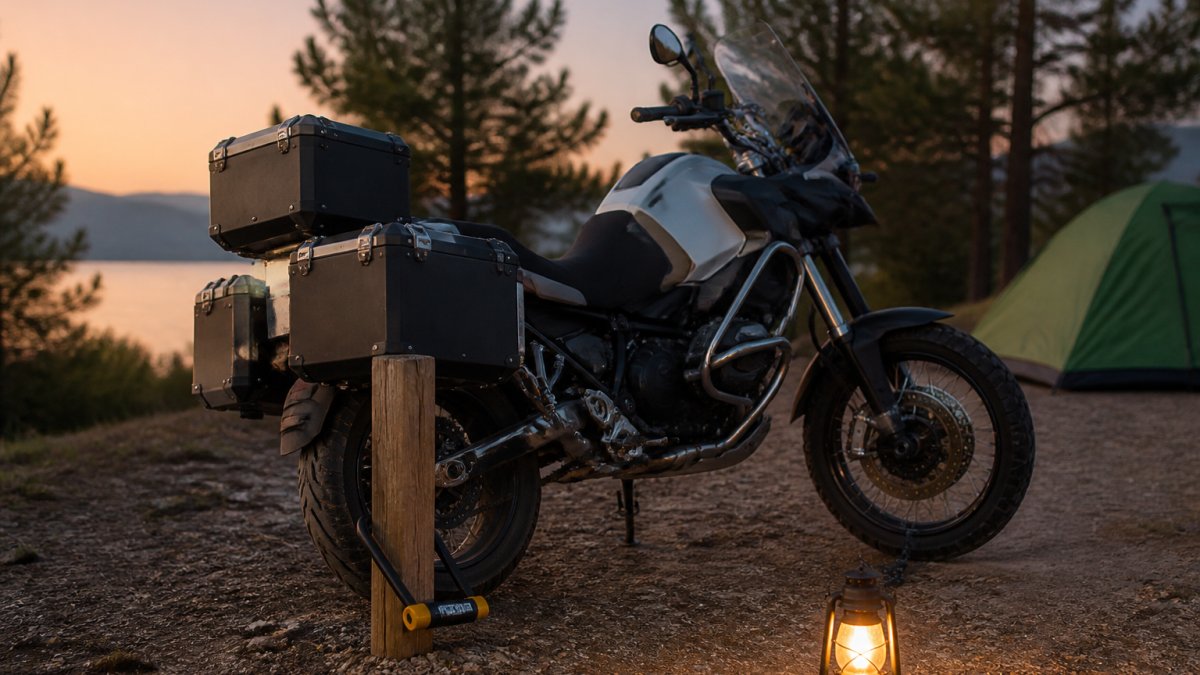
Thread the U-lock through the frame itself, not the forks or a crash bar, and close it around something that does not move.
A common mistake is locking to a rack the thief can disassemble or to a post short enough to lift the lock over. Test the anchor before you trust it: grab it, shake it, and ask whether it moves.
Securing Both Wheels and Quick-Release Components
Quick-release skewers are a gift to thieves. Replace them with locking skewers or security bolts, which require a keyed tool to remove. Then run a secondary cable lock through both wheels and the frame, so a wheel cannot leave without the frame coming along.
The rear wheel is the expensive one on most touring models. Lock it first, then route the cable forward through the front wheel and around the frame. That single cable now protects three components at once.
Motorcycle Saddlebag Locks: Securing Panniers and Removable Gear
Motorcycle saddlebag locks solve the problem riders underestimate most: the bags themselves walk away, not just what's inside them.
Locks at the mount are the answer. Dedicated saddlebag locking hardware keeps the bag attached even when the latch is released.
Watch out: a locked saddlebag with a soft zipper is still an open saddlebag. Locks stop the bag from leaving; they don't stop a blade.
Motorcycle Helmet Lock and GPS Security for Stops and Overnight Parking
A motorcycle helmet lock is cheap insurance against an expensive annoyance.
For GPS units, the math is different. A Garmin zumo or Montana on its mount is a target every time you park, and locking mounts are the only real defense.
The rule for both: if it detaches without a tool, it either comes with you or it gets locked. There is no third option that survives a determined thief.
A Stop-by-Stop Security Routine for Touring Riders
A routine beats willpower. Riders get tired, distracted, and complacent by day eight of a trip, which is exactly when gear disappears. Here is the sequence we'd use at every stop:
- Pull in and scan. Look for lighting, foot traffic, and a fixed anchor before you park. If the spot feels wrong, move.
- Kill the engine and pocket the key. Never leave a spare on the bike.
- Take the small stuff. GPS, phone, wallet, and documents come with you.
- Lock the frame. U-lock through the frame to the anchor.
- Cable the wheels. Secondary cable through both wheels and the frame.
- Lock the bags and seat. Saddlebag locks engaged, seat lock set.
- Helmet last. Lock it or carry it, never leave it hanging.
- Walk away and glance back. A ten-second look from twenty feet catches what you missed up close.
For a five-minute stop, steps 3, 4, and 7 are the minimum. For overnight, run the whole list and add a cover if you carry one.
Motorcycle Theft Prevention Tips: Parking, Visibility, and Deterrence
Motorcycle theft prevention tips usually start with the lock, but parking choice does more work than hardware. A well-lit, high-traffic spot with a camera in view beats a dark corner with the best lock on the market, because thieves avoid witnesses.
Priorities, in order:
- Lighting: park under a working streetlight or building light
- Visibility: high-traffic areas where people pass regularly
- Anchors: something solid to lock to, not a signpost
Overnight storage changes the equation. Ask the hotel or campground about indoor storage or a monitored lot. If neither exists, park where staff can see the bike and use every layer you own.
What to Do After a Theft or Attempted Theft on the Road
Most bike-theft guides stop at 'file a police report.' On a tour, the harder question is how to keep riding after gear disappears, and that response plan is where a touring guide earns its keep.
At the scene, in order:
- Do not move the bike until you photograph it. Capture cut locks, tool marks, the empty mount, and the surrounding area, including any camera or business entrance in view. These photos support the police report and the insurance claim.
- File the police report before anything else. Even an attempt deserves a report; it is the document your insurer will ask for and the record that makes recovery possible. Get the report number in writing.
- Call your insurer while details are fresh. Ask what documentation they need for a touring loss, whether gear and accessories are covered under your policy or a separate rider, and whether they require receipts or photos of the loaded setup.
- Ask nearby businesses for camera footage early. Many systems overwrite within days; ask the same day and leave a contact number.
- Notify your accommodation so staff can watch for the gear and note the loss in their log.
Then protect the rest of the trip:
- Replace the compromised layer before you ride on. A cut cable means the system has a hole; do not continue with a known gap. Buy a replacement at the next town or borrow from a shop, and re-run your stop routine with the new layer in place.
- Separate what was stolen from what you still carry. Rebuild your packing discipline around the loss: if a GPS walked off a mount, the lesson is removal or a locking mount, not a bigger lock on the frame.
- Document the loaded setup now, before the next stop. A photo of the bike with bags, mounts, and accessories helps future claims and makes a recovery report specific enough to matter.
An attempted theft is intelligence. It tells you which layer failed and where. Rebuild that layer stronger before the next stop, and don't let a near-miss talk you out of the routine that saved the bike.
Frequently Asked Questions
How do you secure luggage on a touring motorcycle?
Lock hard cases and saddlebags to the bike's frame using dedicated motorcycle saddlebag locks, and run a secondary cable through soft luggage and panniers. Never rely on the case's factory latch alone. For quick stops, take high-value items like electronics with you. At overnight parking, remove panniers entirely if you can and store them indoors. Layering a case lock, a cable, and removal of loose gear makes your luggage far harder to grab in a hurry.
What is the best way to lock motorcycle saddlebags?
Use locks designed for your specific saddlebag model rather than a universal padlock. A dedicated motorcycle saddlebag lock secures the bag to its mounting arm and prevents the quick-release latch from being opened. Pair it with a short cable through the bag handles and frame for extra security.
How do you secure a motorcycle helmet when you leave your bike?
A motorcycle helmet lock that mounts to the bike's frame or handlebar lets you secure the helmet by its D-ring without carrying it everywhere. Thread the lock through the chin bar or D-ring and close it. For overnight parking, bring the helmet inside with you. Helmets are easy to resell and often targeted, so treat a helmet lock as a deterrent for short stops rather than full protection.
Should I remove motorcycle accessories when parking overnight?
Yes. Remove GPS units, phones, action cameras, and any quick-release accessories before leaving the bike unattended overnight. Thieves target these items because they are small, valuable, and easy to sell. If removal isn't practical, use a locking mount or security bolts. The same applies to soft luggage and tank bags. Anything you can carry inside in under a minute is worth taking with you.
Where is the safest place to park a touring motorcycle?
Choose a well-lit, high-traffic location where the bike is visible to passersby and cameras. Park near building entrances or security cameras rather than in dark corners. At hotels, ask for covered or monitored parking. At campsites, keep the bike close to your tent and lock it to a fixed object. Avoid isolated rest areas for long stops. Visibility and foot traffic are stronger deterrents than any single lock.
What should I do if motorcycle gear is stolen on a trip?
File a police report immediately and get a copy for your insurance claim. Contact your insurer and provide the report number, photos, and receipts if you have them. Check nearby businesses for camera footage. If a GPS unit was taken, change your account passwords. For the rest of the trip, move valuables inside and add a secondary lock. Report the theft to local authorities where it happened, not just at your destination.
