
Table of Contents
- Why Road Trips Make Your Motorcycle a Target
- Motorcycle Theft Prevention Tips for Travel: The Parking Strategy
- Best Motorcycle Locks for Road Trips: Balancing Weight and Security
- How to Secure Motorcycle Luggage, Seats, and Accessories
- Hotel and Motel Security Negotiation for Overnight Stops
- Digital Security: GPS Trackers and Theft Recovery Protocols
- Build Your Nightly Security Routine
- Final Checklist for Cross-Country Travel
- Frequently Asked Questions
Last Updated: September 9, 2026
Why Road Trips Make Your Motorcycle a Target
A motorcycle parked at a motel for the night is a fundamentally different security problem than one sitting in your garage. When you travel, you lose the two biggest advantages you have at home: a known environment and the ability to check on the bike at a moment's notice. Thieves know this, which is why lots targeting touring bikes often focus on overnight stops and crowded tourist areas where a bike might sit unattended for hours.
The stakes go beyond the motorcycle itself. Touring bikes carry thousands of dollars in accessories, from saddlebags and seats to GPS units and custom mounting hardware. For a thief with a pry bar or a portable grinder, removing a seat or a handlebar-mounted GPS takes under a minute. This guide covers how to secure your motorcycle on road trips so you return home with the same bike and gear you left with.
Effective motorcycle theft prevention tips for travel start with understanding the threat model. A determined thief with power tools will defeat almost any lock given enough time. Your goal is to make the theft take so long, create so much noise, and require so much visible effort that the thief moves to an easier target.
Motorcycle Theft Prevention Tips for Travel: The Parking Strategy
Parking strategy matters more than any single lock you carry. The best motorcycle theft prevention tips for travel all share one principle: make your bike the hardest option on the street.
Start with visibility and foot traffic. Park in well-lit areas with CCTV surveillance where people pass regularly, even if it means walking a few extra minutes to your destination. Thieves avoid working under observation. When possible, choose a spot near other motorcycles or expensive vehicles, since thieves typically target the easiest option rather than the most valuable one.
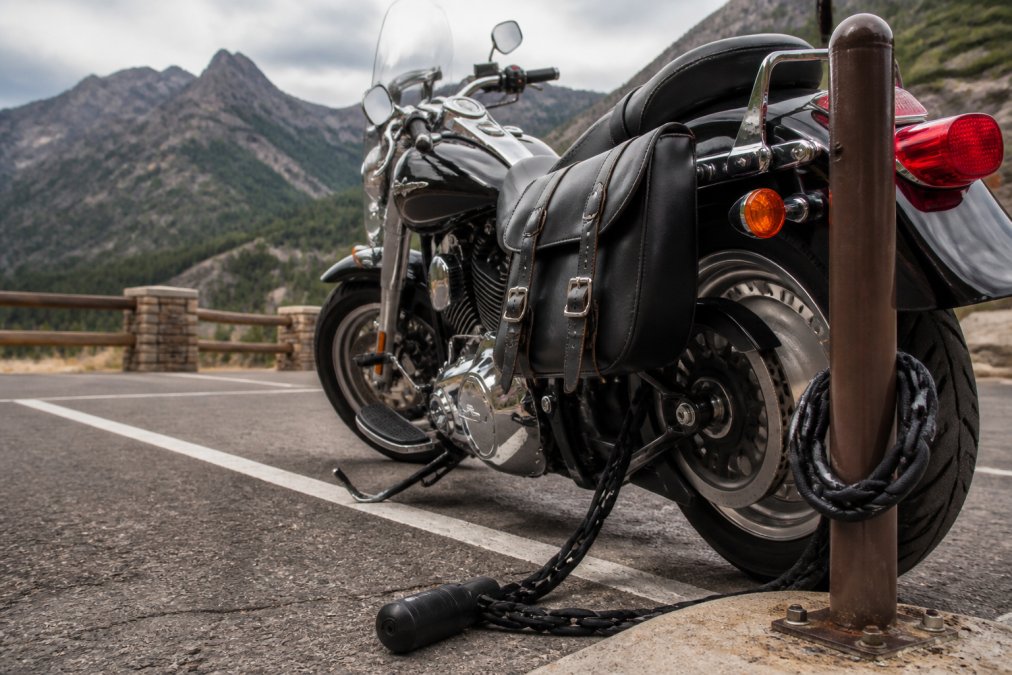
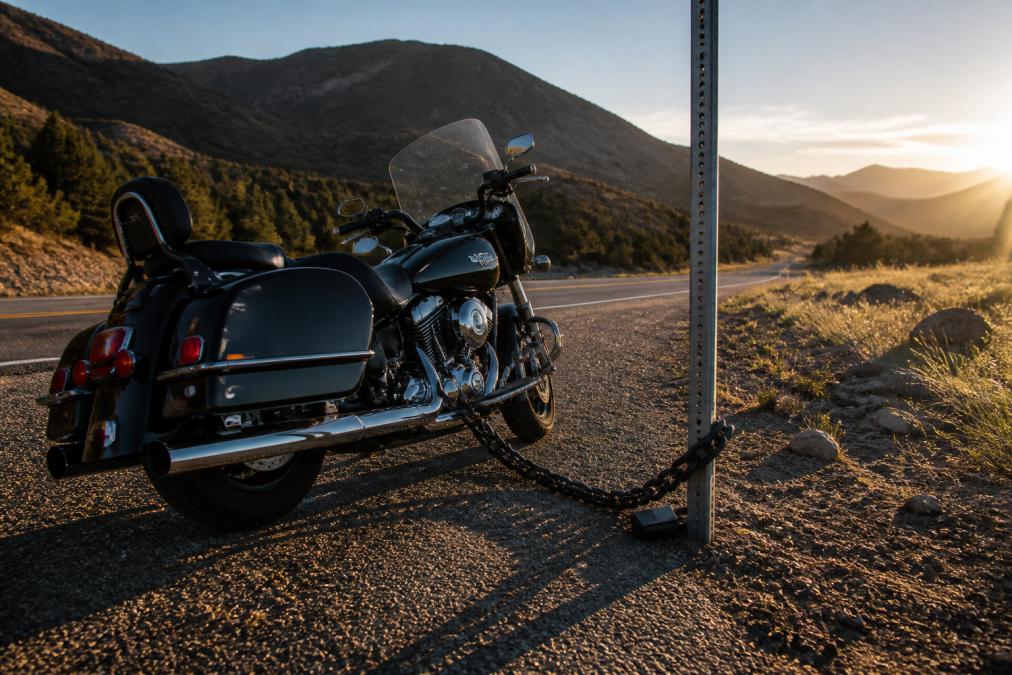
The single most effective tactic is locking your bike to an immovable object. A signpost, a ground anchor, a sturdy fence post, or even another vehicle creates a barrier that a thief cannot simply lift the bike into a van to defeat. National Insurance Crime Bureau motorcycle theft statistics consistently show that motorcycles stolen by professional thieves are usually loaded into vehicles, so preventing that lift is critical.
Park with the rear wheel against a curb or wall when no anchor point exists. This makes it much harder to roll the bike away or load it onto a trailer. Turn the handlebars to full lock and engage the steering lock as well.
Best Motorcycle Locks for Road Trips: Balancing Weight and Security
Security hardware is a trade-off between weight and protection. On a multi-day trip, every pound you carry competes with touring gear, so you need to choose locks that deliver serious theft deterrence without turning your saddlebags into a hardware store.
A hardened steel chain and padlock is the backbone of any travel security setup. Look for a chain with bolt cutter resistance and a shrouded padlock that resists picking and prying. A quality chain lets you secure the frame to an immovable object, which is the single strongest physical deterrent available. The trade-off is weight, typically several pounds depending on length and thickness.
A disk lock adds a second layer for the front brake rotor. Compact and light, it prevents the wheel from rolling. Many disk locks include a vibration sensor that triggers a motion alarm if the bike is bumped or moved, adding a loud audible deterrent. The main limitation is that a disk lock does nothing to stop someone from lifting the bike.
For quick stops where you stay close to the bike, a cable lock offers convenience, but treat it as a delay tactic rather than real security. Cables cut quickly with bolt cutters. Use one to secure your helmet or jacket to the bike, not as your primary theft prevention.
Robert Becker Design specializes in high-quality theft prevention locks and security devices engineered specifically for the motorcycle industry, including specialized locks for saddlebags, seats, and mounting arms. These protect the accessories thieves target most.
How to Secure Motorcycle Luggage, Seats, and Accessories
Thieves rarely steal an entire touring bike when they can strip the expensive components in under a minute. Saddlebags, seats, and GPS units are prime targets because they are quick to remove and easy to resell. Knowing how to secure motorcycle luggage is essential to protecting your investment on the road.
Factory saddlebag latches are not security devices. Many can be popped open with a screwdriver or even a strong hand. A dedicated saddlebag lock replaces or reinforces the latch mechanism, making it genuinely difficult to open without a key. The same logic applies to seats: touring seats often release with a simple key turn or a single bolt, so a seat lock prevents someone from walking off with your seat while you eat lunch.
GPS units present a unique problem because they are designed for quick removal. A handlebar-mounted GPS typically clicks off its cradle in seconds. A locking mounting arm secures the device to the bike so it cannot be detached without a key, which is the difference between losing a $700 unit and keeping it.
For helmets and soft luggage, use a cable lock routed through the helmet visor or bag zippers and anchored to the frame. This does not stop a determined thief with cutters, but it prevents opportunistic theft from walk-by snatching.
Hotel and Motel Security Negotiation for Overnight Stops
The parking lot at your overnight stop is where your bike faces its longest unattended period, often 8 to 10 hours. Most riders simply park in the designated lot and hope for the best, but you have more use than you think.
When checking in, ask the front desk directly about motorcycle parking. Many hotels have a secure area, a loading dock, or a spot near the entrance that is visible to staff. Requesting this at check-in, rather than discovering the lot layout at 11 p.m., is one of the most effective motorcycle theft prevention tips for travel that most riders never use.
If the hotel has no secure option, negotiate. Ask if you can park under a light near the front entrance or within view of the lobby camera. Explain that you are a guest concerned about theft. Front desk staff are usually accommodating, and a bike parked directly in front of the entrance is a strong deterrent.
Before you settle in, do a full security pass on the bike. Engage the steering lock, fit the disk lock with the motion alarm armed, and run the chain through the frame to an anchor point if one exists. Cover the bike to hide the accessories and make it less visually appealing to a thief scanning the lot.
Digital Security: GPS Trackers and Theft Recovery Protocols
Physical locks slow a thief down, but they do not guarantee recovery if the bike disappears. Digital security closes that gap. A hidden GPS tracker lets you locate the motorcycle in real time, which dramatically improves the odds of recovery if the worst happens.
Modern GPS trackers are small enough to hide in several places on a touring bike. Install one in a location that is not obvious, such as inside a fairing panel or under the seat, and make sure it has its own backup battery so it keeps transmitting even if the thief disconnects the main battery. Many trackers offer geofencing, which sends an alert to your phone the moment the bike moves outside a defined area.
If your bike is stolen, your response protocol matters as much as the tracker itself. Call the police immediately and provide the tracker location. Do not attempt to recover the bike yourself, since confronting a thief is dangerous. Give law enforcement the live tracking information and let them handle the recovery.
Insurance documentation is part of this equation. Before you leave, photograph your bike from every angle, record all VINs and serial numbers for accessories, and keep copies of your insurance policy and registration in a secure place separate from the bike. Insurance Information Institute guidance on motorcycle theft claims notes that documented serial numbers and photos speed up claims and help law enforcement identify recovered property.
Build Your Nightly Security Routine
A consistent nightly routine prevents the exhausted end-of-day mistakes that lead to theft. When you have ridden 400 miles and just want a shower, it is tempting to skip the full security setup. A fixed sequence removes the decision-making from the process.
Start with the bike itself. Turn the handlebars to full lock, engage the steering lock, and remove the key. Fit the disk lock with the motion alarm on the front rotor. Run the chain through the rear wheel and frame, securing it to an anchor point if available.
National Highway Traffic Safety Administration motorcycle safety guidance emphasizes that securing the bike properly also prevents accidental roll-aways and tip-overs, which are more common on trips than theft itself. A bike that rolls off its sidestand onto a hotel driveway is a trip-ending event.
Next, secure the components. Lock the saddlebags, lock the seat if you have a seat lock, and remove the GPS from its mount or lock the mounting arm. If you use a cover, fit it over the bike to hide the accessories and add another layer of effort for a thief to remove.
Finally, do a walk-around check. Confirm the motion alarm is armed, the chain is locked, and nothing loose is left on the bike. Take a photo of the bike in its parking spot so you have a record of its condition and location.
Final Checklist for Cross-Country Travel
Before you leave on a multi-day trip, run through this checklist to confirm you have the right gear and the right plan.
- Pack a hardened steel chain and padlock with bolt cutter resistance
- Pack a disk lock with motion alarm as a secondary layer
- Install a hidden GPS tracker with backup battery and geofencing
- Verify saddlebag locks, seat locks, and GPS mounting arm locks are installed
- Photograph the bike and record all VINs and serial numbers
- Carry insurance documentation and registration copies separately
- Confirm your insurance covers theft while traveling, including accessories
- Plan parking strategy for each overnight stop, including anchor points
- Pack a cover to hide accessories during overnight stops
- Build your nightly security routine and commit to following it every night
Weight-to-security ratio matters on a long trip. A 15-pound chain you leave at home because it is too heavy does not protect anything. Choose hardware you will actually carry and use every night, and scale up for high-risk stops.
Theft prevention on the road is a layered system. Parking strategy, physical locks, accessory security, digital tracking, and a consistent routine each add a barrier that makes your motorcycle a less attractive target. Robert Becker Design has developed a robust lineup of protective solutions, including specialized locks for saddlebags, seats, and mounting arms, since 2012. Our products provide essential security for Harley-Davidson, Indian, and other touring motorcycle models. The right hardware, used consistently, is what helps protect your investment.
Frequently Asked Questions
What are the most effective ways to prevent motorcycle theft while traveling?
The most effective approach layers physical and digital deterrents. Start by parking in well-lit, high-visibility areas with CCTV surveillance when possible. Use a hardened steel chain or disk lock to secure the bike to an immovable object, and add a motion alarm to draw attention. A GPS tracker provides a recovery path if the worst happens. For motorcycle theft prevention on trips, pair your steering lock with a secondary device, since thieves often target bikes secured by only the factory lock.
What should I look for in a motorcycle lock for road trips?
Weight-to-security ratio matters most when you are packing for a multi-day trip. Look for a hardened steel chain with a matching padlock, or a high-quality disk lock with a vibration sensor. The lock should resist bolt cutters and portable grinders. Consider how you will carry it: a 5-pound chain fits in a saddlebag but adds bulk. Verify the lock fits your bike's rotor or frame geometry before you leave, and always secure the bike to a fixed object, not just through the wheel.
Is it safe to leave a motorcycle parked at a hotel overnight?
It can be, if you choose the spot carefully. Ask the front desk about secure parking options, such as a locked garage, gated lot, or an area visible to staff and cameras. Avoid secluded corners of the lot. Park close to the entrance and under lighting. Before you settle in, negotiate: many hotels will let you park near the lobby window or in a service area if you explain you ride a touring bike. Always use your full security setup, including a cover to hide accessories and luggage.
Securing your motorcycle on road trips comes down to preparation and consistency. The threat is real, but it is manageable with the right combination of parking discipline, quality locks, and digital tracking. Robert Becker Design offers specialized theft prevention hardware for touring motorcycles, including locks for saddlebags, seats, and GPS mounting arms designed by riders for riders. Get started with Robert Becker Design and protect your investment on every mile of the journey.